Compare eight retail manager resumes for broad, first-promotion, experienced, senior, high-volume, specialty, omnichannel and small-team roles. Find the one that matches your real authority, then use schedules, coaching logs, customer cases, cash checks, merchandising work and inventory records to build evidence you can defend.
Start with the retail manager resume closest to your authority
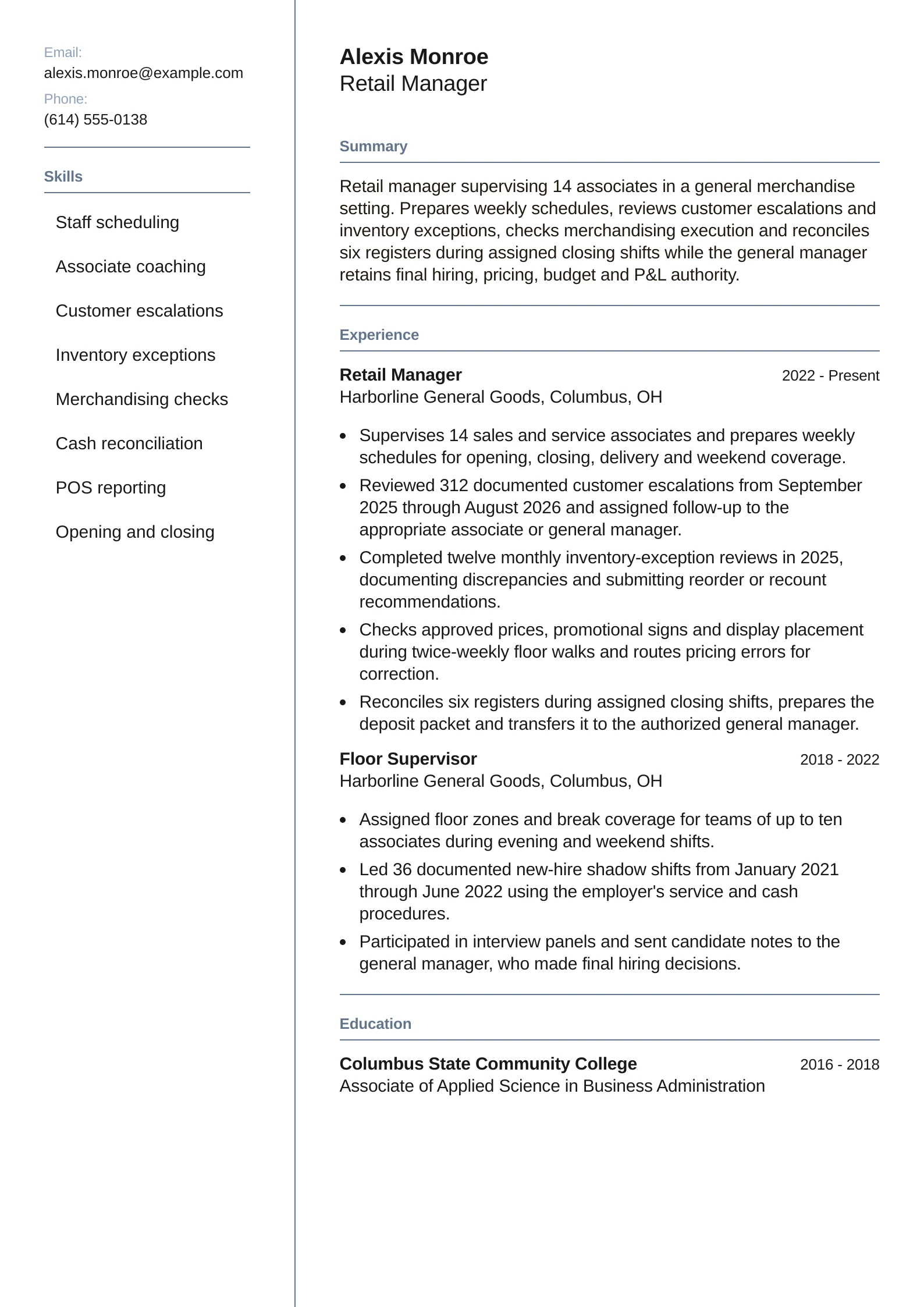
Start with Alexis if your job is broad retail management rather than whole-store ownership. She supervises 14 associates, writes weekly schedules, reviews customer escalations and inventory exceptions, checks merchandising, and reconciles cash at closing. The last line matters too: the general manager keeps final hiring, pricing, budget and P&L decisions.
Move to another example when your store works differently. Jordan makes a recent promotion easy to see. Elena opens with transaction flow and floor coverage in a high-volume setting. Maya combines store leadership with pickup and ship-from-store work. Luis shows what managing a six-person shop looks like when the owner keeps final authority.
Compare 8 retail manager resume examples
Read these examples for scope, not just title. The top of the resume should reflect how the team is set up, how busy the store is, what kind of service it provides and which decisions the manager can make. Pick the candidate whose normal week looks most like yours, then replace every fictional employer, date, count and responsibility with your own record.
The people, employers and quantities below are all fictional. Each example shows how to give a period, a denominator and the limits of the candidate's contribution. None supplies a sales, margin, shrink, customer, loyalty, turnover, safety or compliance result for you to copy.
First-Time Retail Manager Resume Example
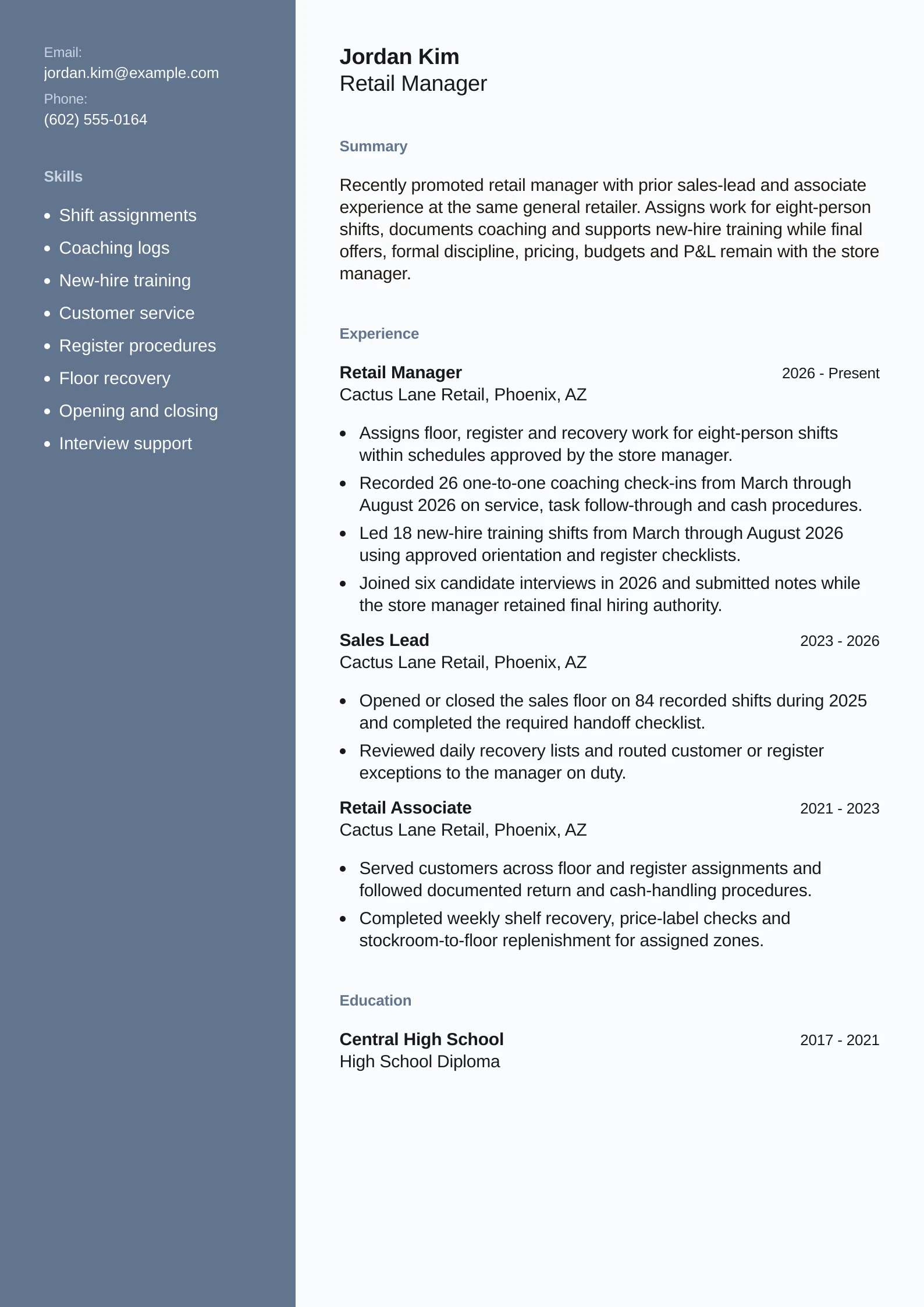
Jordan's March 2026 promotion sits directly above earlier sales-lead and associate roles with the same retailer, so the progression is hard to miss. The current job covers eight-person shift assignments, 26 documented coaching check-ins and 18 new-hire training shifts. Jordan joins interviews, but final hiring and formal discipline remain with the store manager.
The separate titles and dates make the internal promotion clear.
Early management records show new responsibility without overstating authority.
Experienced Retail Manager Resume Example
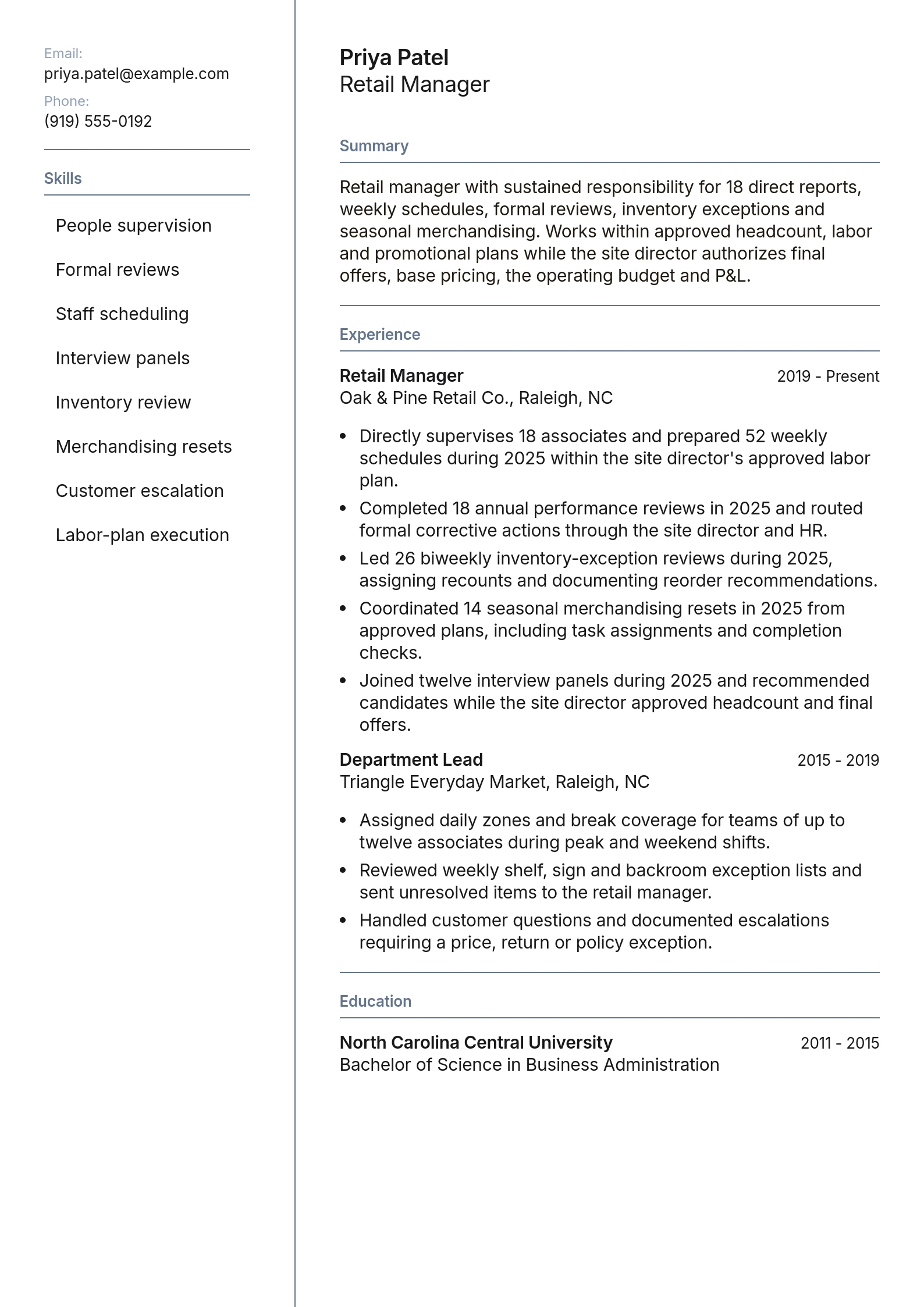
Priya has 18 direct reports and a full 2025 schedule cycle, plus biweekly inventory reviews and 14 campaign resets. She completes formal reviews and joins interview panels. Headcount, final offers, pricing and the operating budget still go to the site director for approval. Each responsibility has a record behind it.
People management sits beside merchandise, inventory and customer work.
Formal reviews are explicit; final budget and hiring authority stay with the site director.
Senior Retail Manager Resume Example
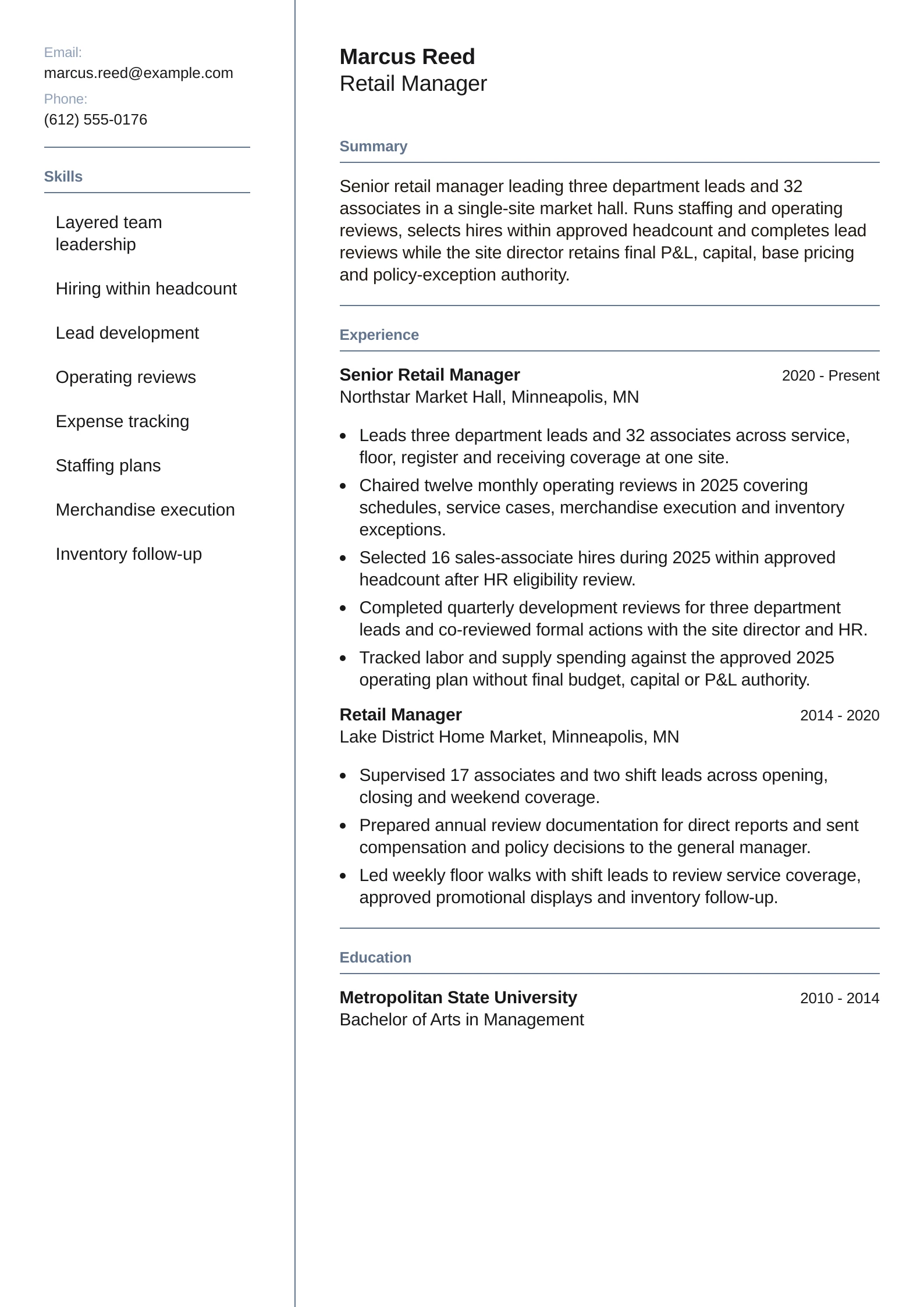
Marcus leads through three department leads and 32 associates. His resume therefore focuses on layered supervision instead of filling the page with frontline tasks. Monthly operating reviews, staffing plans and 16 hires within approved headcount show the senior scope. Final P&L, capital, base pricing and employment-policy exceptions remain with the site director.
The reporting structure shows leadership through department leads.
Hiring within approved headcount is kept separate from final financial ownership.
High-Volume Retail Manager Resume Example
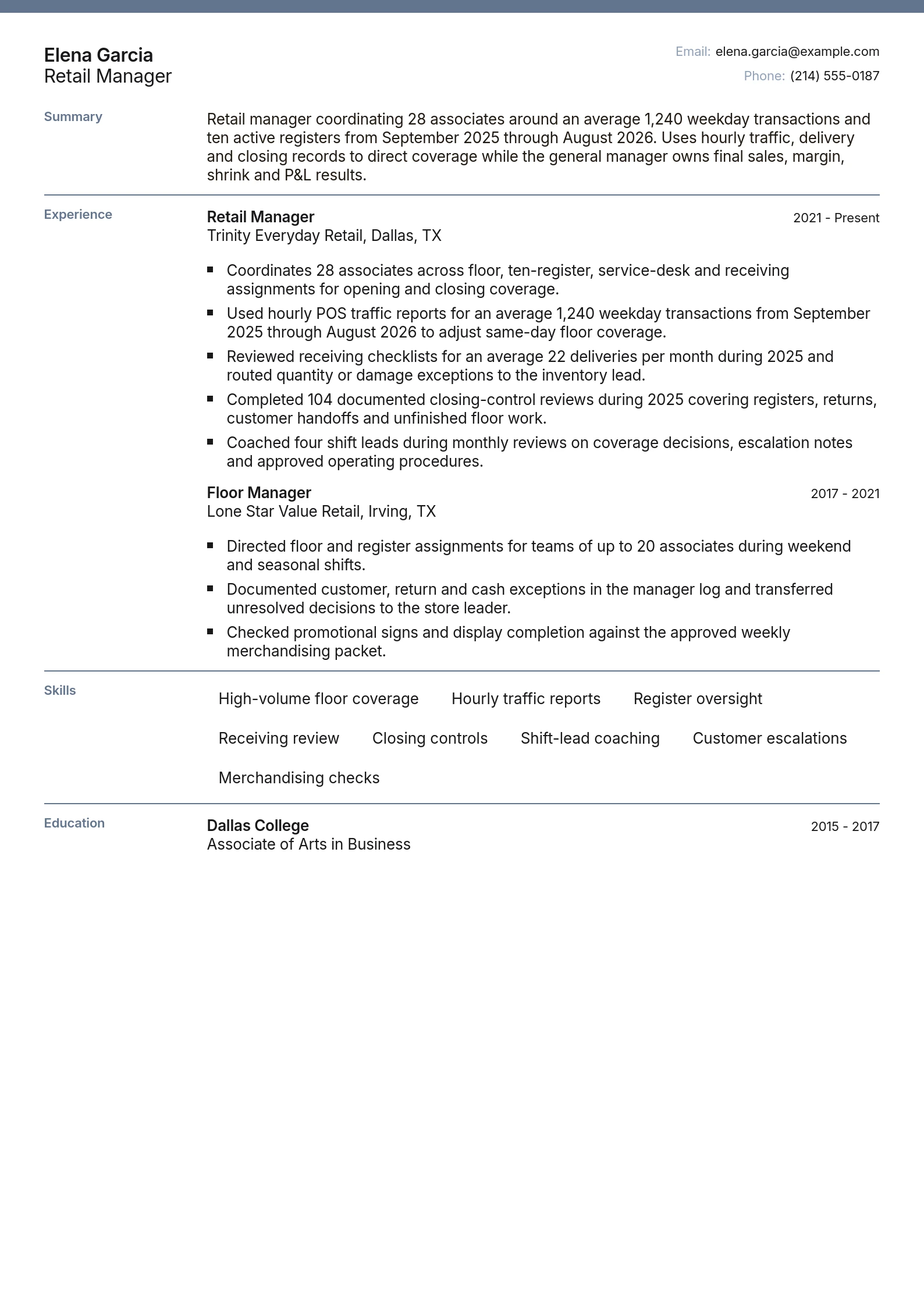
Elena sizes the operation in her first bullets: 28 associates, ten registers and an average of 1,240 weekday transactions during the latest twelve-month period. She uses hourly traffic reports to adjust coverage and tracks receiving across 22 monthly deliveries. These records show workload without making an unsupported claim about revenue, conversion or shrink.
Transaction flow and staffing coverage explain what high volume means here.
Business outcomes are not confused with the candidate's operating record.
Specialty Retail Manager Resume Example
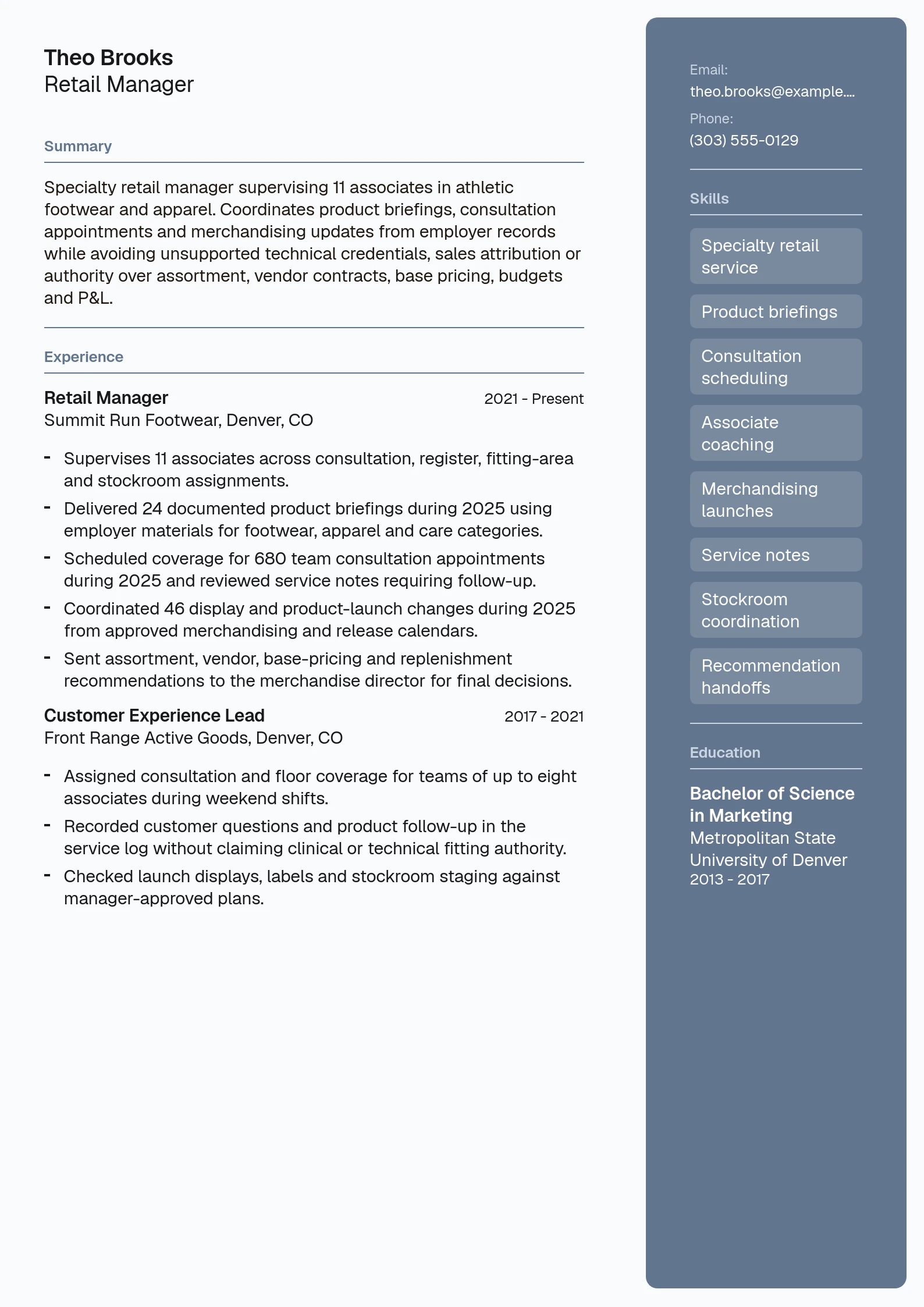
Theo manages an athletic-footwear store built around product briefings and fit consultations. His resume records 24 product briefings, 46 merchandising changes and 680 team consultation appointments in 2025. The language stays close to the employer training record instead of turning that training into a credential or broader technical expertise. Nothing broader is implied.
Documented product education explains the specialty service model.
The resume claims neither an outside credential nor unverified category expertise.
Omnichannel Retail Manager Resume Example
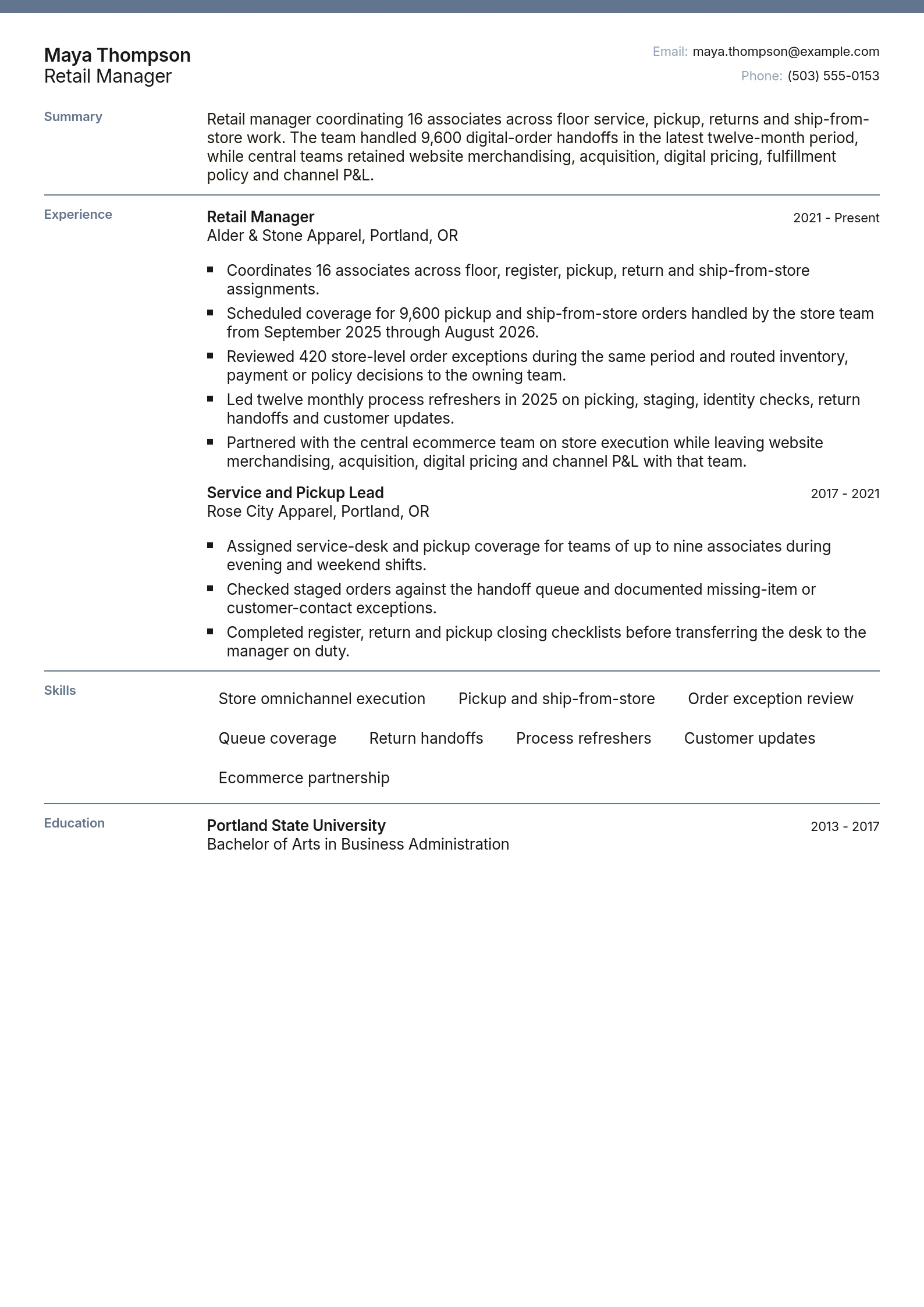
Alongside floor service, Maya's store team handled 9,600 pickup and ship-from-store orders from September 2025 through August 2026. The resume covers queue staffing, 420 exception cases and customer handoffs. Website merchandising, acquisition, digital pricing and channel P&L stay with the central ecommerce team. That division is clear on the page.
Digital-order volume explains the store's staffing and handoff work.
Store execution remains distinct from ecommerce ownership.
Hands-On Small-Team Retail Manager Resume Example
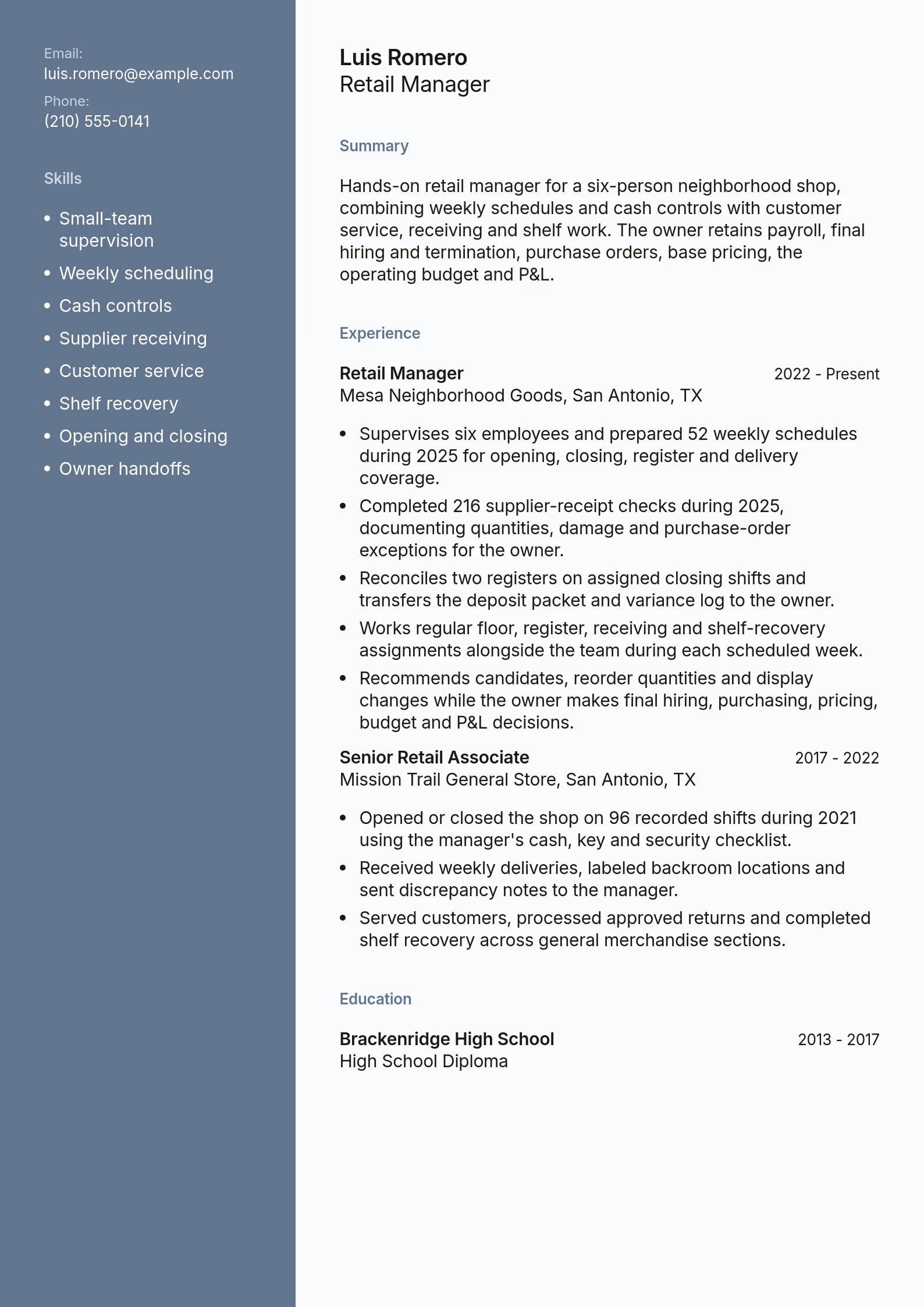
Luis manages six employees but still spends much of the week with customers, receiving goods, resetting shelves and completing opening or closing checks. His 52 weekly schedules and 216 supplier receipts put a clear size on the work. The owner keeps payroll, final hiring, purchasing, pricing, budget and P&L authority.
Frontline work is part of the management role, not hidden below it.
Daily control and the owner's final decisions are clearly separated.
Choose by authority, team structure and store model
Retail manager can mean quite different things from one employer to the next. You might supervise a single sales floor under a general manager, or lead department heads and select hires within approved headcount. In a small shop, you may open the doors, serve customers and count tills while the owner keeps pricing, purchasing and financial control. Make that setup clear before the skills section.
Begin with who reports to whom. Name your direct reports, any team leads and the peers who share coverage with you. Then sort your decisions into three groups: those you make, those you recommend and those another leader approves. That tells the reader far more than a label such as strategic leader, especially if the resume never says who wrote schedules, approved leave, selected hires or managed an expense plan.
Your setting determines the useful proof. In a high-volume store, transactions, register count, deliveries and coverage periods show the pace. Specialty retail calls for product education and consultation records. Omnichannel work brings pickup, return and ship-from-store queues into the store. With a small team, show that management and frontline work happened side by side instead of suggesting a large hierarchy.
One overlapping bullet is not a reason to choose a narrower example. Store Manager and Store Director resumes need whole-store authority. A Retail Sales Manager or Retail Operations Manager resume should lead with that function. District, regional and multi-unit roles need evidence across locations. The examples on this page stay inside one retail establishment or department.
Write a summary that shows the management shape
A useful summary tells me where you worked, what you managed and which records prove it. Alexis can lead with 14 direct reports, weekly schedules, customer escalations and inventory exceptions. Elena should bring transaction flow and coverage closer to the front. For Maya, pickup and ship-from-store coordination belongs in the summary because it changes the shape of her daily work.
When the promotion is recent, let the dates help. Jordan became a manager in March 2026, with the earlier sales-lead role directly below. Recently promoted is accurate; years of management experience is not. The rest of the summary can point to current evidence such as eight-person shift assignments and documented coaching.
Keep every summary verb within the candidate's authority. If the store manager approves hiring and performance actions, use coached, documented, recommended or joined interview panels. If the candidate completes formal reviews, say so and name the group. Mention final pricing, budgets or P&L only when the employment record supports that responsibility.
Build retail manager bullets from a record you can open
When a bullet feels vague, start with the record behind it. A schedule shows team size and coverage. A coaching log tells you who received feedback and when. Service and receiving logs can supply case counts, deliveries, discrepancies and approval handoffs. Once those details are in front of you, the right noun, period and boundary are much easier to write.
Consider this line: "Prepared 52 weekly schedules during 2025 for 18 associates, balancing opening, closing, delivery and weekend coverage within the site director's approved labor plan." It gives the period, uses the team as its denominator and makes clear that scheduling did not include setting the labor budget. That is better evidence than a claim that the candidate optimized staffing.
Be precise about customer work. Cases you resolved yourself, cases the team handled and escalations you reviewed are three different records. Say which one you have. A service queue does not prove a gain in satisfaction, loyalty or repeat purchases unless a named report measures that result and shows your part in it.
Merchandise and stock records need the same care. Record the planogram or display changes you completed, inventory exceptions you reviewed, deliveries you checked and reorder recommendations you submitted. Sales lift, margin, sell-through, shrink and stock accuracy are separate claims. Before using one, find the exact period, comparison, population and your role in the result.
Cash bullets need a line around the candidate's responsibility too. Opening tills, reconciling registers, preparing deposits and recording variances are direct tasks. They do not imply control of bank accounts, credit policy or every store cash result. If a manager reviewed the deposit or approved an exception, keep that handoff in the bullet.
Use retail metrics that retain their source and owner
Use a measure you can trace. Say what it counts, then stop short of outcomes the record does not prove.
Source record
Resume-ready evidence
Keep separate
Schedule and time records
Team size, schedule weeks, opening and closing coverage
Labor-budget ownership or productivity gains
POS traffic report
Transactions, registers or hourly customer flow for a stated period
Revenue, conversion, margin or average ticket
Service-case queue
Cases handled, escalations reviewed and handoff recipient
Satisfaction, loyalty or repeat-purchase outcomes
Inventory exception log
Counts reviewed, discrepancies documented and reorder recommendations
Accuracy, shrink or stockout improvement
Merchandising calendar
Displays, resets or launch updates completed
Sales lift or brand-performance claims
Coaching and review files
Check-ins, training shifts or formal reviews for a named group
Retention, turnover or performance gains
Cash-control checklist
Registers reconciled, deposit packets prepared and variances routed
Financial control beyond assigned procedures
Separate daily work from final authority
Pick the verb that matches the decision you were allowed to make.
Area
Direct retail manager evidence
Authority that needs its own proof
Frontline work
Served customers, stocked, received, opened or closed
No management authority follows from task volume alone
Coaching
Observed, gave feedback, trained and documented
Formal discipline or termination
Scheduling
Prepared or approved shifts within a labor plan
Setting the labor budget or payroll policy
Hiring
Screened, interviewed, recommended or selected within approved headcount
Creating roles, approving headcount or overriding eligibility review
Performance
Ran check-ins or completed formal reviews for named reports
Final corrective action or employment-policy exceptions
Cash
Counted tills, reconciled registers and prepared deposits
Treasury, bank access or storewide financial control
Pricing
Applied approved prices and promotions or reported errors
Base pricing and margin policy
Merchandising
Executed displays, resets and presentation standards
Brand strategy or enterprise assortment ownership
Budget
Tracked spending against an approved plan
Final budget approval, capital allocation or P&L ownership
Show a first promotion without hiding the frontline record
For a first-time manager, the clearest evidence often sits inside one employer. Give each title its own dates even when the company stays the same. The reader can then see when the candidate started assigning work, coaching teammates, opening or closing and joining interviews. Earlier selling or service results remain under the job where they happened.
Put the current management work first, even when it covers only a few months. Schedules, training shifts, floor assignments, service escalations and opening or closing checklists all show trusted responsibility. They do not pretend the candidate has already managed a full annual business cycle. Keep older associate bullets for customer service, cash procedures and merchandise handling.
An acting shift or occasional keyholder duty is not automatically a promotion. Use the title in the employment record and put the extra responsibility in a bullet. Month-and-year dates are enough for a recent move. You do not need to explain or defend why the promotion happened quickly.
Adjust the evidence for high-volume, specialty, omnichannel and small-team retail
Elena gives the reader a way to picture high volume: average weekday transactions, register count, team size and monthly deliveries. Bigger is not automatically better. The figures show the pace of her floor coverage, cash-control and receiving work, so an employer can compare it with the store that needs staffing.
Theo gets specific about specialty retail without presenting himself as a product expert. He uses the categories in his employer training record, the number of briefings he delivered and the team's consultation appointments. If your knowledge came from a vendor session or employer course, name that source. Ordinary product orientation is not a certification.
Maya shows exactly where digital orders enter her store. Her team receives the queue, picks or packs items, stages handoffs and deals with store-level exceptions. Central teams keep site merchandising, digital acquisition, channel pricing and ecommerce P&L. Running this store work does not make Maya an ecommerce manager.
Small-team managers are often on the floor themselves. Luis writes schedules and checks cash controls, then turns to receiving goods, resetting shelves and serving customers. The owner approves purchase orders, base prices, payroll, hires, terminations, budget and P&L. Keeping that boundary makes the role more believable without making it sound junior.
Read current retail postings for the exact authority they assign
O*NET describes first-line retail supervisors as people who coordinate sales workers. Its task list includes customer service, employee direction, price and display checks, cash reconciliation, schedules, inventory records, training, hiring and budgeting. That is an occupational range, not one universal job description. Use the target posting and your employment record to decide which tasks belong on your resume.
Two current Home Depot postings make the difference in level clear. The Assistant Store Manager posting covers associates, customer service, safety, product availability and store appearance, with judgment shared among several leaders. The manager-in-training posting instead describes learning staffing, scheduling, stock and performance processes. Both are Home Depot's own patterns, not rules for every retail manager.
Sephora's three current Store Manager postings differ by market as well. London covers team development, customer experience, KPI review, cash, stock, replenishment, visual merchandising, safety and scheduling. Zürich adds employee appraisals, opening and closing, cash-register closing and goods management. Stuttgart includes recruitment, staff scheduling and daily zoning, appraisal, goods management, cash-register closing, visual standards and store-audit routines. These are useful categories to check against your record, not proof that every US retail manager owns the same commercial or employment decisions.
Compare the verbs in the posting, not only the nouns. Lead, approve, partner, execute, monitor and support describe different levels of authority. If you prepared schedules for approval, do not rewrite that as owned scheduling. If someone else created the display plan, executed or completed may be right. A precise verb is easier to defend in an interview.
Keep the skills list short and supported
Keep a skill when it appears in the target posting and at least one of your experience bullets. The list might include staff scheduling, coaching, customer escalations, POS reporting, cash reconciliation, receiving, inventory exceptions, merchandising execution and opening or closing procedures. Your own work should decide the mix, not a generic retail checklist.
Do not make an exception for systems. Name a POS, workforce or inventory platform only if you used it and can explain how. POS reporting is a fair generic label when the record does not preserve a product name. Filling the gap with a popular brand is not. Platform administration, forecasting models and integrations are separate skills.
Sales growth, margin improvement, shrink reduction, customer loyalty and lower turnover are not skills. They are outcomes, and each one needs a record. Coaching, scheduling and service recovery describe work the candidate performed. A short, supported list beats a crowded column that the experience section cannot back up.
Use a format that makes progression and scope easy to scan
Contact information, summary, experience, skills and education is a dependable order. Put the most relevant current job first. For an internal promotion, keep the employer visible and give each title its own dates. The change in responsibility should be obvious without a separate explanation of the career story.
One page may be enough for a new manager or a focused two-role history. Use a second page when genuine progression, several leadership jobs or technical retail responsibilities need room. Cut repeated duties before shrinking the type. Plain headings, consistent month-and-year dates and selective bullets are much easier to inspect than rating bars or dense graphics.
Open each job with the evidence closest to the posting. That may be transaction flow and register coverage, order queues and handoffs, or the mix of supervision and frontline work in a small shop. Sending the same retail manager resume unchanged to each setting would bury the most relevant evidence.
Before you submit, trace every number back to a schedule, POS report, coaching log, inventory record, service queue or cash-control document. Check its period and denominator. Then read the authority verbs again. Hiring, pricing, budgeting, performance management and final P&L should match the candidate's actual decision rights exactly.
Check three retail records before you submit
Open a schedule, an operating report and one people or training record.
Top tip
Check every number, period and denominator against the record. Then ask what the verb really describes: work you performed, a team result or a decision you had authority to make. If the record shows a recommendation or shared approval, say so in the resume.
Retail manager resume questions
Use these answers during the last edit, especially when a broad claim needs a narrower verb or a source.