When your next role differs from your current one, the resume has to explain the move without editing the past. These 13 examples keep titles, dates and evidence intact while showing where projects, coursework and transferable work can make a new direction believable.
See a career change resume that keeps the old title
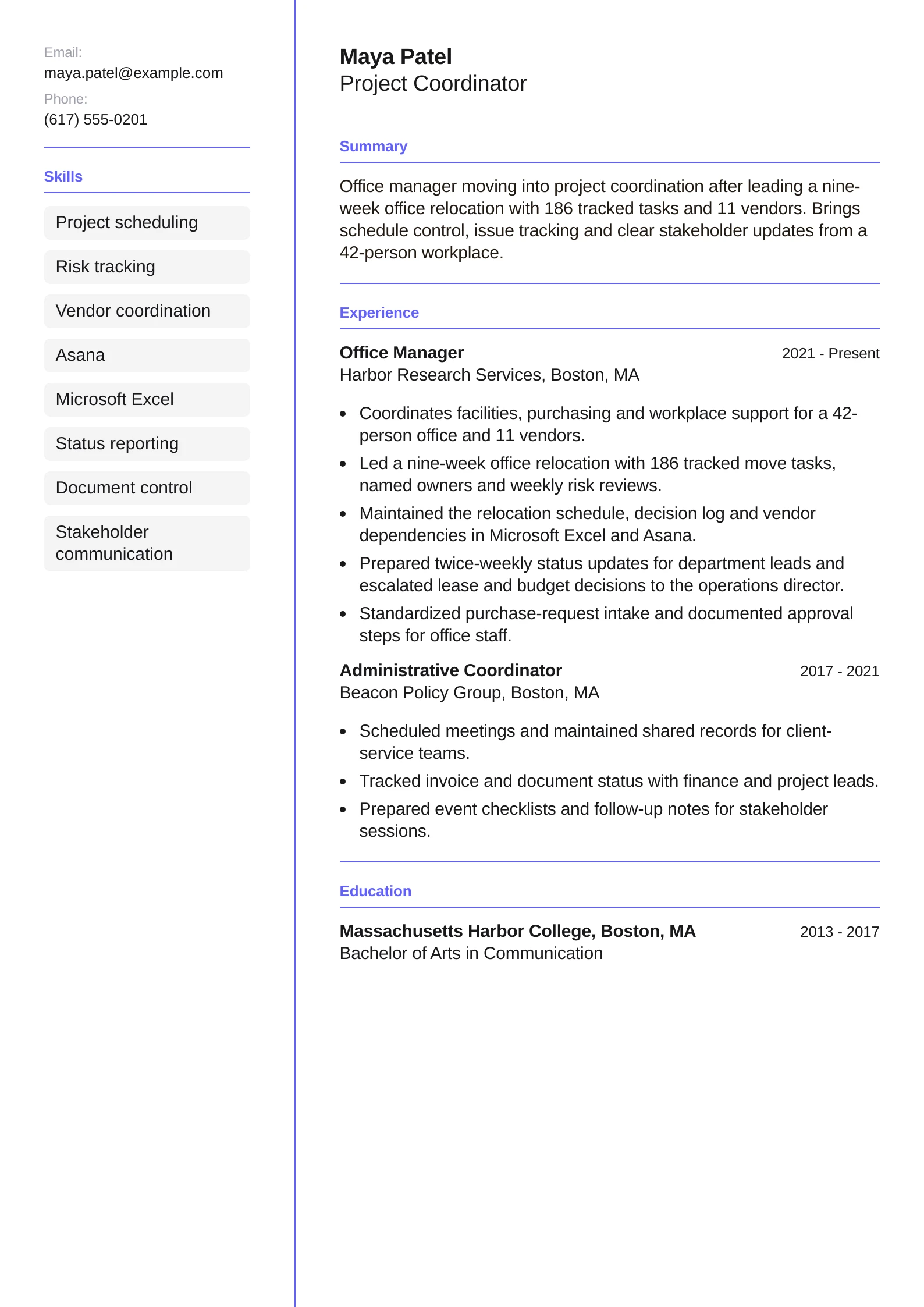
Project Coordinator is Maya's target, not a title she has already held. Her Office Manager role includes a nine-week relocation with schedules, named task owners, vendors, risks and status updates. That project gives the reader relevant proof while the chronology remains exactly what it was.
Borrow the editing decision, not Maya's fictional details. Pick a clear target, find the work in your own record that comes closest and give it enough room to be understood. The employer, title, dates, tools and result still have to be yours.
Find the transition closest to yours
The 13 resumes below start in different places. For some candidates, the best proof sits inside an existing job. For others, a separate course or project is the honest place to demonstrate a technical skill. Each version leaves the earlier career visible.
Look for the closest evidence pattern rather than an exact title match. A teacher who coordinated a lab renovation may get more from the project coordinator example than another education resume. A financial analyst who used SQL only in a portfolio needs the separate project structure, not SQL slipped into an employment bullet.
Sales to Marketing Coordinator Resume Example
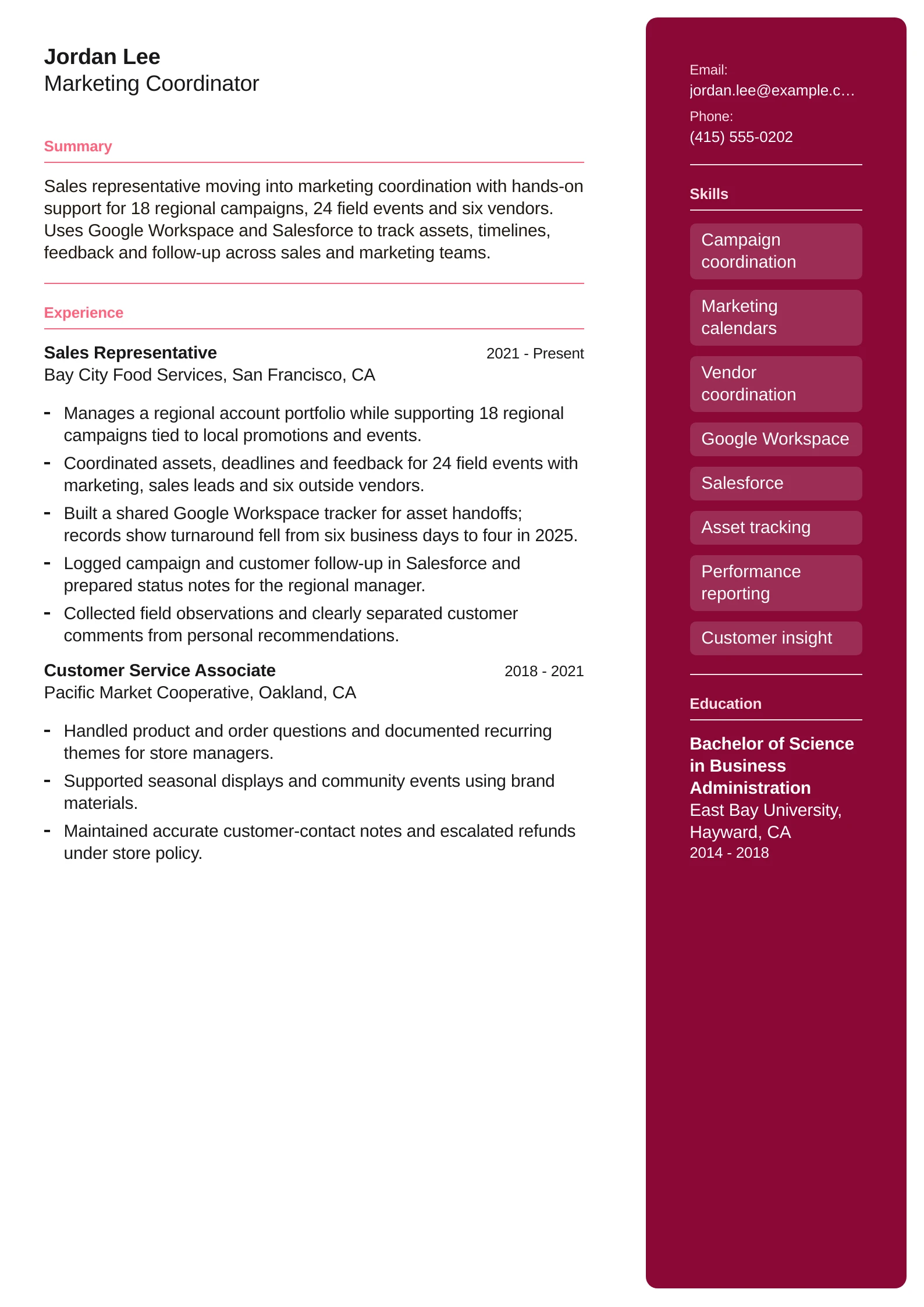
Jordan's Sales Representative job already includes campaign calendars, assets, field events, vendor coordination and reporting. Those assignments move forward in the resume, but the sales title stays put. This pattern suits a change where the current role contains genuine target work and the candidate can name the tools, scale and handoffs without recasting the whole job.
Sales title remains accurate
Campaign support has specific scope
Only demonstrated tools appear
Teacher to Project Coordinator Resume Example
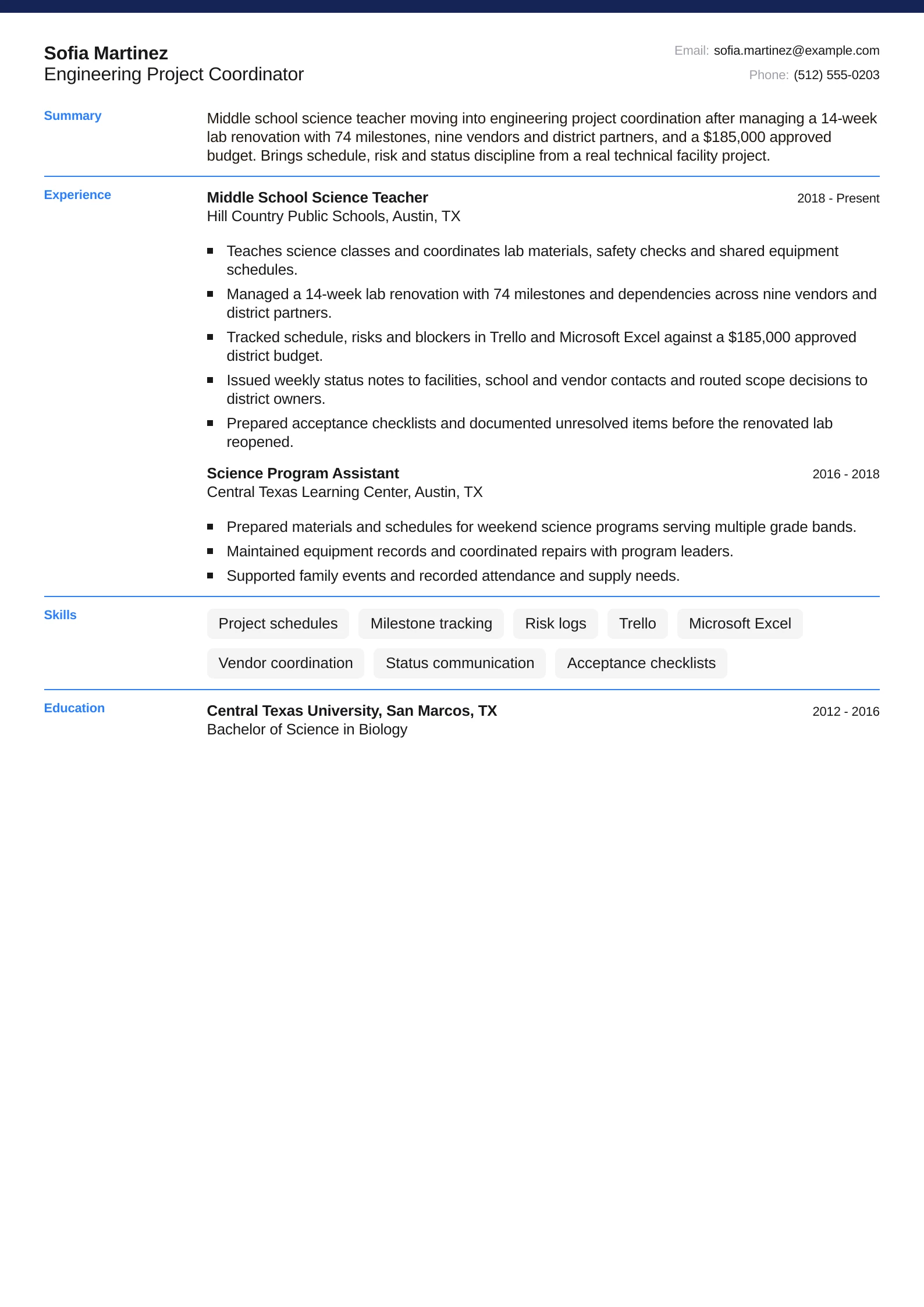
A 14-week lab renovation gives Sofia a sound bridge into engineering project coordination. Her bullets cover milestones, vendors, blockers, the district-owned budget and acceptance checks. Her title is still Middle School Science Teacher, and ordinary lesson planning is not passed off as engineering work. It is a useful model when one substantial project carries the transition.
Teacher title is never renamed
Engineering context comes from a real facility project
Trello and Excel are demonstrated
Teacher to HR Coordinator Resume Example
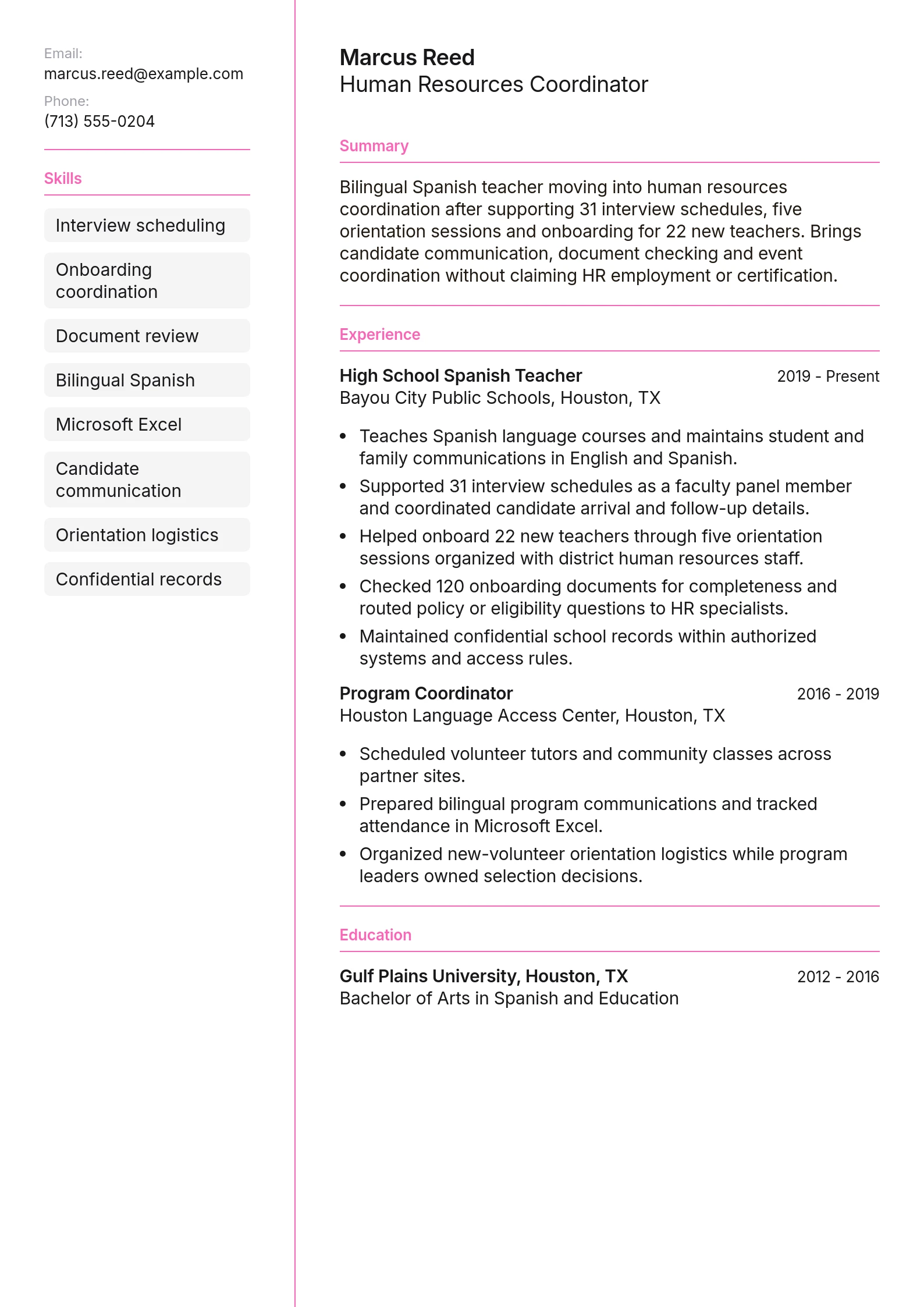
Interview schedules, onboarding documents and orientation sessions are the useful part of Marcus's teaching record for an HR coordinator application. His High School Spanish Teacher title remains visible, and the resume makes no claim to ATS experience or an HR certificate. The bilingual evidence comes from his degree and teaching work, not from a requirement copied out of a posting.
Teaching title remains intact
Bilingual ability has direct evidence
No ATS or HR credential is invented
Teacher to Instructional Designer Resume Example
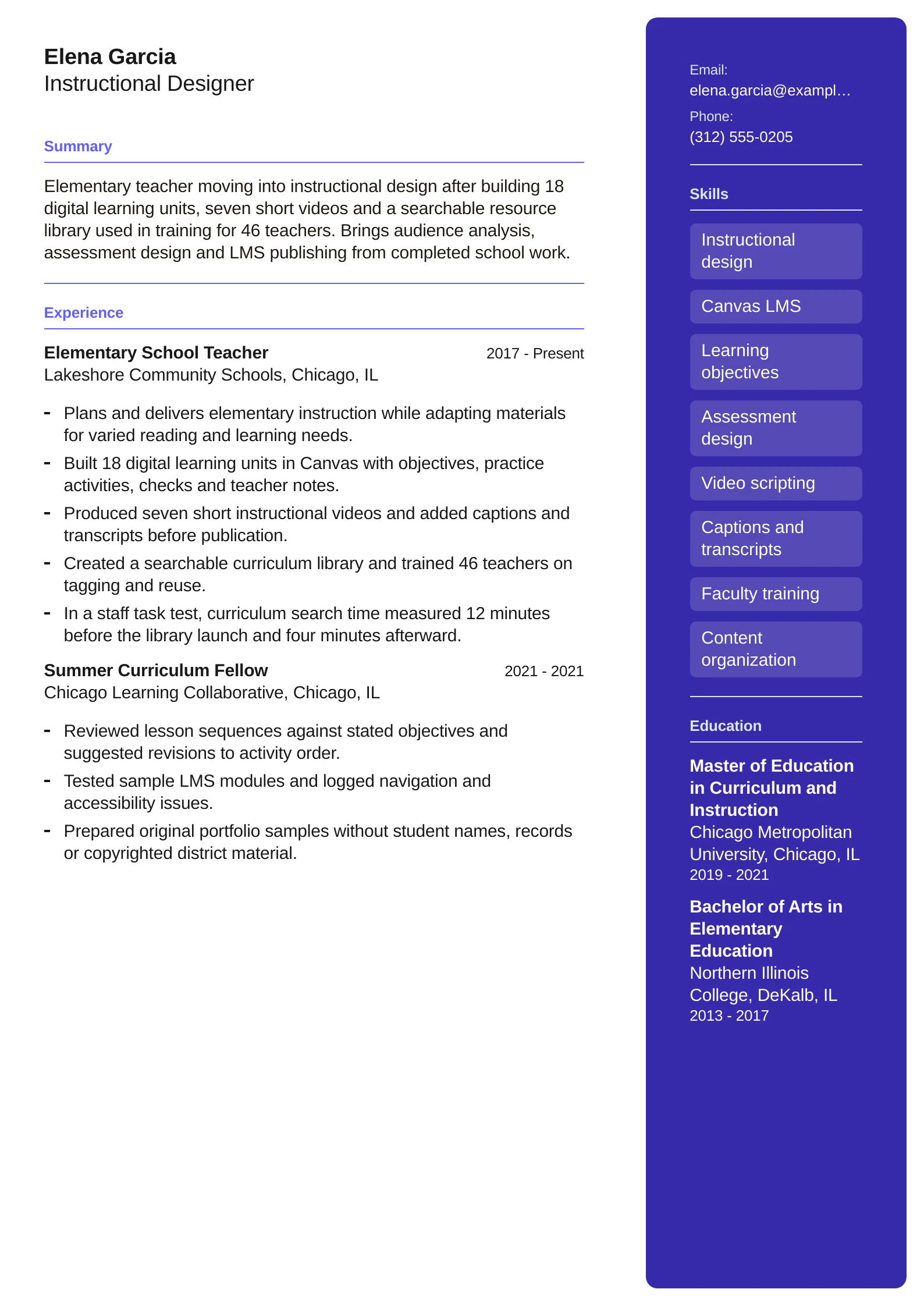
Elena can point to completed digital units, Canvas publishing, instructional videos, assessment work and training for 46 teachers. That is enough to explain an instructional design target without renaming her classroom job. Her portfolio uses authorized original material and removes student information, a boundary worth copying whenever teaching work will be shown outside the school.
Target skills appear inside real teaching work
Portfolio materials have a privacy boundary
No new job title is backdated
Project Coordinator to Administrative Assistant Resume Example
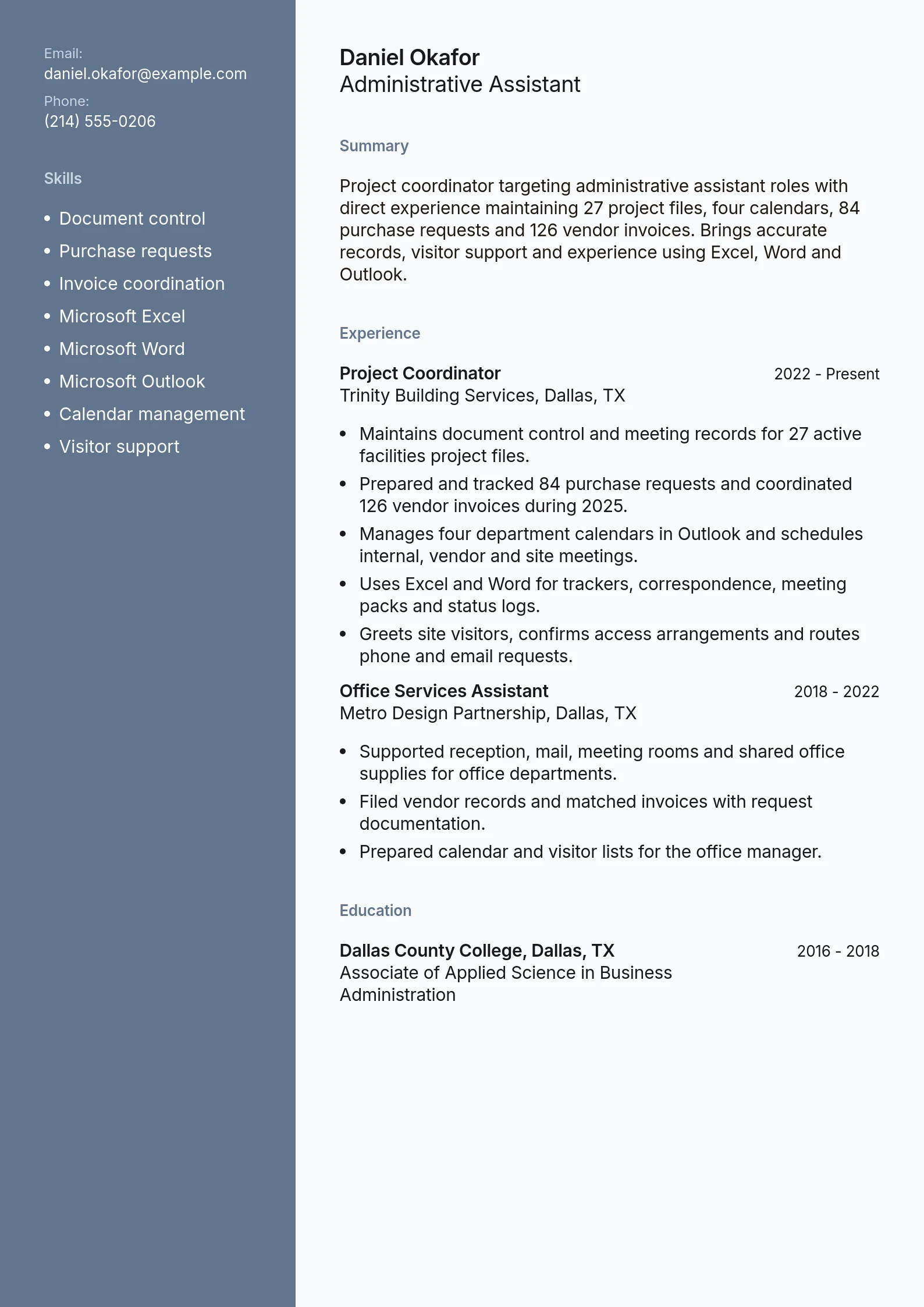
Not every career change is a move to a broader title. Daniel wants an Administrative Assistant role, so his resume spends more time on document control, purchase requests, invoices, calendars and visitor support than on project milestones. Project Coordinator remains his real title, and coordination is not inflated into people management. His office evidence does the work.
Target choice is stated without apology
Administrative records take priority
Project title and authority stay accurate
Customer Support to Customer Success Operations Resume Example
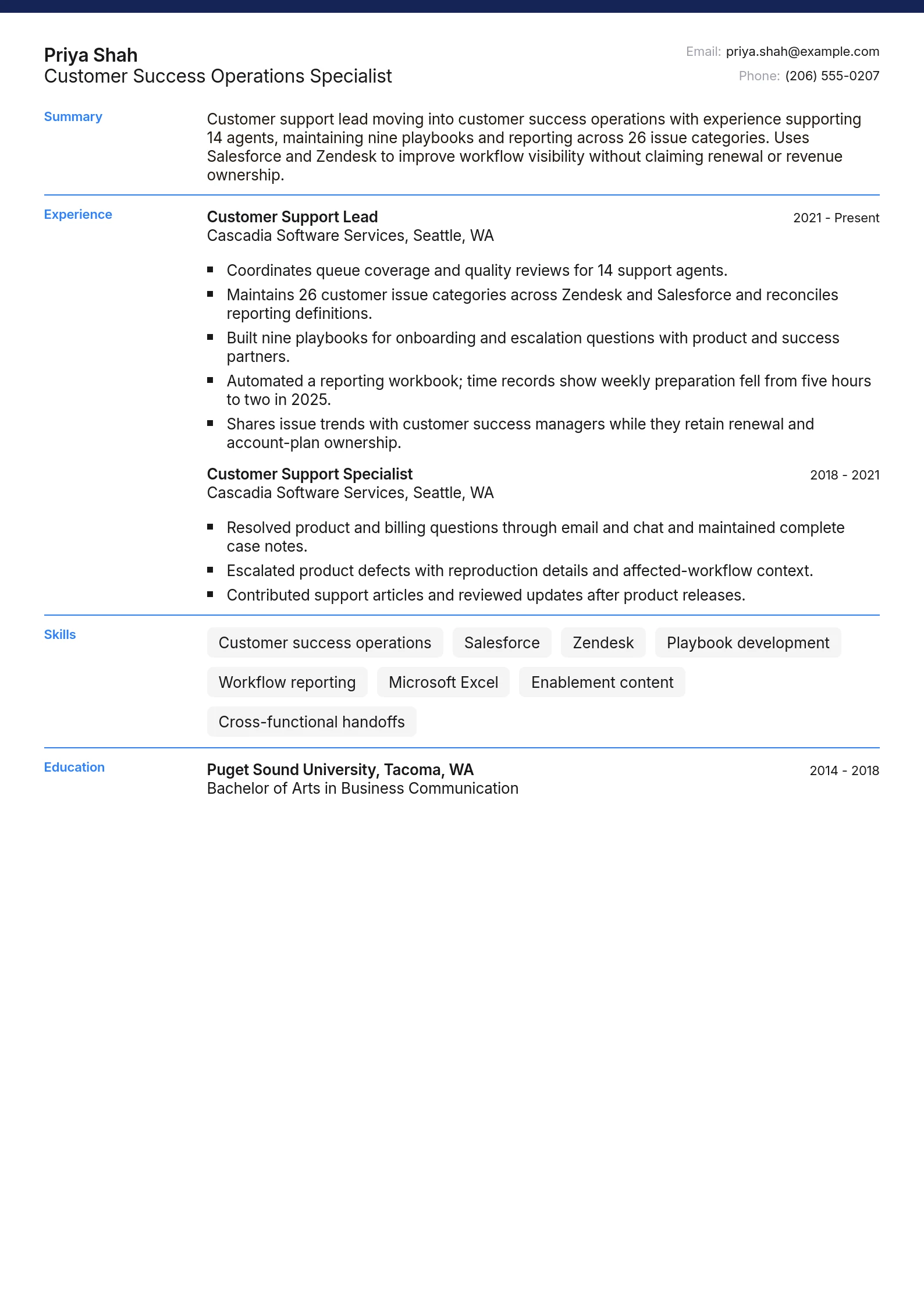
Priya is moving from Customer Support Lead into customer success operations, but she has not owned accounts or renewals. The evidence is operational: Salesforce and Zendesk reporting, playbooks, workflow definitions and handoffs. Customer success managers keep the commercial authority. Use this approach when a support role includes genuine systems work that can be described without borrowing ownership from another team.
Support title and scope remain visible
CRM tools are tied to actual work
Renewal ownership is not borrowed
Retail Manager to Operations Coordinator Resume Example
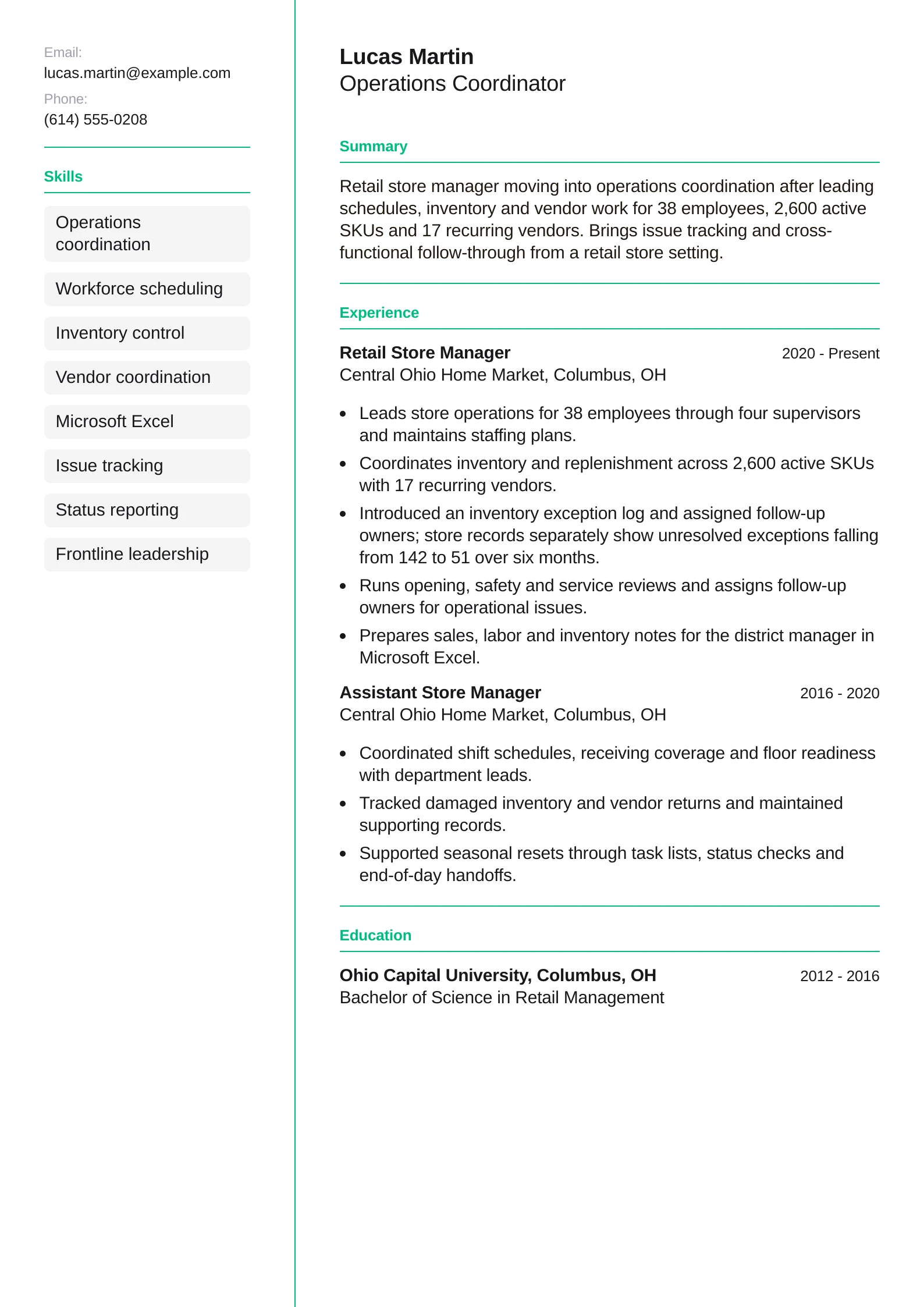
Retail stays visible throughout Lucas's work history. What changes is the emphasis: workforce schedules, 2,600 active SKUs, 17 vendors, issue records and handoffs through four supervisors now lead the story. This is a strong reference when the old workplace looks unlike the target employer, yet the day-to-day coordination and record keeping are plainly comparable.
Retail context is not hidden
Operations evidence has real scale
Target role is a direction, not a past job
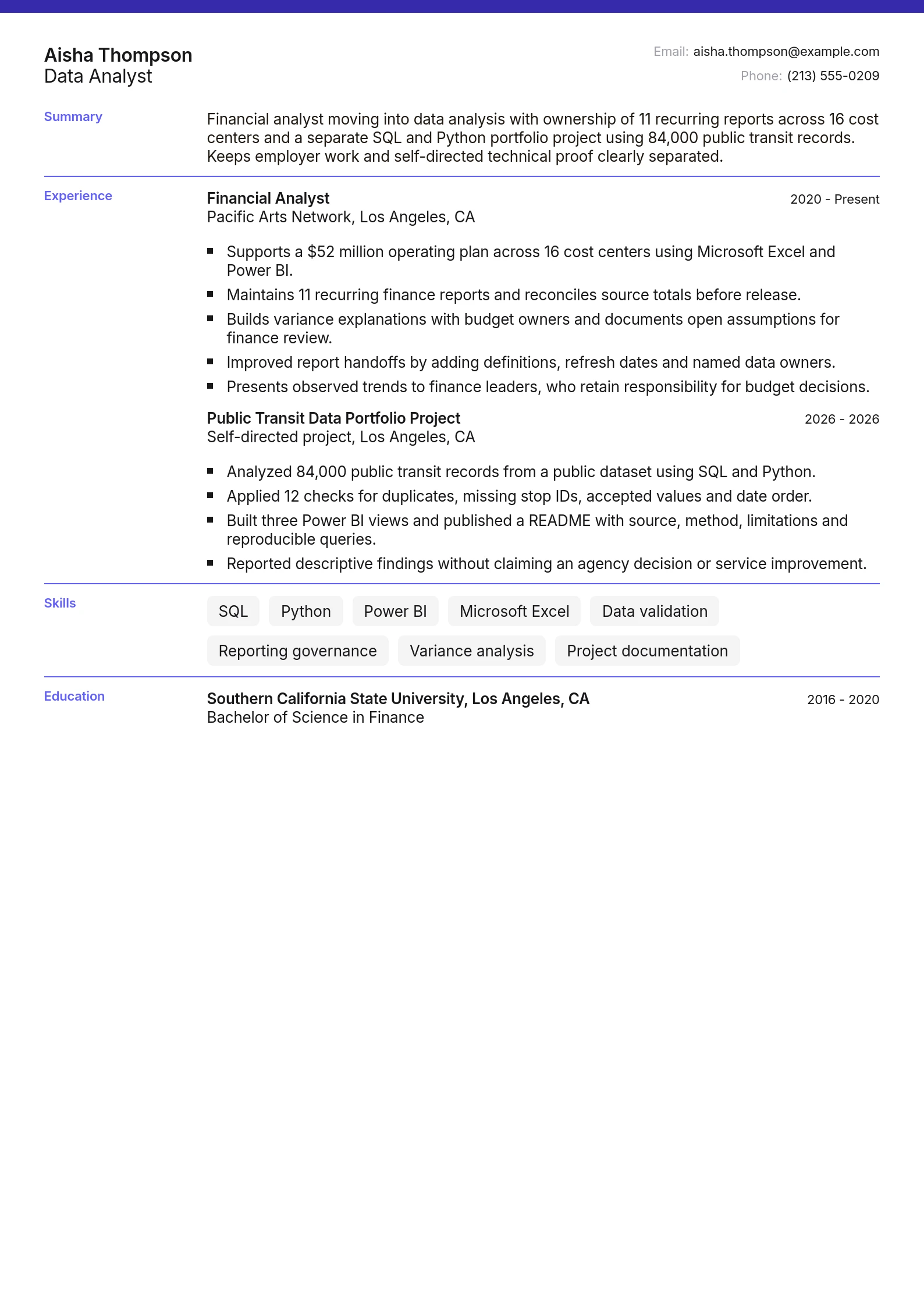
Financial Analyst to Data Analyst Resume Example
The source of Aisha's technical proof matters. Her Financial Analyst role shows reporting, definitions and reconciliation. A separately labeled self-directed project shows SQL, Python, validation checks and Power BI work on public transit data. Keeping the two entries apart lets a reviewer see what she did at work and what she built independently, without guessing which tools belong where.
Finance employment is not relabeled
Technical proof has its own project entry
Public data and limitations are recorded
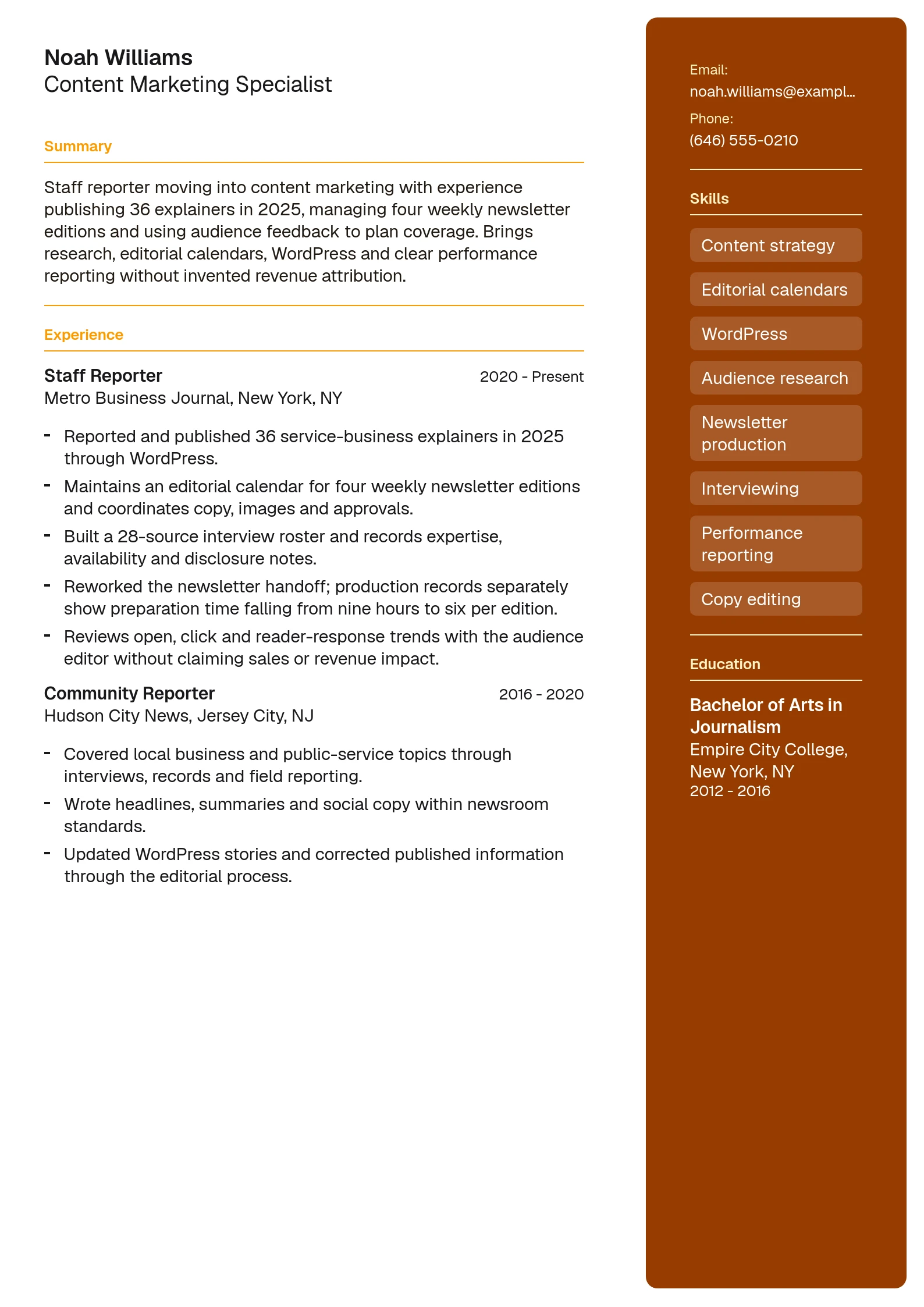
Journalist to Content Marketing Resume Example
Noah does not need to turn journalism into a marketing job. His Staff Reporter work already covers editorial calendars, WordPress, newsletters, audience feedback and performance reports. The resume translates those activities for content marketing without inventing leads or revenue. It fits transitions where the work is familiar but the target industry uses different language for planning and publishing.
Journalism chronology remains visible
Content tools are demonstrated in published work
Audience measures are not turned into revenue
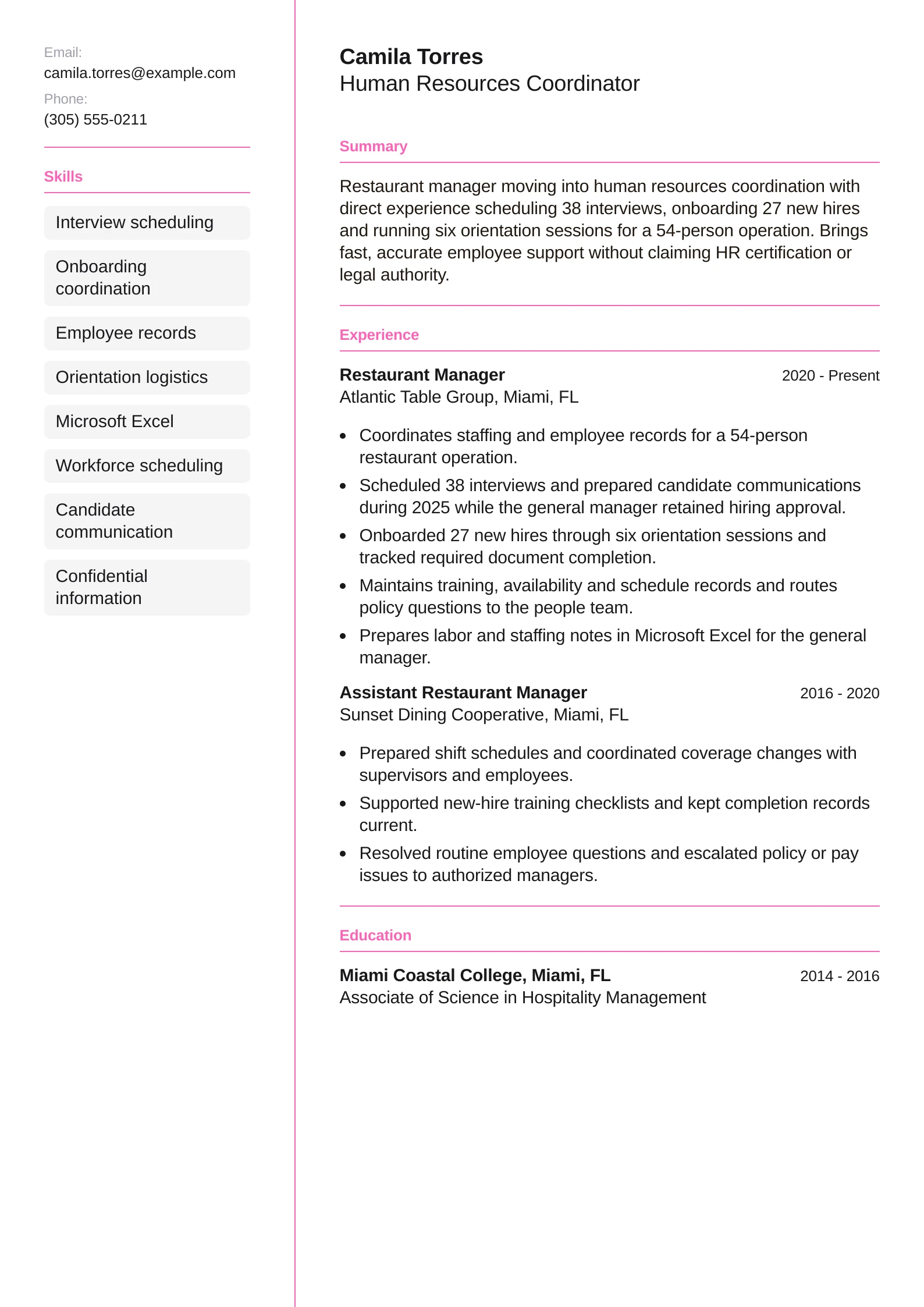
Restaurant Manager to HR Coordinator Resume Example
Restaurant management has given Camila plenty of people coordination, including interview schedules, candidate messages, onboarding documents, orientation and employee records. The resume names that work while keeping Restaurant Manager as the title. The general manager still owns hiring approval, and Camila claims neither policy authority nor an HR credential. That precision makes the transition easier to trust.
Restaurant title is preserved
Hiring logistics have exact quantities
No HR authority or credential is added
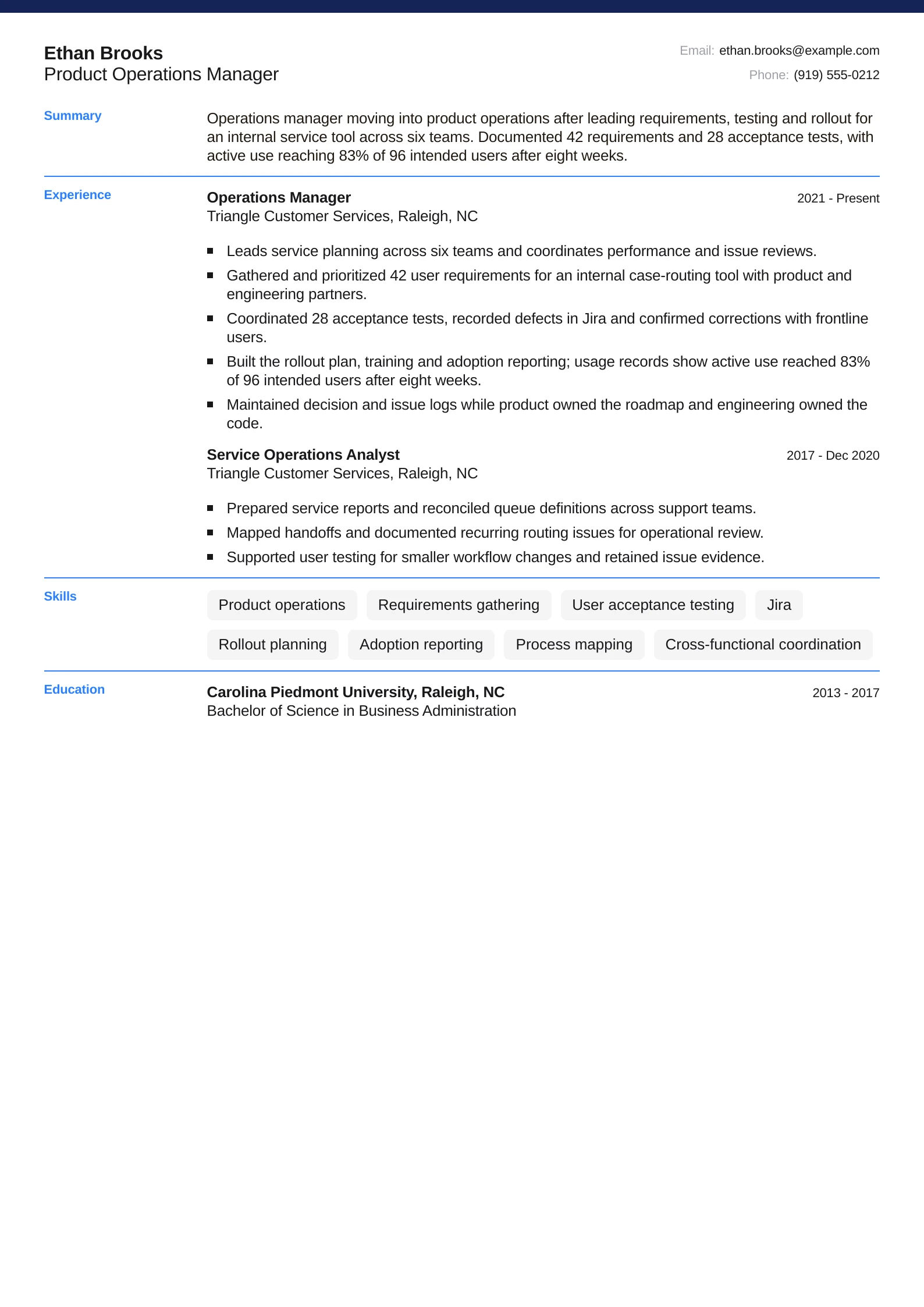
Operations Manager to Product Operations Resume Example
One internal tool project carries Ethan's case for product operations. He gathered 42 requirements, ran 28 acceptance tests, recorded Jira defects and owned rollout planning and adoption reporting. Product retained the roadmap; engineering retained the code. The Operations Manager title is unchanged. This version shows how to claim a substantial contribution without absorbing every team's responsibility.
Internal-tool proof is documented
Roadmap and engineering ownership stay separate
Adoption has a defined user base and period
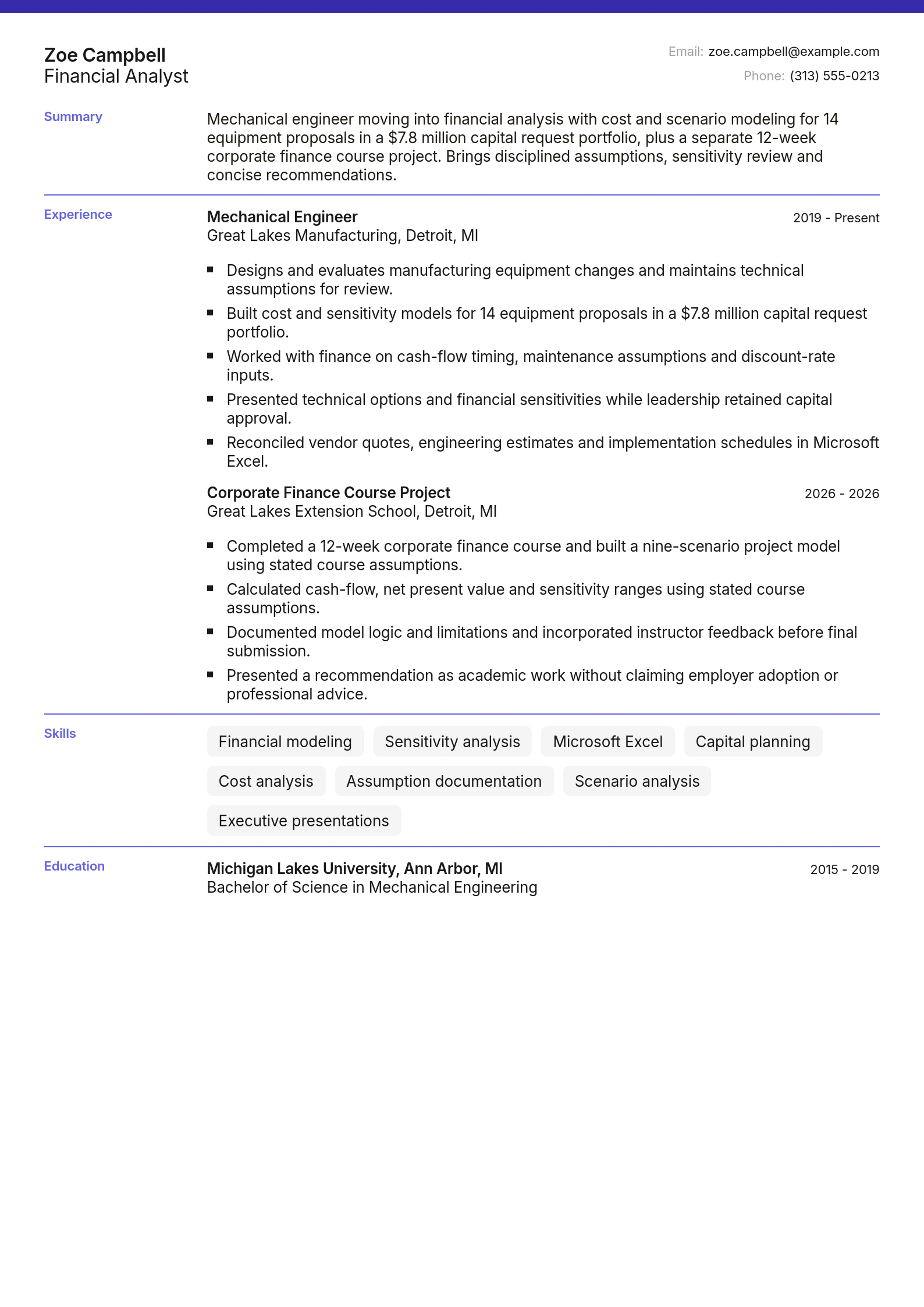
Mechanical Engineer to Financial Analyst Resume Example
Zoe brings two separate forms of evidence to a financial analyst target. At work, she prepared capital-cost models with finance while leadership kept approval authority. In a completed 12-week course, she built a nine-scenario model from stated course assumptions. Neither entry changes her Mechanical Engineer title or implies an MBA, CFA, CPA or accounting authority.
Engineering and finance evidence remain distinct
Course project has exact status and dates
No unearned finance credential appears
Choose the target before rewriting
Start with a job you can name. "Something in business" is too loose to tell you what deserves space. "Marketing coordinator for a regional consumer brand" gives you something to compare against: campaign dates, assets, vendors, reports and team handoffs. Put that target in the headline if it helps, but leave the titles in the experience section alone.
Open several current postings and mark the duties that repeat. Keep one employer's unusual requirement separate. Your resume should lead with responsibilities you can already prove, while a missing requirement stays a gap rather than becoming a convenient keyword.
Before you rewrite, make a short evidence sheet. Beside each repeated duty, note the closest assignment, where it happened and which record confirms it. Add the boundary too. Perhaps you scheduled interviews but did not select candidates, or prepared a cost model while leadership approved the spending. If no source maps to a requirement, mark it "missing." This is a useful guardrail when a job ad starts to sound more familiar than your record.
Decision
What to write down
What not to change
Target role
One recognizable title and the work it repeatedly requires
Old job titles or dates
Transferable proof
Assignments, outputs, people, records and results from real work
A duty you never performed
New proof
A project, course, volunteer assignment or credential with its real label
Training presented as employment
Missing requirement
The skill, tool, credential or experience still absent
A tool added only because the posting names it
Application version
The evidence most relevant to this employer
Chronology, metrics or outcome ownership
Write a summary that explains the direction without apology
A good summary tells me where you are going and why the move is plausible. Maya targets project coordination after running a relocation as an office manager. Jordan's campaign and event assignments support a marketing coordinator target. One sentence establishes the direction; the next supplies the proof.
Choose a few details that deserve attention. A schedule, campaign count, user group, tool or finished project is more useful than a paragraph about wanting a new challenge. Elena can say she built 18 digital learning units in Canvas and trained 46 teachers. That gives an instructional design recruiter something concrete to assess.
The summary must not award you the target title early. Calling Maya a "project coordinator with eight years of experience" would be false. Calling her an "office manager moving into project coordination after leading a nine-week relocation" describes both sides of the change accurately.
Do not use this small section to sneak in a credential or tool you hope to gain. An in-progress credential can appear only when the status is real and useful to the application. A planned course is still a plan.
Let the wording reflect the evidence below it. Phrases such as "moving into," "targeting" and "bringing experience from" are honest when the target is new. Once the title appears in a genuine employment entry, you may not need them. The summary is a preview of the record, not an upgrade to it.
Separate transferable evidence from invented experience
Transferable work need not be identical to the target job, but it must show something the new role requires. Keep the original setting in view. Describe the work, scale, tools and where your responsibility ended so a reader can judge the connection.
Try a blunt test: could a former manager, project file or portfolio artifact confirm this exact sentence? If the answer is no, narrow the claim.
Note the source beside each draft bullet. A calendar may confirm event volume, an issue log the open tasks and an approved report a measured change. Those records do not automatically prove why the result changed. When you can support your action and the scale but not the cause, write separate facts.
Starting point
Transferable evidence
Boundary to preserve
Sales to marketing
Campaign calendars, assets, events, vendors and field feedback
Sales remains the job; campaign support is one part of it
Teacher to project coordination
A real facility project with milestones, blockers and acceptance checks
Lesson planning alone is not engineering project work
Teacher or restaurant manager to HR
Interview schedules, onboarding logistics, records and orientation
Do not claim ATS, policy or hiring authority without evidence
Finance to data analysis
Reporting and reconciliation at work plus a separate technical project
Do not insert project-only SQL into the employer role
Operations to product operations
Requirements, tests, rollout and adoption for a real internal tool
Product owns roadmap; engineering owns code
Mechanical engineering to finance
Cost models at work plus a clearly labeled finance course project
Coursework is not professional financial-advisory experience
Use projects and training to prove what work cannot
A separate project is useful when employment cannot prove an important part of the target role. Aisha's finance job covers reports, Power BI, reconciliation and stakeholder questions. Her public-data portfolio covers SQL, Python, validation and documentation. Blending all of that into the Financial Analyst entry would make the resume smoother and less truthful.
Treat a project like a real piece of history. Give it a title, relationship, dates, data source or brief, method and output. "Self-directed project" and "course project" tell the reader what kind of work it was. If the data was public or simulated, say so. If the work ended with a recommendation, do not write as though an organization implemented it.
Status words carry weight. Completed, in progress, expected, earned and licensed do not mean the same thing. Zoe completed a 12-week corporate finance course and lists its nine-scenario project. She does not claim an MBA, CFA, CPA or finance license. The course proves study and a model, not professional authority.
For a technical move, offer something inspectable: a README, documented queries, an acceptance-test record, requirements or an original portfolio sample. Remove employer secrets, login details, customer information, student records and copyrighted material before sharing it.
The right project detail depends on the hiring decision. An analysis project should identify the dataset, cleaning checks, queries and report. A coordination project needs milestones, dependencies, issues and acceptance. Instructional design work should show the audience, learning objective, published units and review process. Method is valuable evidence even when there was no client or operating result.
Keep work projects under the employer where they happened, with the real title. State independent, course and volunteer relationships just as plainly. The label should explain who requested the work, what information you used, who reviewed it and whether anyone acted on the result.
Rewrite bullets without changing facts or causality
Draft from your records, with the posting closed for a moment. Begin with what you did, the object and enough context to understand it. Add a result only when evidence supports it. Jordan coordinated assets for 24 field events with six vendors. The line helps because it is specific, not because anyone renamed the sales job.
Keep the period and owner attached to a result. Lucas introduced an inventory exception log and assigned follow-up owners. Store records separately show the queue falling from 142 to 51 over six months. Ethan led requirements, testing and rollout, while product kept the roadmap and engineering kept the code. Shared results work when the candidate's part stays clear.
Numbers should explain the size of the work: 74 milestones, 120 onboarding documents, 27 active project files, 26 issue categories or 96 intended users. You do not need a percentage in every bullet. A named handoff, acceptance check, documentation rule or risk review can be better evidence of careful work.
Tailoring changes the order and space, not the history. Jordan can put campaign work above account management in a marketing application. Daniel can give document control and calendars more room for an administrative role. Their titles, dates, tools and outcomes do not move with the target.
Small verbs can create large factual problems. "Supported interviews" does not mean "selected candidates." Preparing a capital recommendation does not grant approval authority. Recording a defect is not engineering the product. Use the verb that the record, and a former colleague, would recognize.
Check comparisons as carefully as totals. A fall from 142 to 51 matters only if both numbers describe the same queue over a stated period. A change from six days to four needs consistent start and finish points. If the definition shifted, report the narrower observation rather than turning a team measure into a personal win.
Some bullets do not need a result at all. A decision record, difficult handoff, exception or maintained standard may show the target behavior more directly than a percentage you cannot defend.
For every new target keyword, find the sentence in your source record that it translates. If the link takes a paragraph to explain, use plainer words.
A safer career change bullet, side by side
Both versions aim at project coordination. The first one names Maya's real Office Manager work and the relocation that supports the target.
The target skill comes from real work
Led a nine-week office relocation with 186 tracked move tasks, named owners and weekly risk reviews.
The target role replaces the old record
Managed enterprise projects as an experienced project coordinator and delivered transformational results.
Keep chronology visible and shorten unrelated work with care
A reader needs to see what happened when. Keep each employer, title, location and date range together, usually in reverse chronological order. A combination resume may put a strong project near the top, but the work history must remain easy to follow.
Spend more space on recent assignments that support the target. An older role can shrink once it has shown progression or a useful foundation. Daniel's Office Services Assistant entry only needs enough detail to establish reception, invoices and calendars. His current Project Coordinator job contains the stronger administrative proof.
Label a break, return, course or period of study for what it was. Never extend a job across a project simply to close a gap. Work and study dates may overlap when both truly happened at once; otherwise, keep them separate.
The title field should match the employer record. If an internal title is unfamiliar, explain it briefly in the summary or with an accurate parenthetical. Do not replace it with the title you want next.
Promotions need their actual dates and titles. Concurrent duties belong inside the job that held them. A temporary assignment is not a new position. When trimming an older role, remove routine detail first and retain what shows progression or a lasting skill.
Match the posting and name what is still missing
The postings behind five examples are concrete. Marketing asks for campaign timelines, assets and vendors. HR names interview and onboarding operations. Data analysis asks for SQL and dashboards. Project coordination names milestones and blockers; administrative work calls for document and invoice control. Each tells you what proof a broad skill label needs.
A requirement found in one posting does not become a rule for the whole occupation. The HR opening reviewed for this page requires bilingual Spanish. Marcus can support Spanish through his degree and teaching career. Camila cannot add it just because she is pursuing a similar role.
Separate each posting into repeated duties, hard requirements and employer-specific context. Repeated duties decide which evidence appears first. A hard requirement tells you whether applying makes sense now. Industry, customer group and language needs show whether an example is close to your situation. Use the target role's dedicated resume page when you need deeper occupational guidance.
Keep an unmet hard requirement in your private comparison notes. It does not belong on the resume as a future promise.
Target
Current posting patterns
What the example proves
Marketing coordinator
Timelines, deliverables, assets, vendors, calendars and reporting
Jordan shows 18 campaigns, 24 events, six vendors and Google Workspace tracking
HR coordinator
Candidate communication, interview schedules, onboarding documents, systems and orientation
Marcus and Camila show real scheduling and onboarding work without ATS claims
Data analyst
SQL, dashboards, stakeholder questions, KPIs and data-quality judgment
Aisha separates employer reporting from a SQL and Python portfolio project
Engineering project coordinator
Schedules, milestones, dependencies, risk, blockers and status communication
Sofia proves those through a documented lab renovation and Trello
Administrative assistant
Records, purchase requests, invoices, visitors and Excel, Word and Outlook
Daniel already performs those tasks as Project Coordinator
Missing hard requirement
A credential, language, tool or years of experience you do not yet have
Leave it absent, build genuine proof or target a role whose requirements fit now
List skills and choose a format only after the evidence is clear
Keep the skills section defensible. Aisha lists SQL because her portfolio contains reproducible queries. Ethan lists Jira because he recorded acceptance-test defects there. Sofia lists Trello because it held the renovation schedule. Every tool should point to an entry that shows its use.
Use ordinary headings, consistent dates and a reading order that makes sense. A chronological layout works for many career changers. A combination layout can put a substantial project above less relevant employment, provided the complete work history remains obvious.
The headline may name the target level, but the summary should state the move honestly. Decorative charts, self-rated skill bars and a vague list of "transferable skills" take attention away from the evidence. The reader should notice the proof before the design.
Compare the finished draft with your source records before sending it. Recheck the employer, title, dates, tools, project relationship, credential status, each metric and its period, and who owned the outcome. Then return to the posting and confirm that the strongest truthful match appears early.
One last search is worth the minute it takes. Find every new title, tool and credential in the file. The headline should mark a target, each tool should lead to a real example and each credential should use its exact status. Make sure no reader could mistake coursework, volunteering or a self-directed project for paid employment. Fix the label first; polish the wording afterward.
Career change resume questions
These are the questions I would settle before polishing a career change resume.