Explore seven military resume examples built for civilian operations, area management, logistics, IT support, site security, Reserve service and federal applications. See how each one translates real duties, handles overlapping service dates and describes credentials or clearance status without stretching the facts.
Start with the military resume closest to your civilian target
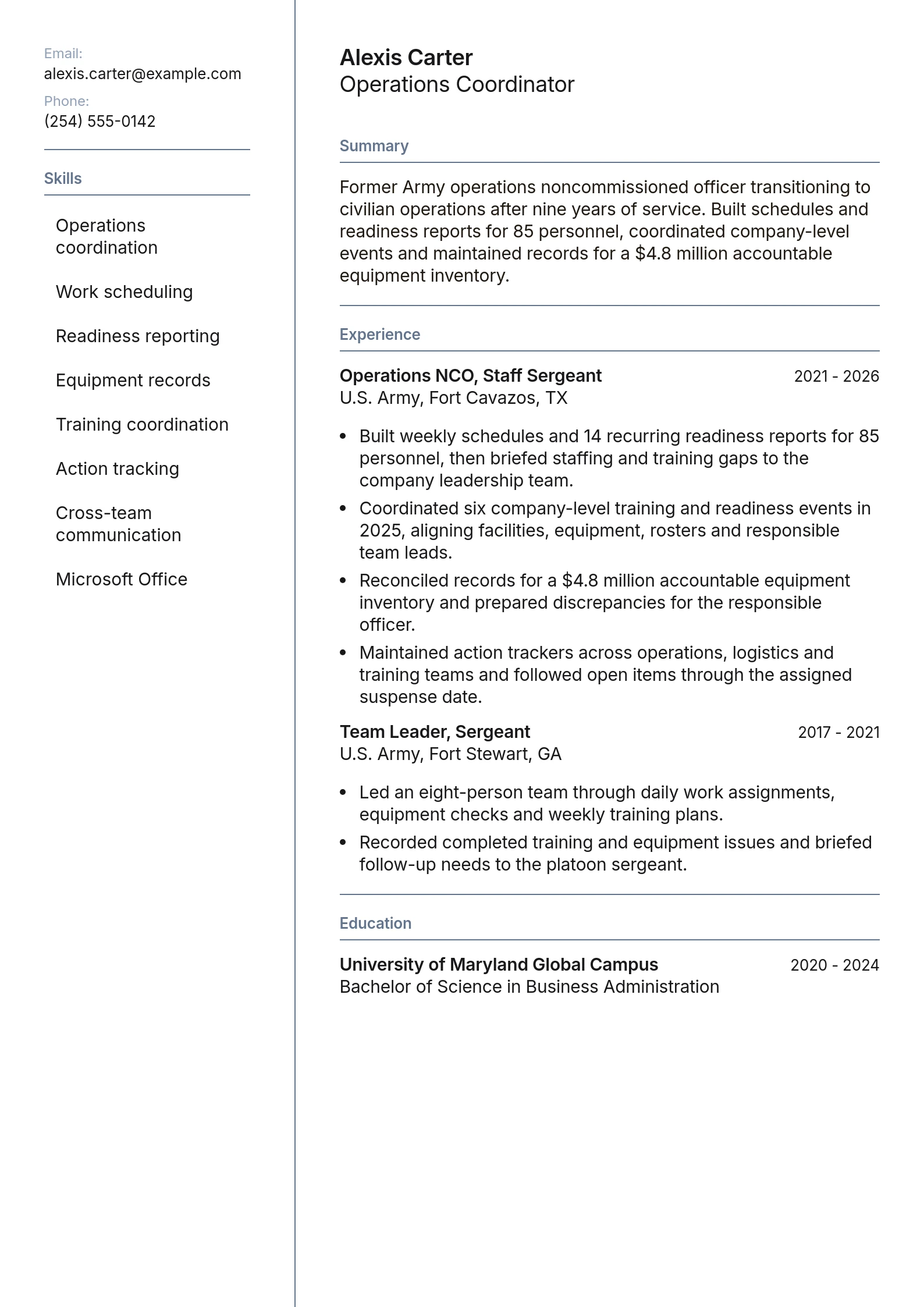
Alexis left the Army in August 2026 after nine years and is applying for operations coordinator roles. Her resume keeps both the Staff Sergeant rank and Operations NCO duty title, but the bullets lead with weekly schedules, 14 readiness reports, a $4.8 million equipment record and six events from 2025. Readers can understand the work without knowing what the rank meant.
Use Alexis's resume as a broad starting point. One of the other examples will be a better fit if your next job is in area management, transportation, IT support or site security, or if you need to explain concurrent Reserve service or meet federal application requirements.
Compare 7 military resume examples
Choose the example that matches the work you want next. Branch and rank alone are not enough: two people with similar military titles need different resumes when one is applying to a private warehouse and the other is responding to a federal logistics announcement.
The people and numbers in these examples are fictional. Borrow the structure and amount of detail, then use your own dates, duties, records, credentials and current clearance status.
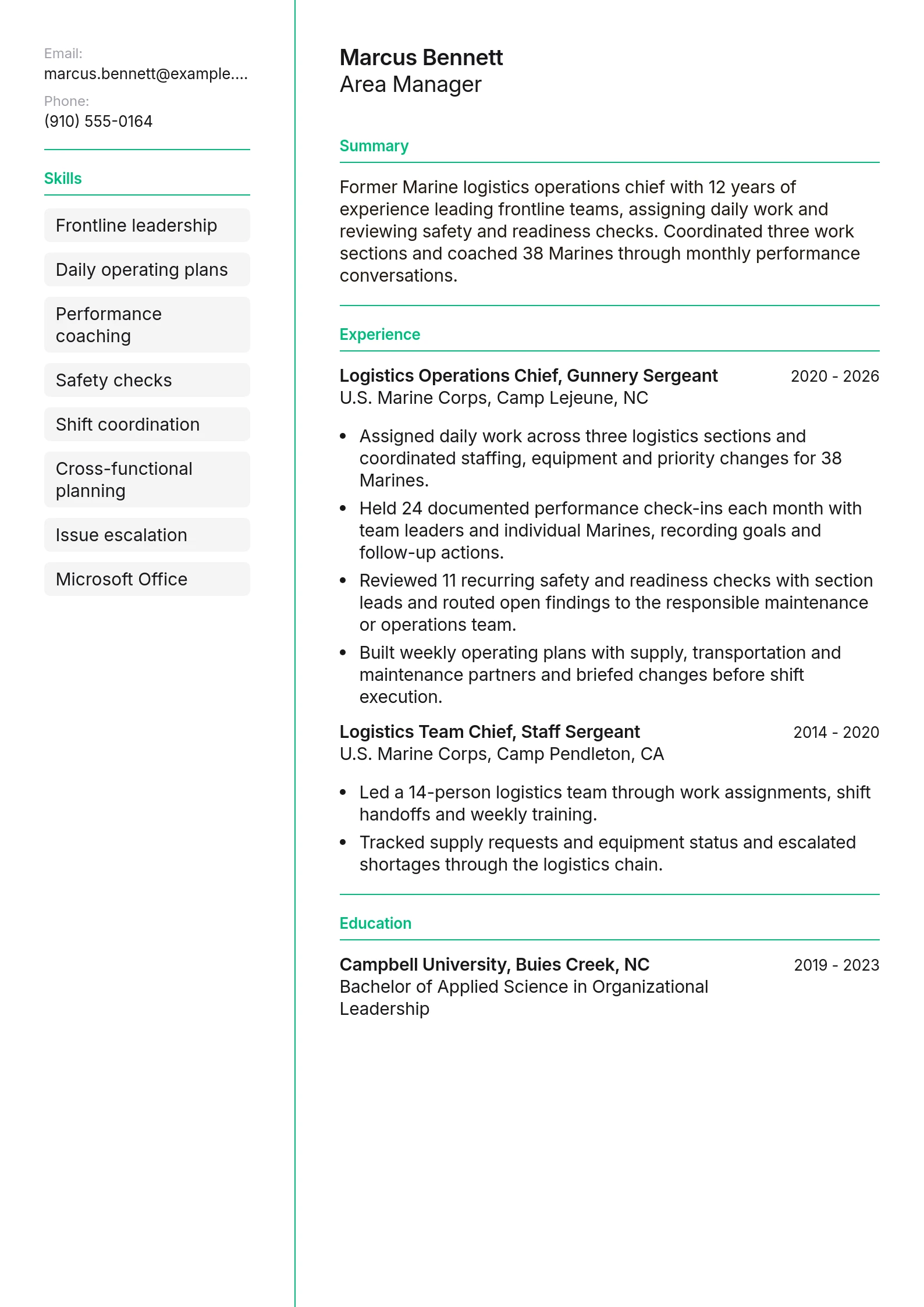
Military Veteran Area Manager Resume Example
Marcus spent 12 years in Marine logistics and is now applying for private-sector area manager roles. His resume separates his completed bachelor's degree from the experience an employer still needs to see: daily work across three sections, leadership of 38 Marines, monthly performance conversations and recurring safety checks. The result gives the employer management evidence behind his military title.
Connects people leadership to daily operating plans and follow-up.
Shows the completed degree and experience as separate qualifications.
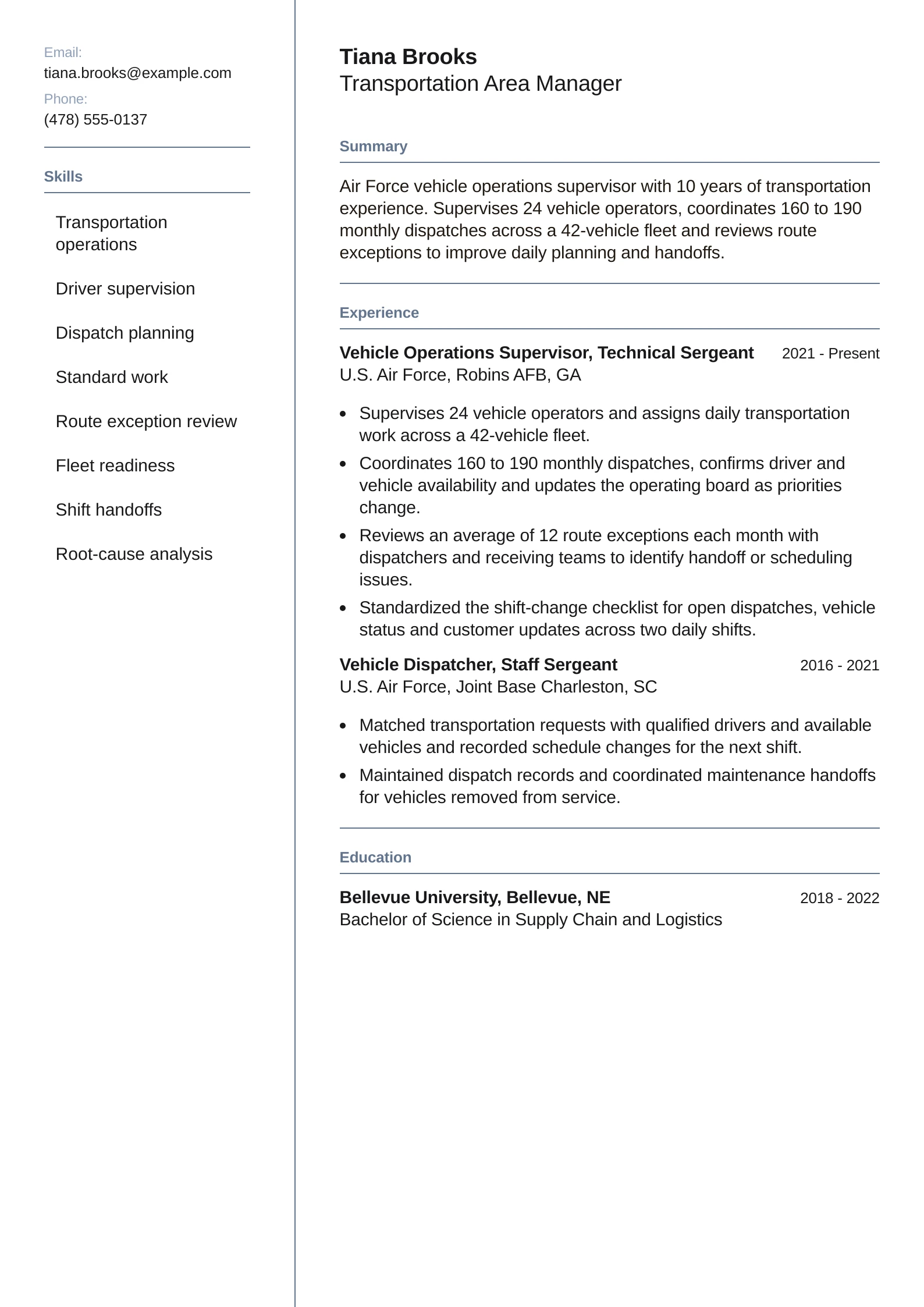
Military Logistics Resume Example
Tiana is still serving in the Air Force and wants to move into transportation operations. Her resume gives the work a useful scale with 24 vehicle operators, a 42-vehicle fleet and 160 to 190 monthly dispatches. Route exceptions stay tied to the dispatchers and receiving teams who review them with her.
Makes dispatch volume and team scope easy to find.
Uses transportation workflow evidence for a transportation destination.
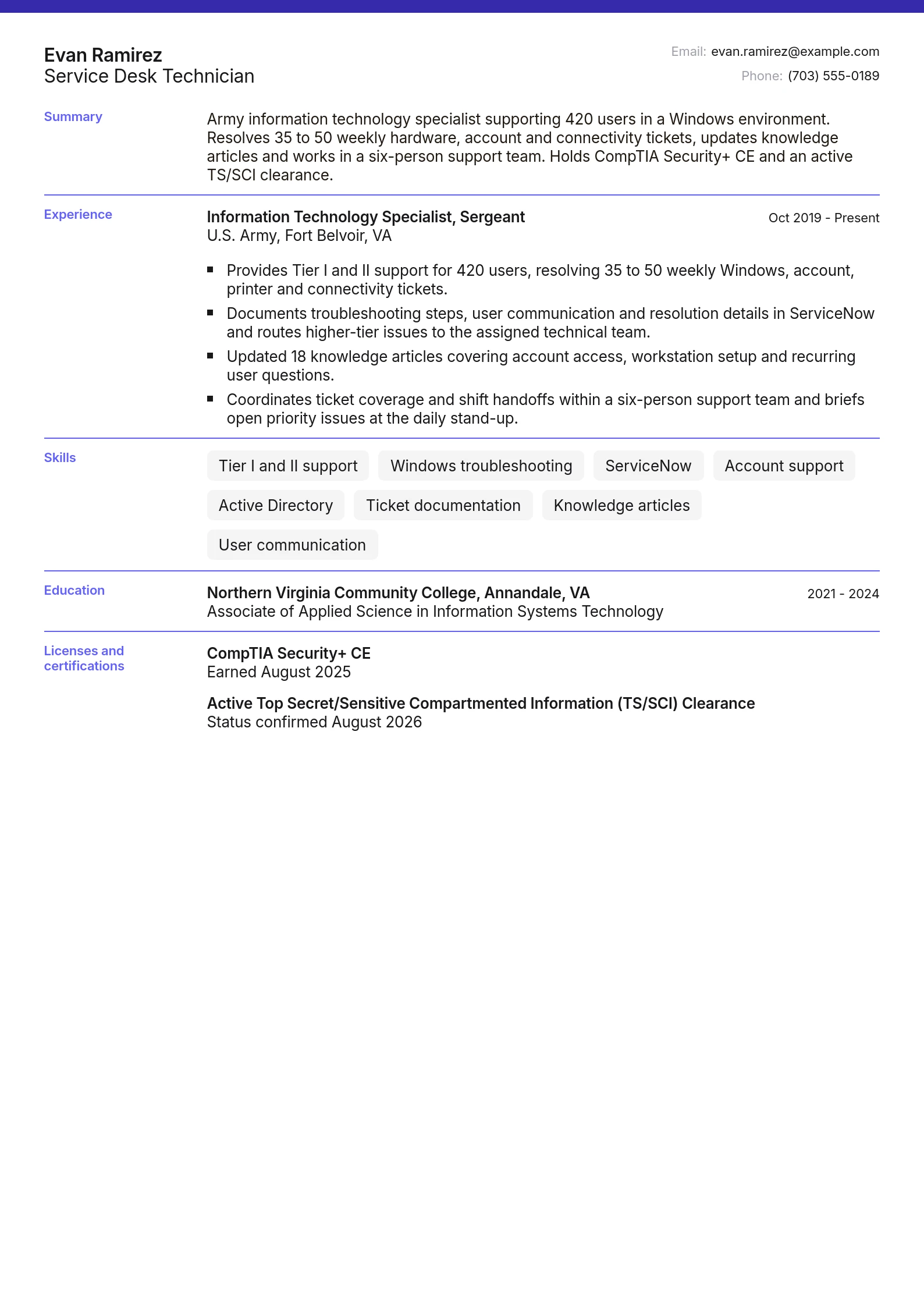
Military IT Support Resume Example
Evan's Army IT work maps closely to a civilian service desk. He supports 420 users, resolves 35 to 50 tickets each week, updates knowledge articles and shares coverage with a six-person team. The credentials section names CompTIA Security+ CE and his active TS/SCI status without turning product skills into certifications.
Pairs technical tools with user and ticket volume.
States the credential and clearance status precisely.
Military Security Operations Resume Example
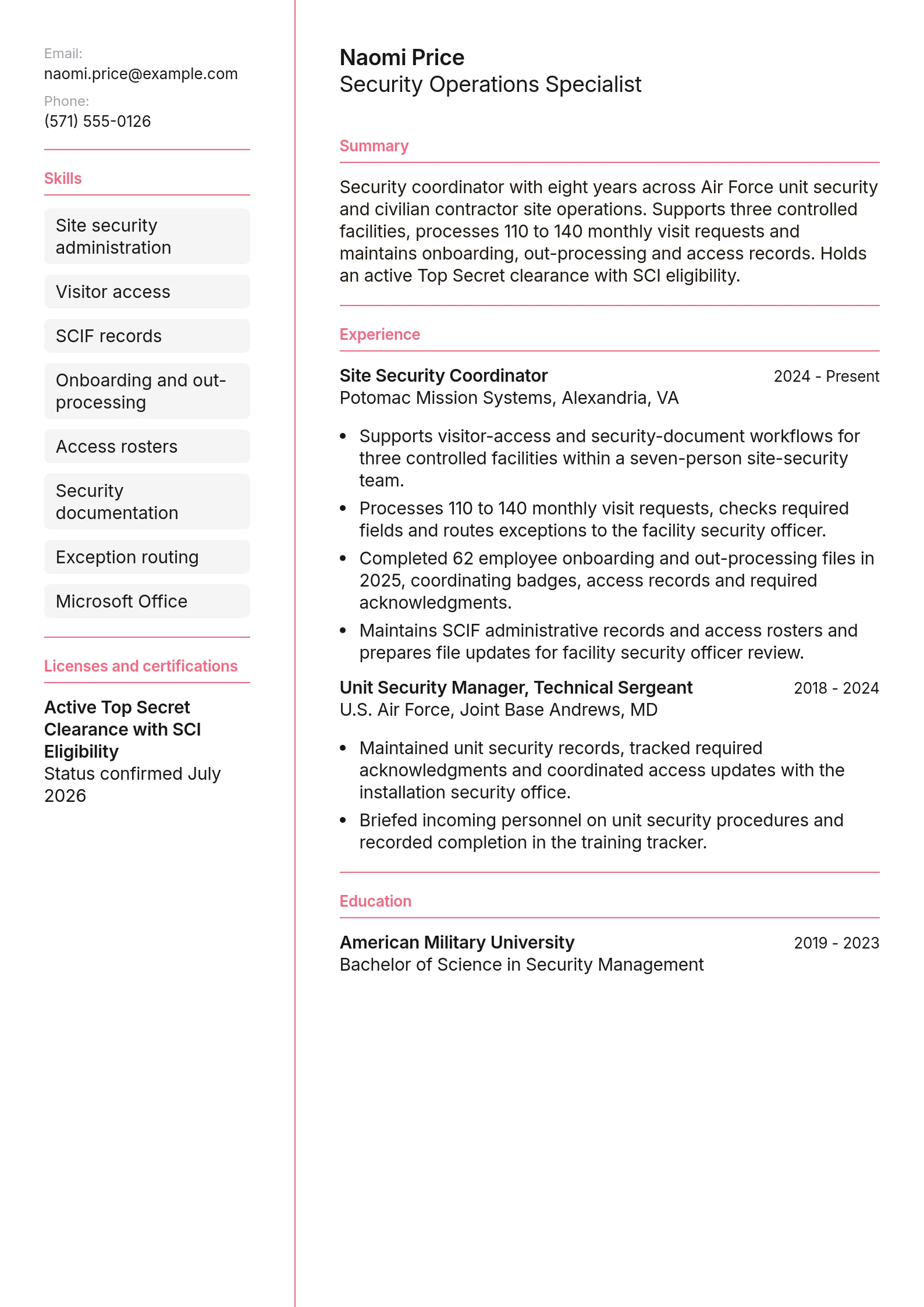
Naomi's earlier Air Force unit-security job is separate from her current contractor role. The current job covers three controlled facilities, 110 to 140 visit requests each month and 62 onboarding or out-processing files completed in 2025. Her clearance line says exactly what her record supports: active Top Secret with SCI eligibility.
Shows relevant civilian contractor experience after military service.
Keeps active Top Secret and SCI eligibility in one accurate line.
Army Reserve Resume Example
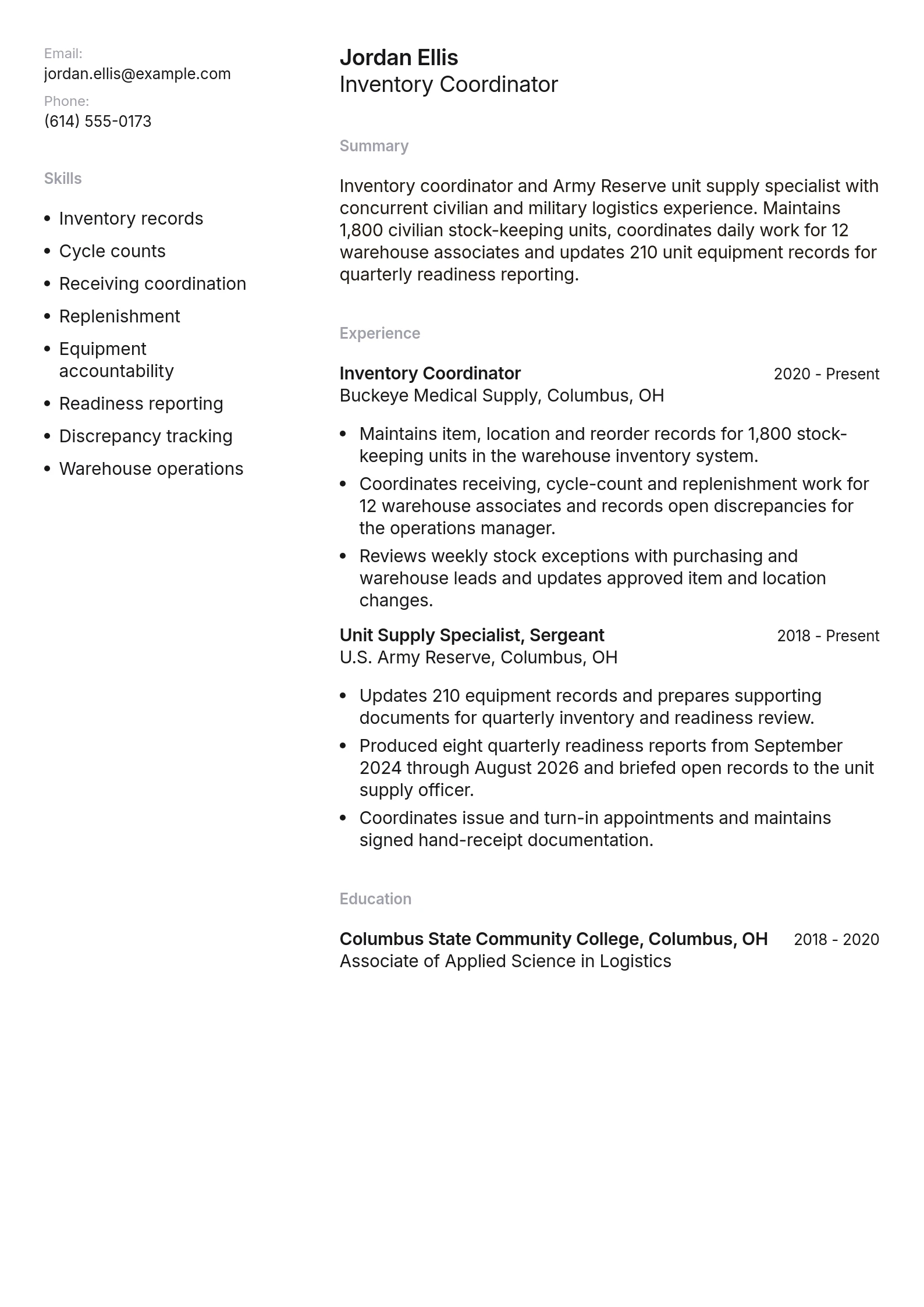
Jordan has two current roles, and the resume dates each one separately. The civilian inventory position comes first because it is closest to the target job. The Army Reserve entry keeps its own May 2018-to-present dates, so the 1,800 civilian stock-keeping units never get mixed with 210 military equipment records.
Uses separate date lines for concurrent civilian and Reserve work.
Leads with the role most relevant to the civilian target.
Federal Military Logistics Resume Example
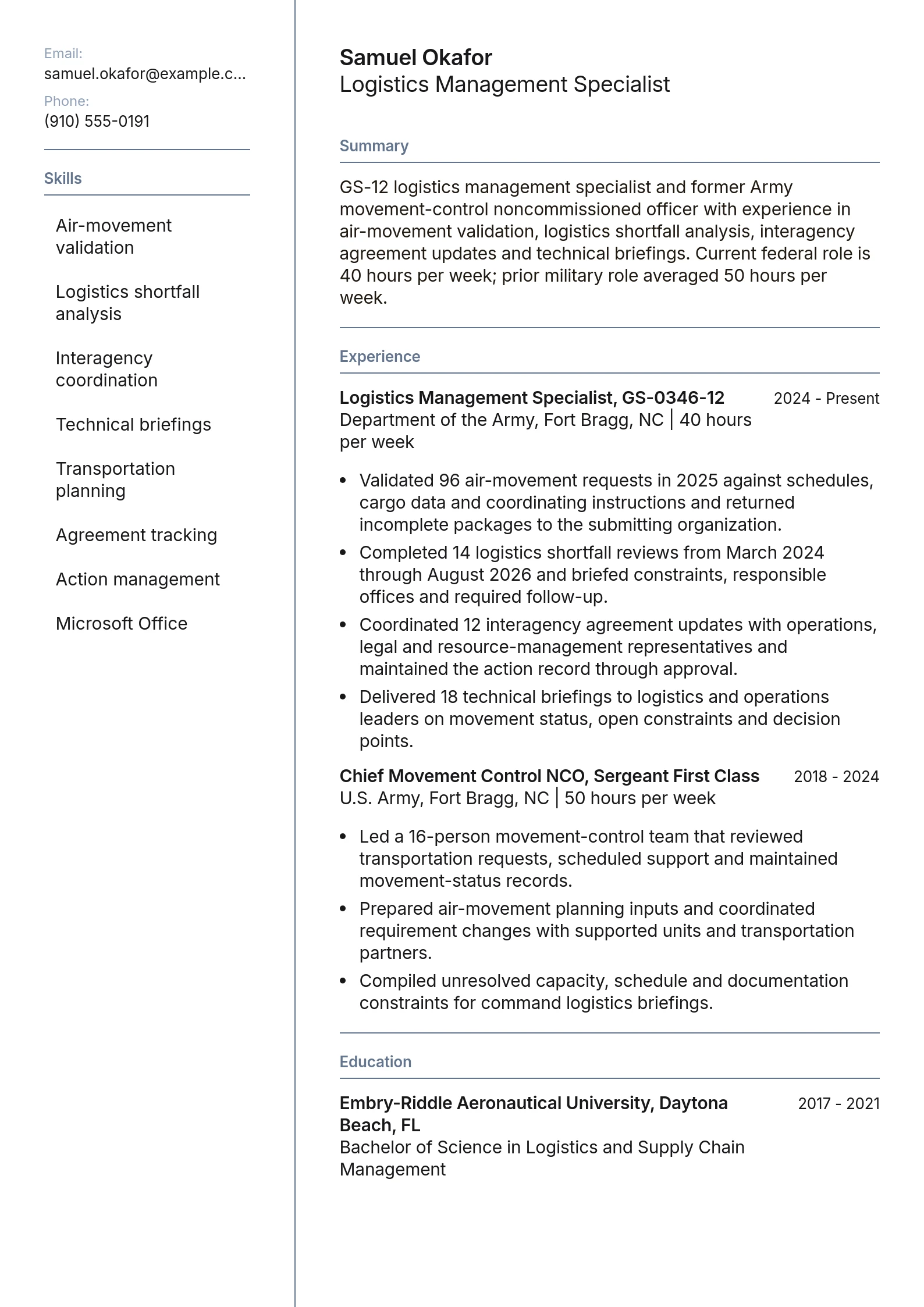
Samuel's federal civilian role is listed as GS-0346-12; his earlier Army role has no invented GS grade. Both entries include month, year and weekly hours. His air-movement requests, shortfall reviews, agreement updates and briefings match several parts of the recent GS-13 announcement, but they do not prove the missing high-cost assessment requirement.
Includes current USAJOBS date and hours fields.
Keeps the military role separate from the civilian GS-12 position.
Pick the civilian destination before you translate
Read the posting before you touch the resume. Mark the work the employer asks for, whether that is people leadership, dispatch, user support, controlled-facility records, purchasing or project schedules. Next, search your evaluations, duty descriptions and records for work that matches those requirements. Put the strongest supported match near the top. The chronology keeps your military title; the summary and bullets explain why the experience fits this civilian job.
A single generic version struggles because employers ask for different proof. Amazon's Area Manager II posting focused on hourly employee leadership and operating plans. Its Transportation Area Manager posting also called for standard work, delivery measures and root-cause analysis. Both may value military experience, but neither treats it as a substitute for the job's stated basic qualifications.
A military occupation crosswalk can give you ideas, but check every suggestion against work you actually performed. It does not award a license, credential or hiring decision. Police work, law enforcement, facilities management, business analysis and project management each need evidence tied to that field. Read several openings for your chosen destination and note the responsibilities that repeat before deciding what belongs in the summary. Keep the target title at the top of your notes so every choice stays tied to the same job.
Translate the work, not the rank
Keep the official title and rank where they help document your history. Follow them with plain-language evidence a civilian reader can understand.
Military starting point
Civilian-facing version
Why it works
Served as operations NCO for the company
Built weekly schedules and 14 recurring readiness reports for 85 personnel
Names the people, rhythm and documents
Maintained unit equipment readiness
Reconciled records for a $4.8 million accountable equipment inventory and prepared discrepancies for the responsible officer
Shows the record and the handoff
Led vehicle operations mission
Supervised 24 vehicle operators and coordinated 160 to 190 monthly dispatches across a 42-vehicle fleet
Connects leadership to transportation flow
Provided tactical IT support
Resolved 35 to 50 weekly Windows, account and connectivity tickets for 420 users
Uses service-desk language supported by the work
Managed unit security
Maintained unit security records, tracked required acknowledgments and coordinated access updates with the installation security office
Uses evidence from the military period and names the receiving office.
Keep the service context while making it readable
Translating military work does not mean erasing where it happened. Record the branch, installation, rank and duty title accurately, especially when they show progression. Spell out an unfamiliar acronym the first time, or name the function the employer needs instead. Someone outside the service can understand a weekly staffing schedule or vehicle dispatch record without knowing the unit's internal vocabulary.
Use concrete nouns to describe the work. Reports, schedules, work orders, tickets, inventories, briefings and training rosters show what passed through your hands. Add team size, frequency or operating scale when you can verify it. Phrases such as mission-focused leader and proven warrior use space without describing the job.
Be clear about your share of a larger result. Use led for people you formally directed, coordinated for work you organized across groups, and contributed when the result belonged to a wider team. When a handoff matters, name the person or function that received it, such as the responsible officer, security manager or maintenance lead.
Build military resume bullets from records you know
A useful bullet usually combines the action with enough context and evidence to understand its scale. Tiana can write, "Coordinated 160 to 190 monthly dispatches across a 42-vehicle fleet, assigned work to 24 operators and reviewed route exceptions with dispatchers and receiving teams." The numbers describe her workload without claiming that every delivery result belonged to her alone.
Work from records you are allowed to use. Evaluations, training rosters, inventory summaries, help-desk reports, schedules and personal work logs may all help. Give every number a period: a weekly ticket range and a count of six events in 2025 are not lifetime totals. Remove anything sensitive, classified or unrelated to the hiring decision.
Keep outcomes you can trace to a baseline, end point and period. Counts also work when they show real scope, such as employees coached, vehicles scheduled, users supported, files reviewed or briefings delivered. A precise readiness or safety percentage is not useful if you cannot explain its source and your contribution. Before using a number, record what was counted, when it happened and whether the result belonged to you, your team or the wider unit. If you could not explain a figure in an interview, leave it out or replace it with scope you can verify.
Turn one military bullet into civilian evidence
The clearer version retains the real role while giving the reader a workflow, scale and recipient.
The work is concrete
Built weekly schedules and 14 recurring readiness reports for 85 personnel, then briefed staffing and training gaps to the company leadership team.
The translation is still too broad
Leveraged military leadership to ensure mission success in a fast-paced environment.
Show Reserve or National Guard service beside civilian work
Overlapping service dates are normal. Give the civilian job and the Reserve or Guard role separate entries, each with its own organization, title, location and month/year dates. Mark both as Present when both are current. Put the role closest to the target job first, then let the bullets show what each setting adds.
Jordan's civilian inventory job runs from January 2020 to present, while the Army Reserve supply role began in May 2018 and is also current. Keeping both entries intact makes the overlap easy to follow. It also keeps the 1,800 stock-keeping units with the civilian employer and the 210 equipment records with the Reserve unit.
Federal announcements may ask for hours per week. Use the real average for each period, especially if active orders changed the commitment. A private-sector resume usually does not need weekly hours unless the employer requests them. Month and year still help whenever two current roles might otherwise look like a dating mistake.
Give an activation or deployment its own dated entry when it created a distinct full-time period and changed the duties relevant to your application. Routine drill status can remain inside the continuing Reserve or Guard entry. Do not force overlapping work into one combined position. A reader needs to see which organization assigned each duty and where its dates belong. Each accomplishment should stay attached to the organization and period that produced it.
State clearance status with the exact words your record supports
Copy clearance status from a current, authorized record. Evan's example says "Active Top Secret/Sensitive Compartmented Information (TS/SCI) clearance." Naomi's says "Active Top Secret clearance with SCI eligibility." They are different statements, and each belongs only to that fictional candidate.
If an announcement says the employee must be able to obtain or maintain a clearance, it is describing a condition of employment. The phrase does not mean the applicant already holds one. SCI eligibility also does not claim current SCI access. Use only the status your record supports and follow the employer's process for verification.
When a posting asks for it, place a relevant active clearance near the summary or in a short Clearance section. Add a status-confirmed date when that information is available and appropriate. Do not include operational compartments, assignments, investigation details or sensitive program information.
Separate military training, education and civilian credentials
List a civilian certification by its exact issuer and title after you have earned it. Evan's service-desk example uses "CompTIA Security+ CE, earned August 2025." A course, preparation program or military school can sit under Training with its provider and completion date, but do not rename it as a certification.
Keep military schools that help prove the destination match and remove the ones that only add length. If a course name is obscure, explain the subject it covered. Degree entries need the school, degree and completion date. Any credential with an expiration or continuing-education status should agree with the candidate's current record.
Copy the credential title from the issuer record and add only the earned or current status that record supports. If a posting accepts several alternatives, list the one the candidate actually holds. Windows troubleshooting and other product skills belong in Skills or Experience, not in the certification section.
Adjust the resume for private-sector and federal applications
Both versions need relevant evidence, but the current USAJOBS format asks for fields a private employer may not request.
Decision
Private-sector resume
Current USAJOBS resume
Length
Use the space needed for relevant work; many candidates can stay concise
Maximum two pages under current USAJOBS guidance
Dates
Month and year make transitions and concurrent service clear
Month and year for relevant experience
Hours
Add only when requested or useful
Hours per week for relevant work
Series and grade
Not applicable
Use series and grade for federal civilian positions you actually held
Military role
Branch, duty title, rank and translated evidence
Branch, duty title, rank, dates, hours and relevant evidence; no invented GS series or grade
Eligibility
Follow the employer's basic qualifications
Follow the announcement's hiring paths and document instructions
Tailoring
Prioritize the destination team's required workflows
Address each specialized-experience element with evidence inside the two-page limit
Treat the federal announcement as its own evidence checklist
USAJOBS now accepts resumes of no more than two pages. For each relevant job, it asks for month and year dates, hours per week and evidence that you can perform the required work. Build the resume around the announcement instead of attaching an unedited career history. Series and grade apply only to federal civilian positions you held, not active-duty service or contractor work.
The Army GS-13 logistics announcement had a September 9, 2026 application deadline, so it is no longer an open vacancy. It required one year at the GS-12-equivalent level covering four specialized-experience areas: complex air-transportation work and airlift validation; movement plans and high-cost program assessments; complex logistics and regulatory analysis; and advice to leaders combined with coordination of joint requirements, outside organizations and agreements. Education could not replace that experience.
Samuel can point to 96 air-movement requests, 14 shortfall reviews, 12 agreement updates and 18 technical briefings. Those examples cover several parts of the announcement, but they do not show the required high-cost program assessments or prove every other element. A degree or long service history does not replace a required experience element. Follow the same structure, then supply your own evidence for every requirement and include the eligibility documents the announcement requests.
Use a format that makes the transition easy to follow
Most private-sector versions need contact details, a short target summary, reverse-chronological experience, skills, education and any relevant credential or clearance. Keep branch, rank and duty title in the role entry. Let the first two bullets establish the civilian match, and spell out an unfamiliar acronym the first time it appears.
One page may be enough for a short transition; two can help when several roles are relevant. A USAJOBS resume must stay within the current two-page limit. Before sending either version, check every date, number, credential and clearance phrase against the record you used to write it.
Read the top half as a civilian hiring manager
Cover the bottom half of the page and scan what is left.
Top tip
Can you identify the destination job, the candidate's current status, a relevant workflow and a measure of scale? Can you tell which title is military and which is civilian? If it takes more than a few seconds, move the clearest evidence up and translate another unfamiliar term.
Military resume questions
These are the questions that most often change a military-to-civilian draft.