Eight complete Customer Success Manager resumes show how the role changes across first moves, senior portfolios, mid-market, enterprise, scaled and technical work. Compare lifecycle evidence, adoption, retention, reviews and handoffs, then use the model closest to the work and authority you can actually prove.
Start with a complete Customer Success Manager resume
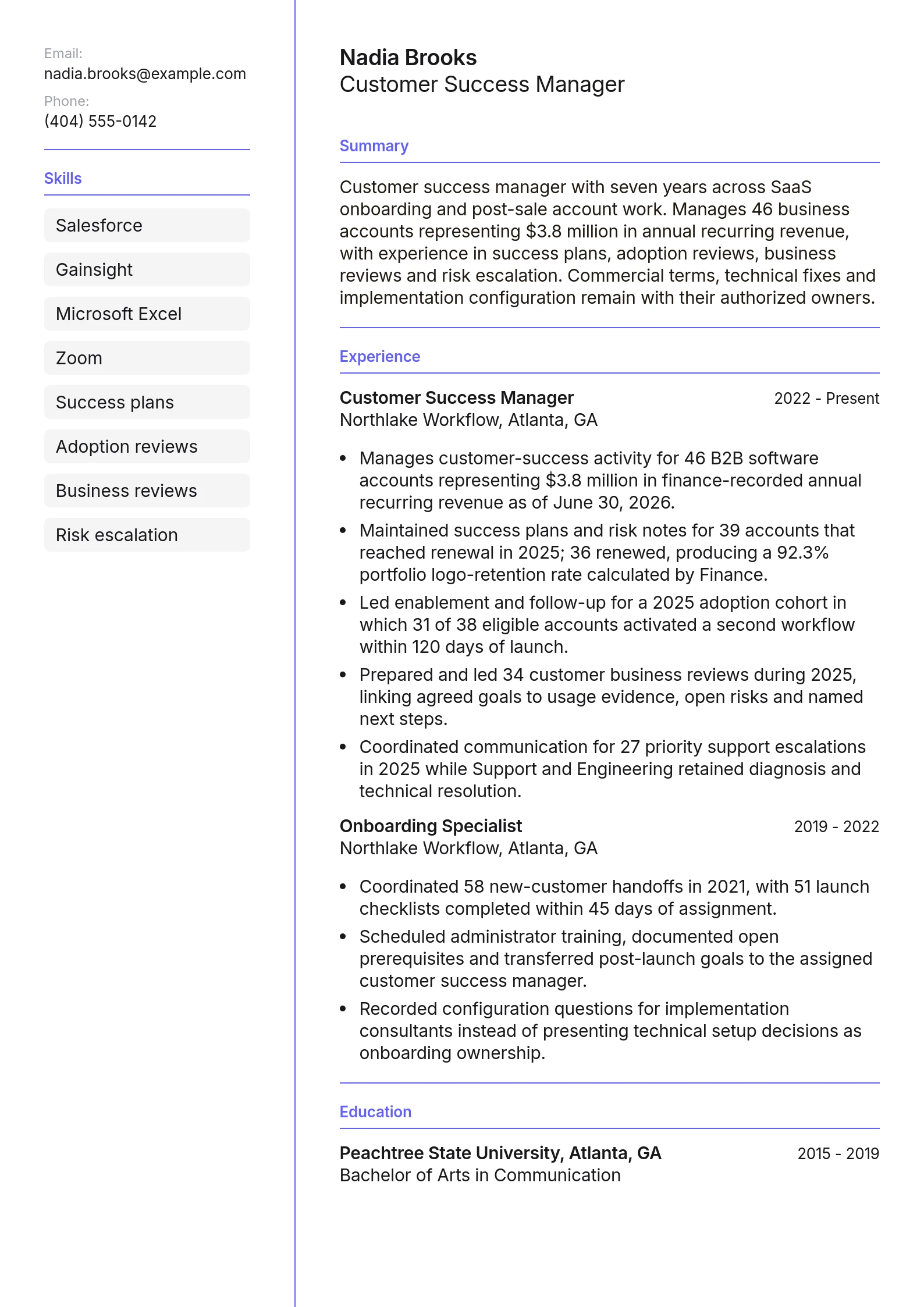
Nadia is the broad starting point because her resume follows the post-sale rhythm without folding every adjacent job into one CSM role. The opening lines size a 46-account, $3.8 million ARR portfolio, then ground it in a 39-account renewal cohort, a 38-account adoption cohort and 34 completed business reviews.
Those figures make sense because the handoffs stay visible. Nadia maintains success plans, leads enablement and handles customer communication during priority escalations. Account Directors negotiate terms, Finance calculates retention, Implementation configures the launch, and Support or Engineering resolves technical issues. Use the same honesty with your own records.
Look first for the portfolio and engagement model that resembles your job. Career stage matters, but account volume, contract complexity, technical depth and the point where another team takes over matter just as much. A scaled CSM with 430 accounts should not borrow the cadence of an enterprise CSM with nine.
Every candidate, employer and quantity here is fictional. Each metric has a defined record, period, denominator and contribution boundary. Follow that discipline rather than copying a number, platform, industry claim or authority line your own records cannot support.
First Customer Success Manager Role Resume Example
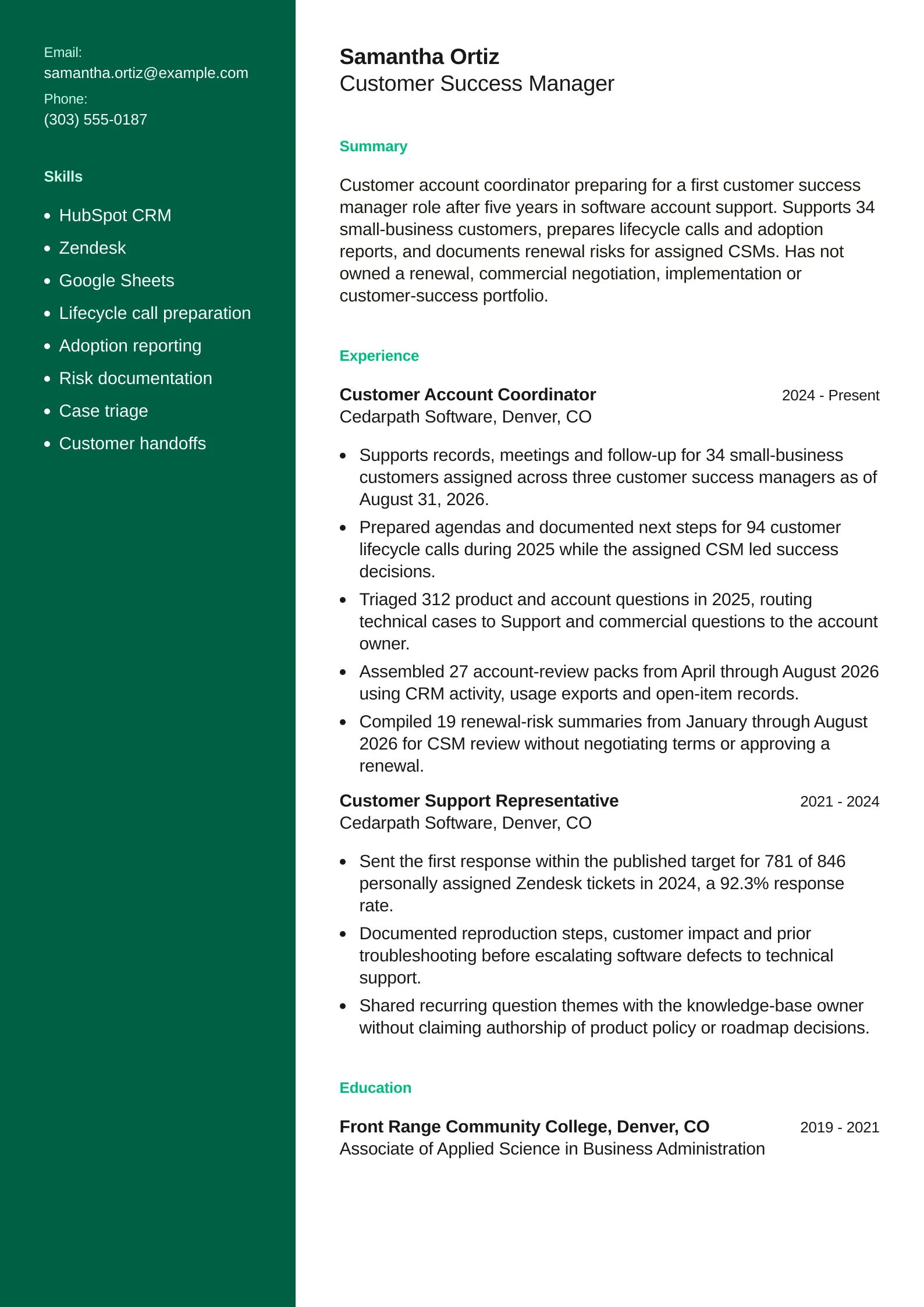
Samantha keeps her real Customer Account Coordinator title and lets the work make the case for a first CSM role. Across 34 supported customers, 94 lifecycle calls and 19 renewal-risk summaries, the evidence shows preparation without rewriting her job. Portfolio strategy, renewals and technical resolution stay with their existing owners.
Uses transferable records without relabeling past work as CSM ownership.
Separates support response, commercial work and customer-success decisions.
Experienced Customer Success Manager Resume Example
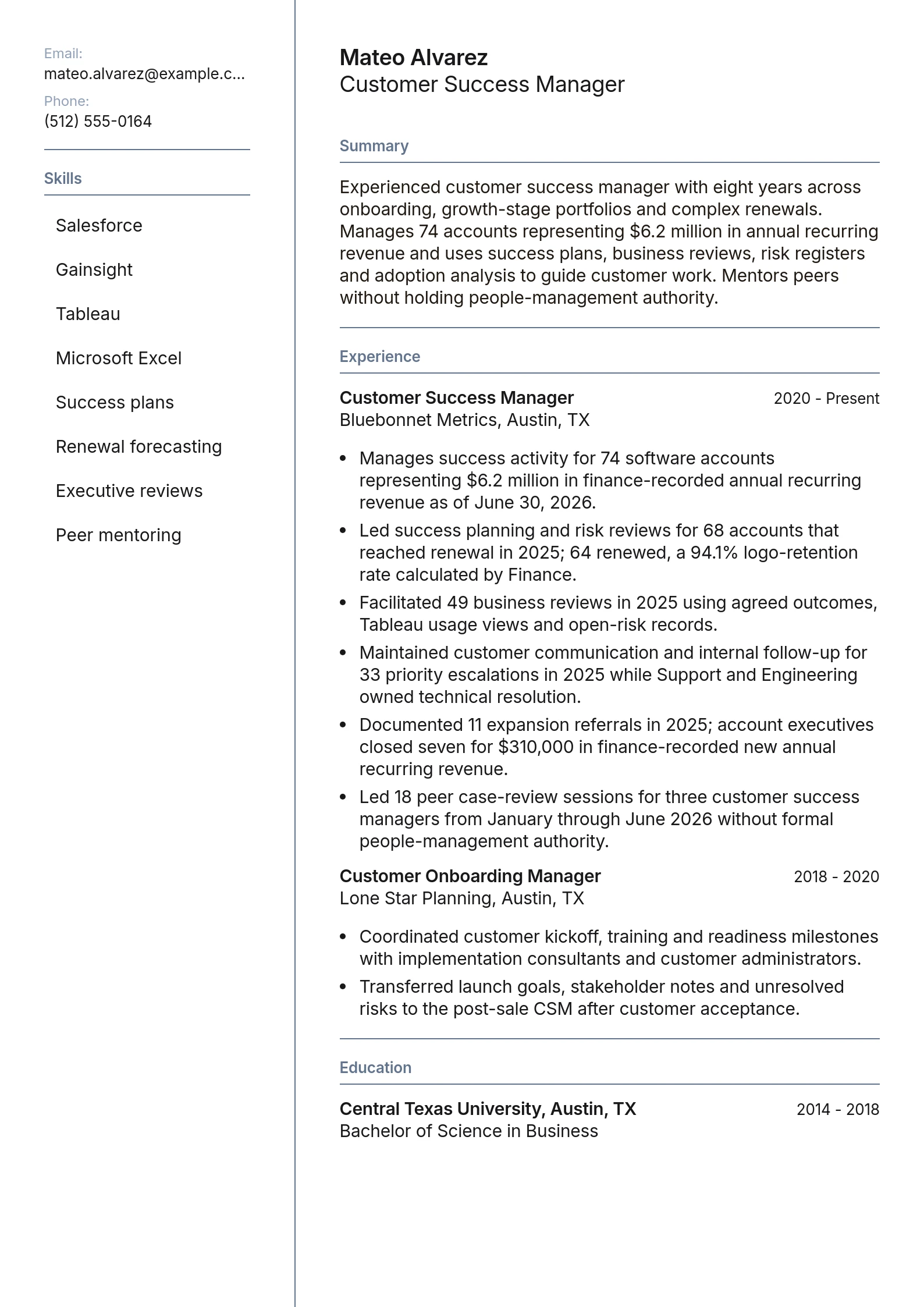
Across eight years, Mateo has built a record that combines a 74-account, $6.2 million ARR portfolio with renewal cohorts, business reviews, escalations and expansion referrals. Account Executives close the opportunities and Finance records ARR. His 18 peer case reviews add a senior contribution while keeping mentoring separate from direct management and formal reviews.
Pairs portfolio scale with defined retention and referral cohorts.
Shows mentoring while preserving an individual-contributor authority boundary.
Senior Customer Success Manager Resume Example
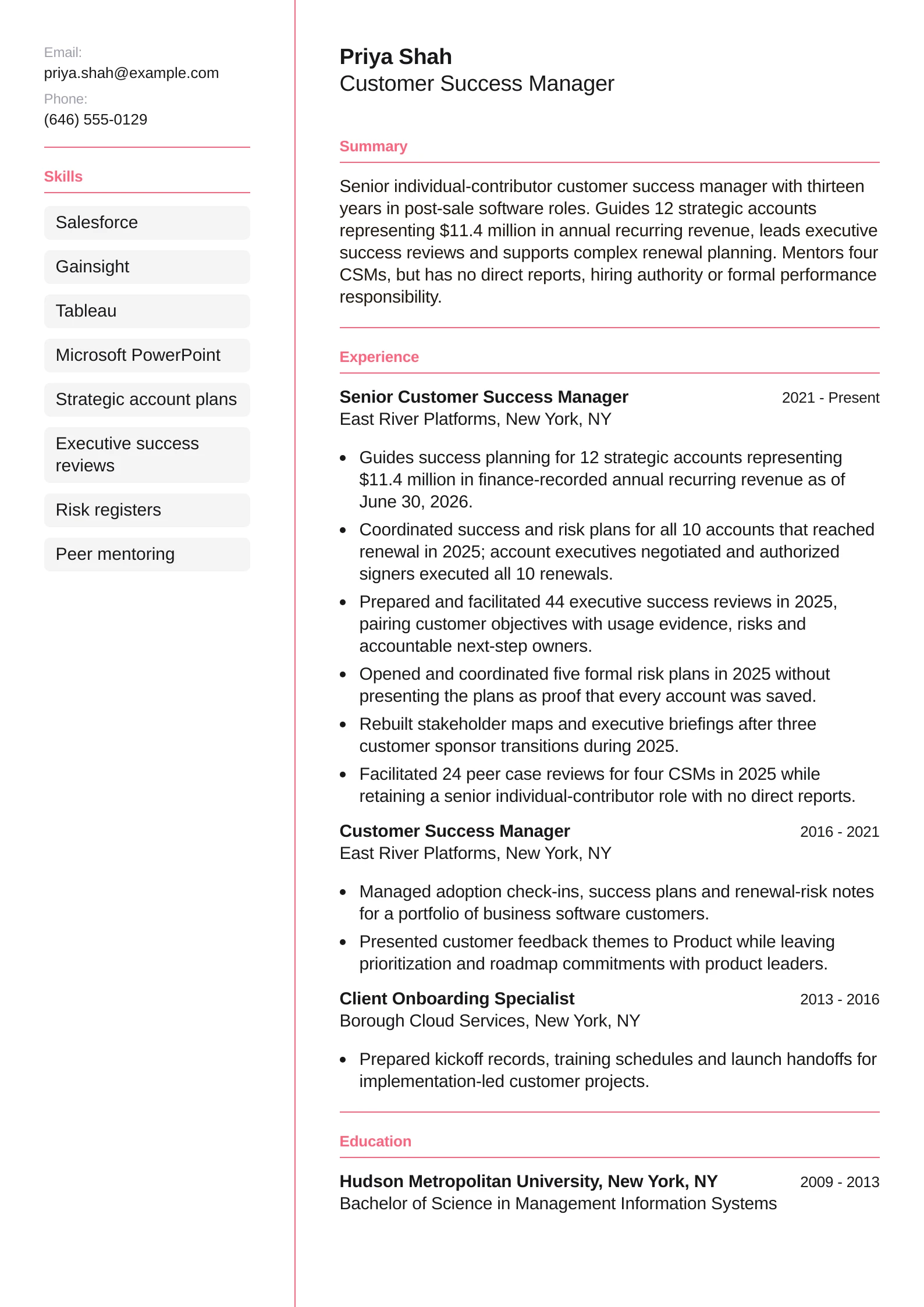
Account count tells only part of Priya’s story. She manages 12 strategic accounts and leads executive success work as a senior individual contributor; 44 reviews, five risk plans and three sponsor transitions reveal the complexity. Four CSMs appear as peers in the mentoring bullet, preserving the line between senior influence and hiring or performance authority.
Uses strategic complexity, not account volume alone, to show senior scope.
Keeps executive facilitation and peer mentoring distinct from formal authority.
Mid-Market SaaS Customer Success Manager Resume Example
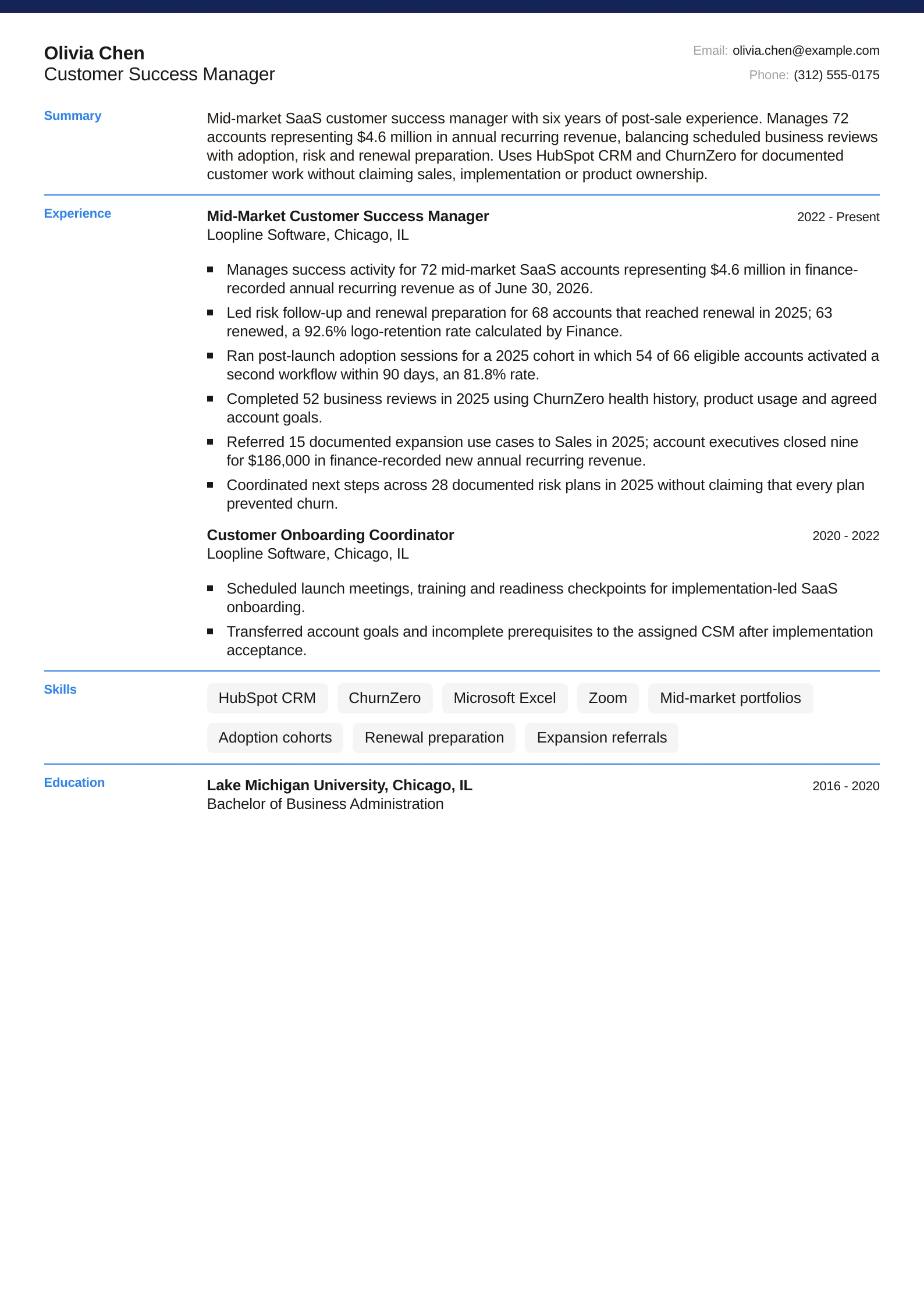
For a repeatable, moderately high-touch SaaS book, Olivia is the closest model here. She balances 72 mid-market accounts with scheduled reviews, adoption sessions and documented risk plans. The activation rate covers 66 eligible accounts over 90 days, while Finance and Sales remain the owners named on renewal and expansion outcomes.
Defines the adoption cohort before stating the rate.
Connects expansion discovery to Sales without claiming the close.
Enterprise Customer Success Manager Resume Example
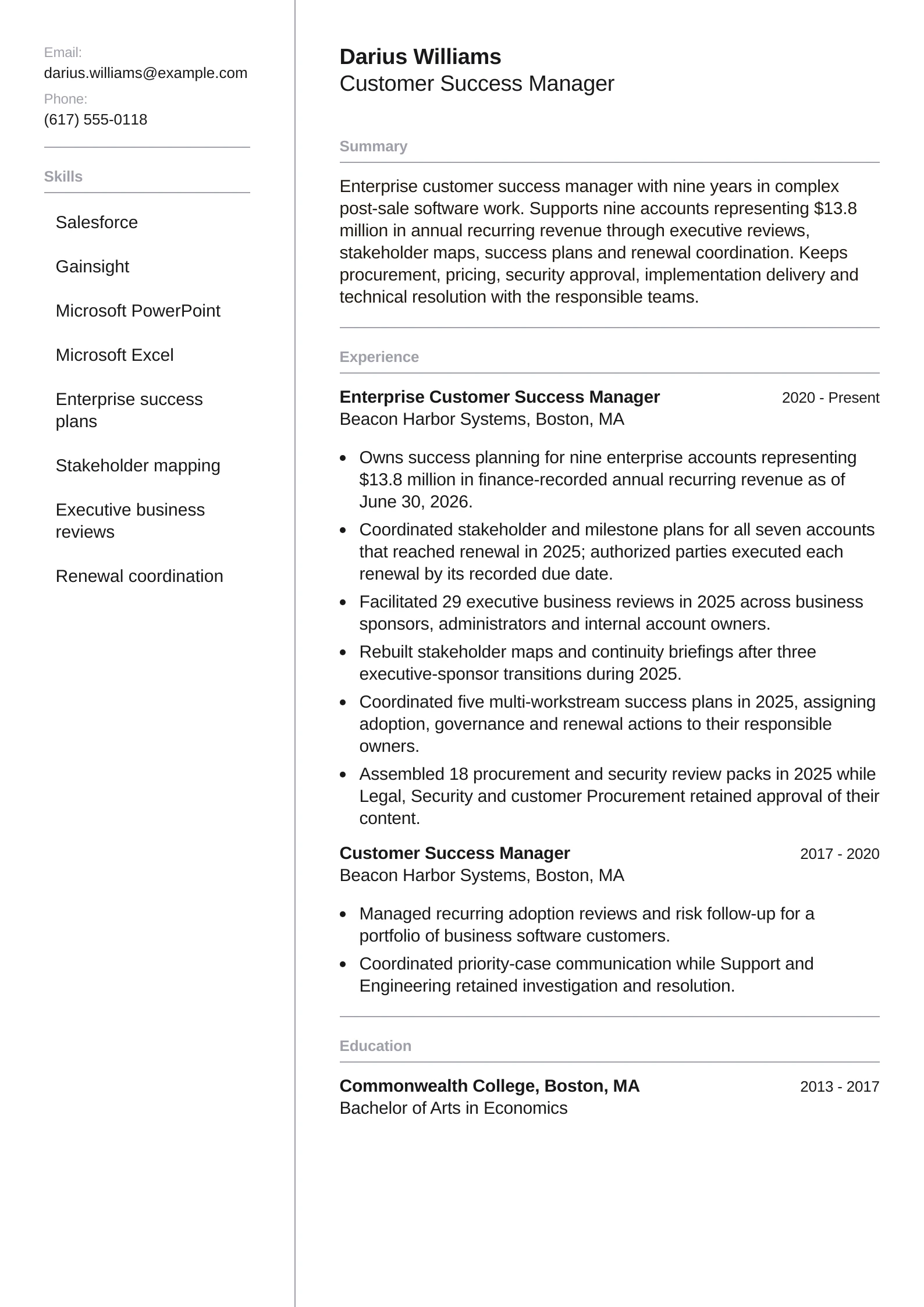
Nine enterprise accounts give Darius plenty of complexity to show. Together they represent $13.8 million in recorded ARR and require executive reviews, sponsor transitions, multi-workstream plans and procurement or security packs. The structure makes that complexity visible. He coordinates renewals; Legal, Procurement, Account Executives and authorized signers retain negotiation and approval.
Shows enterprise complexity through stakeholders, reviews and governance.
Names every commercial and security approval owner.
Scaled Customer Success Manager Resume Example
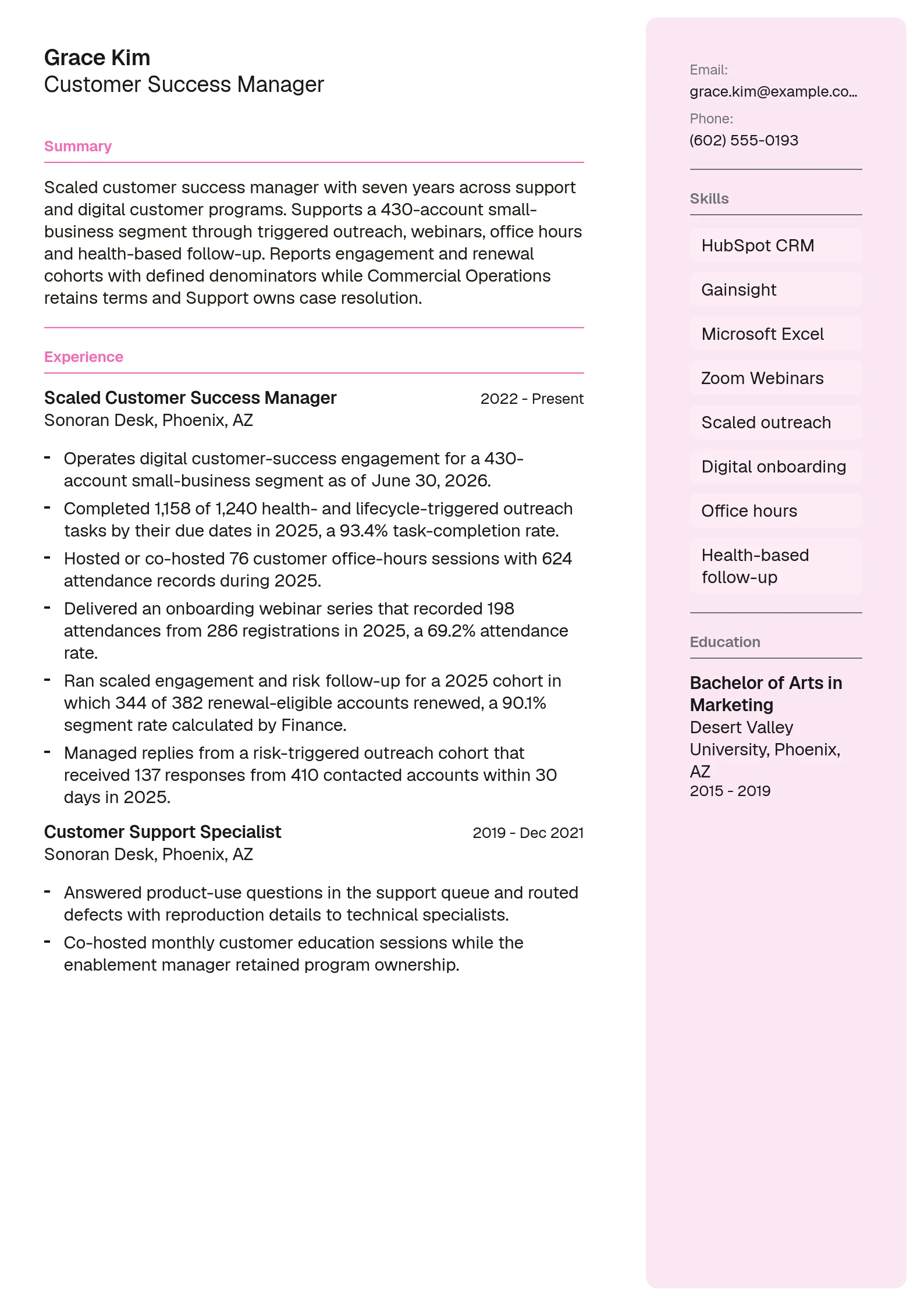
A 430-account segment changes both the cadence and the proof. Grace uses triggered outreach, webinars and office hours, then reports tasks, registrations, attendances, replies and renewals as clearly separate measures. Customer Success Operations owns the automation rules, Commercial Operations handles terms and Finance calculates retention from the defined annual cohort.
Uses high-volume program evidence instead of pretending every account is high touch.
Keeps engagement, response and renewal measures separate.
Technical Customer Success Manager Resume Example
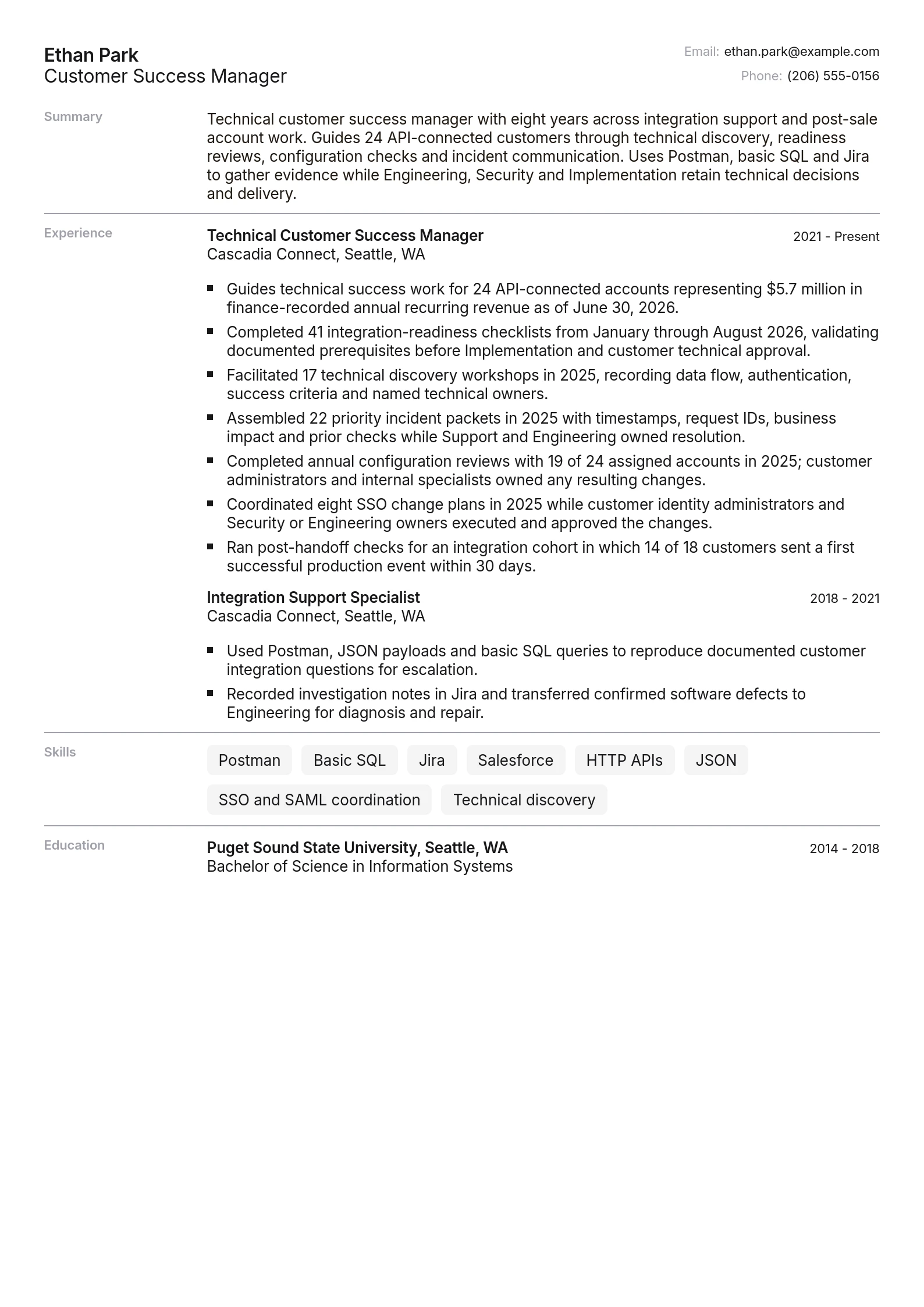
Ethan can discuss every technical item on his resume: API discovery, readiness checklists, Postman, JSON, basic SQL, incident packets and SSO change plans. Configuration belongs to Implementation, customer administrators approve their environment, and Support, Security or Engineering resolve and authorize technical changes. The detail shows technical fluency without borrowing another team’s authority.
Connects technical tools to observable account work.
Separates evidence gathering and coordination from engineering and security decisions.
Choose by portfolio model before you copy a bullet
Start with the work that fills your week. Nadia is the broad model, combining success plans, adoption follow-up, business reviews and renewal preparation. Samantha is aiming for a first CSM role, so her resume keeps support and account coordination in their real lanes. Mateo and Priya show two kinds of experience: a larger established book and a smaller strategic portfolio with more executive complexity.
Segment names become useful when they change the operating rhythm. Olivia’s 72-account mid-market book allows scheduled reviews and adoption work at a repeatable cadence. Darius has only nine accounts, but each requires stakeholder maps, governance and formal procurement or security steps. Grace uses digital programs for 430 accounts. Ethan works with 24 API-connected customers and spends more space on technical evidence and handoffs.
Impressive-looking numbers are a poor reason to choose an example. Pick the nearest account count, customer type, renewal role and level of technical work, then rewrite the summary, first three bullets and skills from your own records. If Account Manager, Implementation Manager, Technical Account Manager or Support Manager better describes the center of your job, use that occupation’s dedicated page.
A title alone may hide a meaningful difference. Some employers ask a CSM to negotiate renewals; others assign pricing and contracts to Sales or Commercial Operations. Some CSMs guide implementation, while a separate delivery team owns configuration. Before adapting a bullet, mark the work you personally did, the outcome owner and the person who approved the final decision.
Show the customer lifecycle through records
A strong experience section lets the reader follow customer work from goals to evidence. Open with the assigned portfolio and customer segment, then show the mechanisms that shaped the role: success plans, adoption reviews, health or risk notes, business reviews, renewal preparation, feedback and escalation. Not every job needs every mechanism.
Success plans are useful when the bullet names what they contained. Customer objectives, milestones, evidence, risks and accountable owners are clearer than managed strategic success plans. Priya’s five multi-workstream plans separate adoption, governance and renewal actions. Darius uses similar structure with enterprise stakeholders. In both cases, the plan coordinates work rather than proving every customer outcome occurred.
Adoption needs an event and a population. Nadia’s second-workflow metric covers 38 eligible accounts and a 120-day window. Olivia uses 66 eligible accounts and 90 days. Those details tell a reader what activation means. A count of training sessions or logins can still work, but do not relabel attendance as adoption when the product record does not show qualifying use.
Business reviews deserve more than the acronym QBR. Name the audience, evidence and decision the meeting supported. A review might pair customer goals with usage, outstanding risk and next-step owners. Enterprise reviews may add executive sponsors, procurement milestones or several business units. Record the actual cadence instead of writing quarterly when meetings were scheduled differently.
Health scores and risk flags are internal signals, not outcomes. Explain what you did when a signal appeared: reviewed usage, checked open support cases, contacted the sponsor, opened a risk plan or routed a blocker. Keep the scoring method with Customer Success Operations or the system owner unless you designed and governed it yourself.
Build every customer-success metric from a record
The best starting point is a source you can still inspect. CRM assignment reports can establish account count and portfolio ARR. Contract records define a renewal cohort; product analytics define activation. Calendars and completed-activity reports support business-review counts, while support logs establish escalation volume. The resume should state what the record contains, even when memory offers a stronger-sounding result.
Add a period that fits the measure. Portfolio size and ARR usually need a snapshot date because assignments change. Renewal and expansion rates need a closed cohort such as calendar 2025. Adoption needs a starting event and observation window. A rolling health score needs its measurement date. Without time, the number may look current long after the underlying book changed.
Write the denominator before calculating a rate. Nadia’s 92.3% logo-retention rate is 36 renewed accounts divided by 39 that reached renewal during 2025. It is not 36 divided by all 46 accounts in the June 2026 book. Grace’s webinar rate is 198 attendances from 286 registrations, while her 624 office-hours figure counts attendance records rather than unique people.
Use the company’s defined measure and label it correctly. ARR is contract value recorded under the company’s rules. Logo retention counts accounts, not dollars. Gross revenue retention, net revenue retention, churn, expansion and renewal rate have different numerators and denominators. If you cannot reconstruct the calculation, use a narrower count such as accounts reviewed, risk plans opened or referrals accepted.
ROI and satisfaction require the same care. A customer presentation may contain an approved ROI calculation, but that does not mean the CSM created all of the value. NPS and CSAT need a survey period, population and response basis. Leave either result out when you cannot explain the underlying record and your contribution without guessing.
Keep the denominator and contribution boundary together
A useful CSM metric names what was counted, when it was counted and which part of the result belongs to the candidate.
Source record
Resume-ready evidence
Boundary to preserve
CRM portfolio snapshot
Assigned accounts and finance-recorded ARR on a named date
Portfolio work is not personal sales or revenue recognition
Executed-renewal cohort
Renewed accounts divided by accounts that reached renewal in the same period
Success planning is separate from negotiation and signature
Product adoption cohort
Eligible accounts completing a defined event within a stated window
Enablement does not prove sole causation
Business-review register
Completed reviews with audience and period
Meeting facilitation is not executive decision authority
Support escalation log
Priority cases coordinated and business impact documented
Communication is not technical resolution
Expansion referral report
Accepted referrals and any later Sales-closed outcome
Discovery and referral are not negotiation or close
Webinar or office-hours export
Registrations, attendances or replies with the right denominator
Engagement is not automatically adoption or retention
Separate customer ownership from commercial authority
Own the customer relationship leaves too much unanswered. One CSM may run success planning and renewal forecasting while an Account Executive negotiates pricing. Another may prepare a proposal and discuss terms inside a published band. A third may handle the full renewal motion. The useful resume claim is the action your employer assigned, rather than the broadest version found in a posting.
Renewal work can include identifying risk, confirming goals, building a timeline, validating contacts, forecasting status, preparing internal notes, discussing commercial options, negotiating terms, routing legal language and securing signatures. These are different actions. Use the strongest one you performed, then name the next owner when it changes the meaning.
Expansion deserves the same split. Mateo and Olivia identify use cases and refer opportunities. Their Account Executives negotiate and close. The resume can report the later closed outcome because the source connects the accepted referral to the opportunity, but the sentence must not suggest the CSM personally sold or approved it. If your record ends at referral, stop there.
Account ARR is scope, not an achievement by itself. Give the snapshot date and call it assigned or managed portfolio value. Do not imply that you created all revenue in the book. When the company changes account assignments, use the period that your portfolio report covers rather than combining several high-water marks.
Contract language is especially sensitive. Partnered with Legal on a renewal means something different from approved terms. Coordinated procurement means something different from signed the agreement. Keep Legal, Finance, Procurement, Account Executives and authorized signers visible wherever they retain the decision.
Write technical customer success without borrowing another team’s work
Artifacts and handoffs are what make technical CSM work credible. Ethan uses readiness checklists, discovery notes, incident packets, configuration reviews and SSO change plans. APIs, JSON, Postman and basic SQL all appear inside clearly defined tasks. The reader can see genuine technical work without mistaking evidence gathering for software engineering.
Separate implementation from post-launch success. A CSM may schedule milestones, validate prerequisites, lead adoption sessions or coordinate customer owners. Implementation or Professional Services may still configure the system, manage the project plan and obtain acceptance. If you personally delivered configuration, state the platform, scope and approval path from a real record.
Support response and technical resolution also differ. Samantha has a first-response metric from her earlier Support role. Nadia and Mateo coordinate priority escalations as CSMs. Ethan assembles reproducible evidence and communicates status. In each case, Support or Engineering retains diagnosis, code changes, incident closure and technical assurance.
Product feedback is not roadmap authority. You can describe collecting themes, documenting use cases and presenting evidence to Product. Avoid wrote the roadmap, prioritized features or committed delivery unless your title and records truly support those decisions. A customer promise made without product approval is not a stronger resume bullet.
Security and identity work needs exact verbs too. Coordinated an SSO change, assembled a security review pack and documented authentication requirements are bounded claims. Approved the customer’s security posture, certified compliance or designed the identity architecture require different authority and evidence. Use the technical detail that you can explain without crossing that line.
Make the move into a first CSM role credible
Your real title can stay exactly as it is while the bullets build the bridge. Samantha is a Customer Account Coordinator, preparing for Customer Success Manager work through account context, lifecycle meeting preparation, adoption reporting, risk documentation and cross-functional routing. Her earlier Support role adds written communication, case evidence and service discipline.
Choose transferable work that matches the target posting. Support candidates can use discovery questions, escalation packets, knowledge-base feedback and account context. Account coordinators can use meeting preparation, stakeholder notes, usage reports and renewal timelines. Implementation candidates can use kickoff, readiness, training and handoff records, while keeping delivery ownership accurate.
Do not hide the gap with an inflated summary. Say preparing for a first CSM role, customer-facing professional moving into customer success, or another plain description that matches the facts. Avoid experienced CSM when you have not held the role. Your first bullets should show the customer work already completed and the decisions you are ready to learn.
A metric from support must keep its support meaning. First-response rate is useful evidence of reliability, but it is not retention. Ticket resolution is not product adoption. A renewal-risk summary prepared for a CSM is not renewal ownership. The specificity makes your transition easier to trust because the employer can see both your preparation and your current boundary.
Education can support the story, but it should not carry the whole application. List the degree, diploma or training you actually completed. Product courses and customer-success certificates belong only when you can verify the issuer, title and status. The examples add no certification because the fictional personas do not need one.
Match your evidence to the engagement model
Olivia’s record shows the mid-market rhythm clearly: a 72-account book, 52 reviews, adoption cohorts and expansion referrals. It is repeatable work with scheduled one-to-one touchpoints, not a pooled portfolio. When accounts move by tier or region, name the segment and use a dated book snapshot.
Enterprise work puts more weight on complexity than volume. Darius has nine accounts, but the resume shows executive sponsors, procurement, security, multi-workstream plans and renewal milestones. Priya’s senior-IC example adds sponsor transitions and peer case review. Neither needs a giant account count to communicate scope.
Scaled work uses a different evidence set. Grace reports triggered tasks, webinar registrations, attendance records, office hours and reply cohorts for 430 accounts. Her wording does not imply quarterly reviews with every customer. If automation created the task, credit Customer Success Operations with the rule and describe the outreach or follow-up you performed.
Technical customer success should name integration and incident artifacts. Ethan’s account count is smaller because the work includes discovery, readiness, Postman checks, SSO coordination and incident evidence. Use a Technical Account Manager page instead when deep technical account strategy, service architecture or incident programs are the primary job rather than customer-success outcomes.
Senior does not always mean manager. A senior or principal CSM can own complex accounts, guide executive reviews, mentor peers and improve practice without direct reports. If you did manage a team, give the team size, hiring role, review authority and operating results. Otherwise, keep mentorship and influence in an individual-contributor frame.
Six live first-party postings illustrate these differences rather than setting universal rules. Gainsight’s principal opening combines strategic accounts with peer mentoring, while its manager opening adds direct team leadership and scaled-program signals. Synthesia’s enterprise and strategic CSM openings pair book-of-business work with market-specific language and location requirements; its separate operations director opening owns systems, forecasting and people leadership. DeleteMe adds enterprise procurement, security and escalation coordination. Tailor to the live posting, then verify every borrowed term against your own work.
Use CSM skills where the work proves them
The experience section should earn every item in the skills list. A success-planning bullet can name goals, milestones, risks and owners. Adoption analysis needs a defined product cohort, and renewal forecasting needs a dated status process. Completed business reviews with a named audience give executive communication something concrete behind it.
Connect systems to a workflow. Salesforce or HubSpot can support account assignments, renewal milestones and activity history. Gainsight or ChurnZero can hold health, playbook and success-plan records. Tableau or Excel can support a defined analysis. Postman, JSON and basic SQL belong on Ethan’s resume because the bullets show how he used them.
Do not copy a software list from the job advertisement. A posting may name the employer’s own product, a customer-success platform, AI tooling or industry systems. Add a tool only when you used it and can explain the account task, report or decision it supported. None of these fictional resumes claims AI-tool experience because no persona ledger supports it.
Use relationship terms precisely. Customer sponsor, administrator, Account Executive, Implementation Consultant, Support, Engineering, Product, Legal, Finance, Procurement and Customer Success Operations each signal a different handoff. Partnered with is useful only when the rest of the bullet says what you contributed and what the partner owned.
Tailor the first half first. Match the real target title, adjust the summary for its segment and reorder the first three bullets around the posting’s core work. Then tighten the skills list. Keep your original employer titles, metrics and authority boundaries even when the new employer uses different language.
Keep the summary and format proportional to the evidence
In two or three sentences, a CSM summary should reveal the length of your relevant experience, the portfolio or customer model you know, the post-sale mechanisms you can prove and any authority boundary that changes the story. Results-driven, customer-obsessed and trusted advisor add little unless the next line supplies evidence.
Lead the experience section with current scope and the strongest relevant record. For a broad CSM, that may be assigned accounts and ARR followed by renewal and adoption cohorts. For a first-role applicant, lead with supported customers, meetings and risk records. For a technical CSM, put integrations, readiness and incident evidence before a generic relationship bullet.
One page may work for Samantha or another focused early-career candidate. Two pages can be reasonable for Priya or Darius when the extra space contains relevant progression, strategic scope and distinct evidence. Remove repeated relationship language before shrinking the type. A senior title does not justify a second page by itself.
Use familiar headings, reverse chronology and month-and-year dates. Keep promotions as separate roles so outcomes stay in the right period. Export to PDF and confirm the text can be selected in reading order. The code-rendered examples provide the visual model here, but your own file still needs a final text and layout check.
List education and credentials exactly as recorded. The reviewed postings vary in experience and product expectations, so this page does not invent a universal degree or certification rule. Do not turn a vendor course into a professional license or add a badge you have not completed.
Before sending, trace every number to its source and check the numerator, denominator, period and portfolio owner. Read each renewal, expansion, technical and people-leadership verb again. The resume is ready when a reader can tell what you did, what changed, what was measured and who made the final decision.
Open four records before you submit
Check a current portfolio export, one closed cohort, a completed customer activity and an authority source such as the renewal process or escalation policy.
Top tip
Confirm that account count and ARR share a snapshot date. Recalculate the renewal or adoption denominator. Match the meeting, risk or escalation count to a completed record. Then make sure pricing, signature, implementation, resolution, product and people decisions still belong to the correct owner. Remove anything you cannot explain from the source.
Customer Success Manager resume questions
Use these answers for the last factual and editorial pass.