Compare 21 tutor resumes covering first jobs, campus and volunteer work, learning centers, independent clients, adult education and program leadership. Pick the version that fits your actual role, then improve yours with specific session evidence, careful progress language and exact education or training labels.
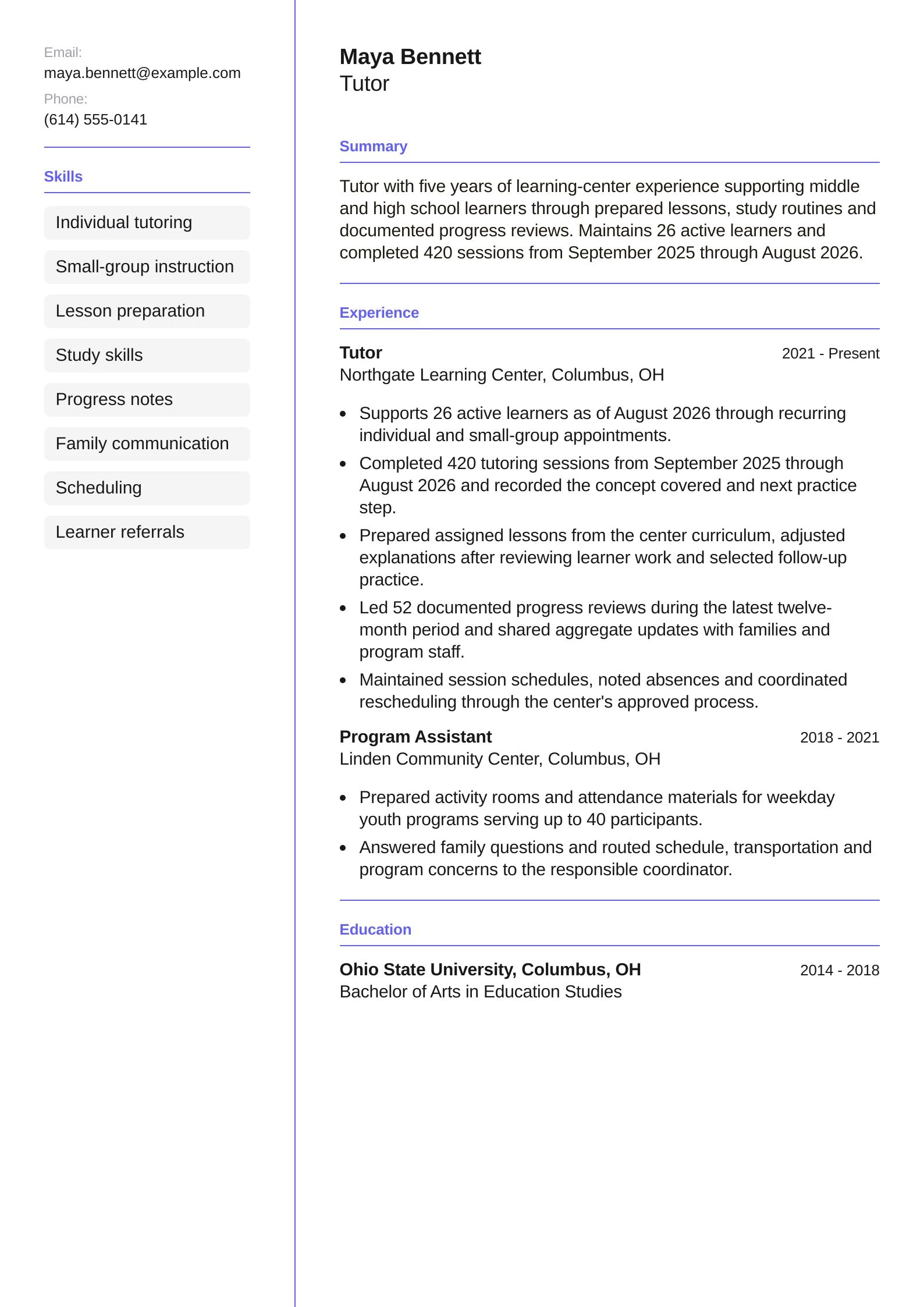
Maya is a useful starting point for an experienced tutor with a steady learner list. Her resume gives the work a clear size: 26 active learners, 420 completed sessions and 52 progress reviews. It also covers preparation from supplied materials, study routines and the notes that guide the next appointment. Her numbers describe her work without making her responsible for every learner grade.
Pick another example when the working arrangement changes. A student needs enrollment and campus hours to make sense immediately. A freelancer has client records and invoices to explain. School, test-prep, adult-education and lead roles each leave a different trail of evidence. Matching that trail is more useful than copying facts from someone who happens to teach the same subject.
Compare 21 tutor resume examples
Start with the person whose working week looks most like yours. Experience level matters, but so do the setting, employment relationship, usual group size and amount of responsibility. These examples are different jobs and career stories, not one resume with the subject line swapped.
Every person, employer and figure is fictional. Use the structure, then replace each date, subject, tool and measure with evidence from your own record that you could explain in an interview.
Entry-Level Tutor Resume Example
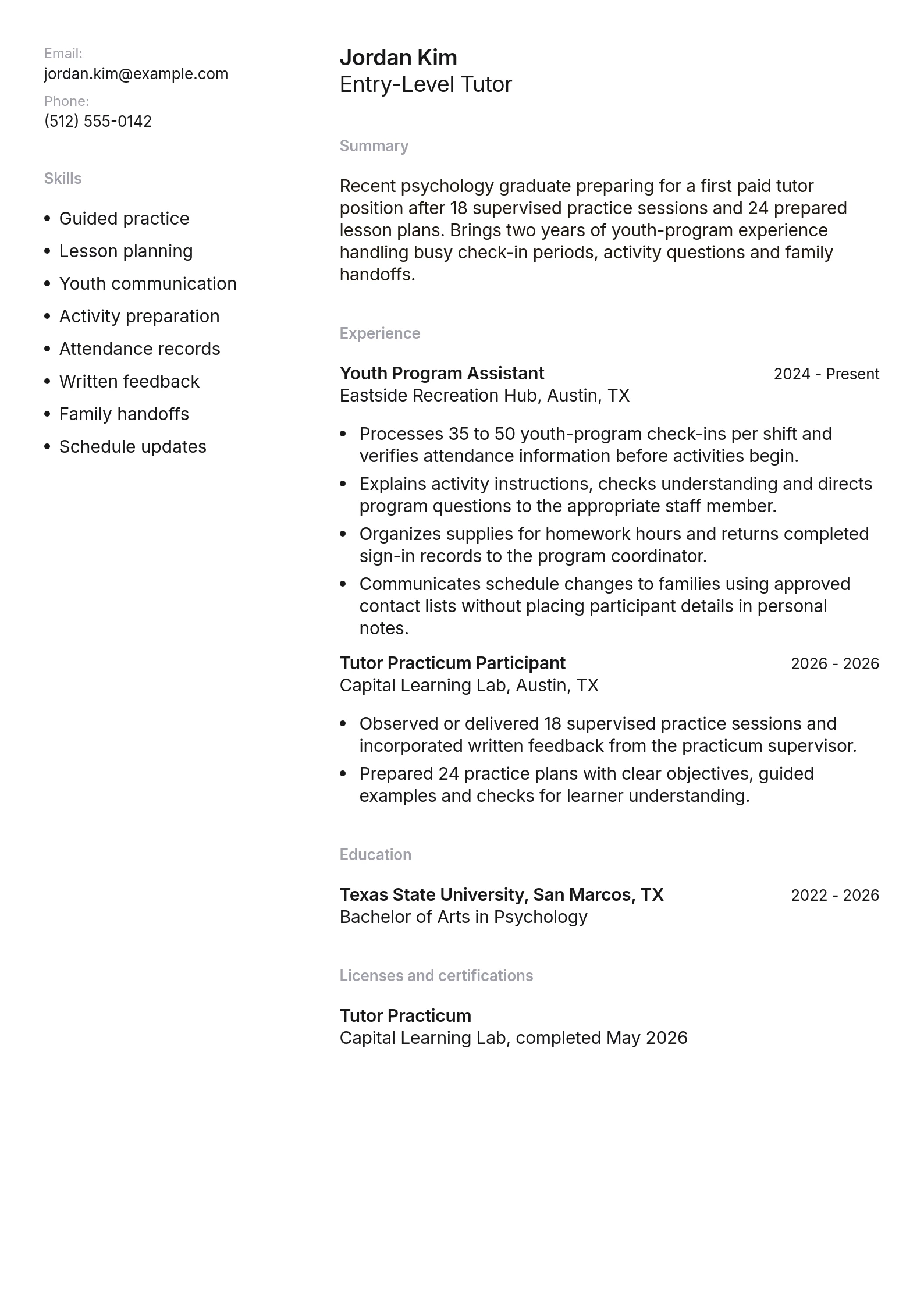
Jordan is applying for a first paid tutor job, and the resume is candid about the preparation behind it. The evidence comes from 18 observed or supervised practice sessions, 24 prepared plans and youth-program shifts with 35 to 50 check-ins. His practicum is not presented as employment. This order works when preparation and service experience carry the application.
Keeps supervised practice in its proper place.
Builds the application around preparation and youth communication.
Student Tutor Resume Example
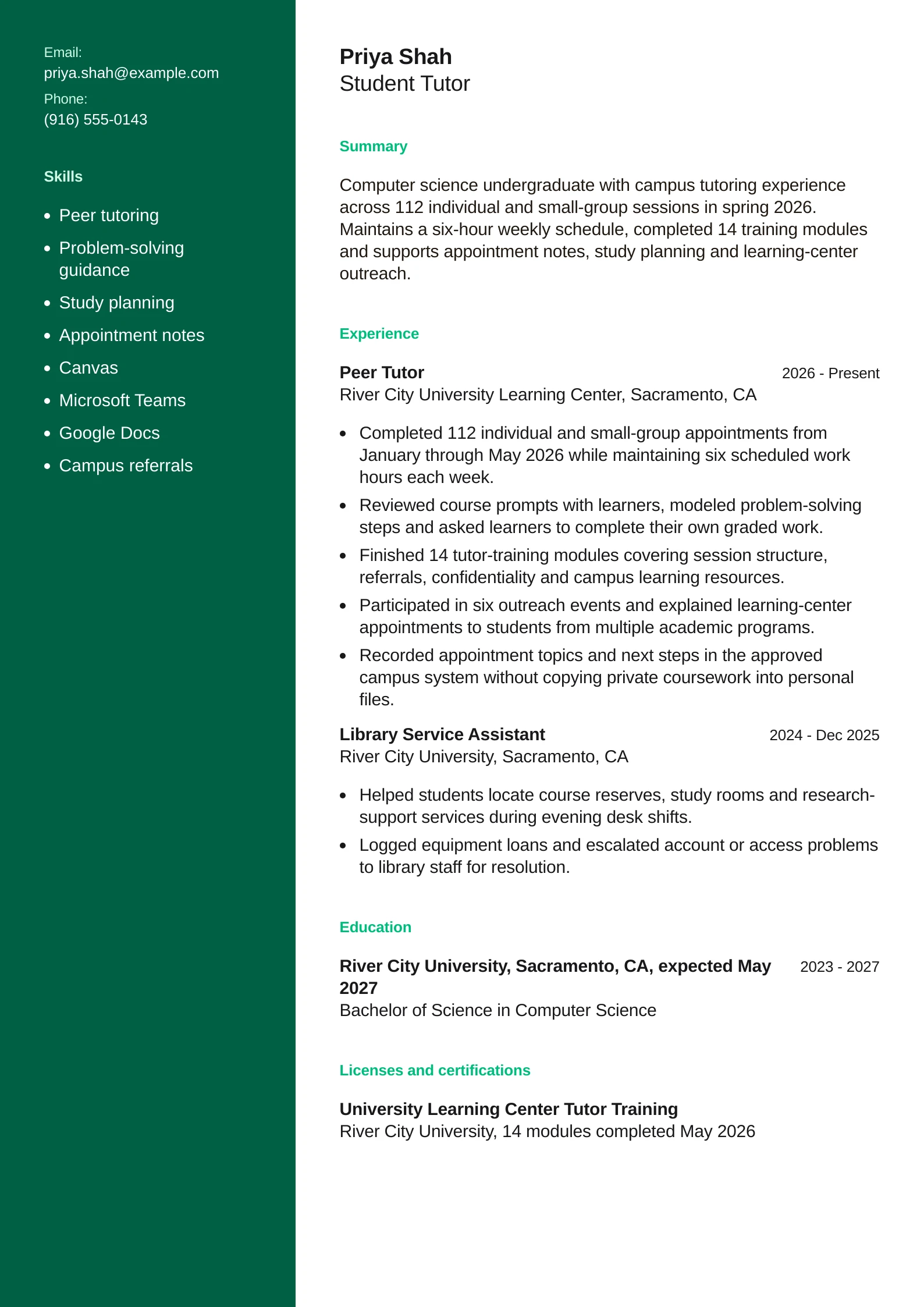
Priya is still an undergraduate, so expected May 2027 belongs beside the degree. Her campus tutoring already has enough detail to stand on its own: 112 sessions, six scheduled hours each week, 14 training modules and six outreach events. A current student can follow this structure to keep paid work, institution-issued training and unfinished education distinct.
States the expected degree date plainly.
Places campus appointments, training and outreach in context.
Freelance Tutor Resume Example
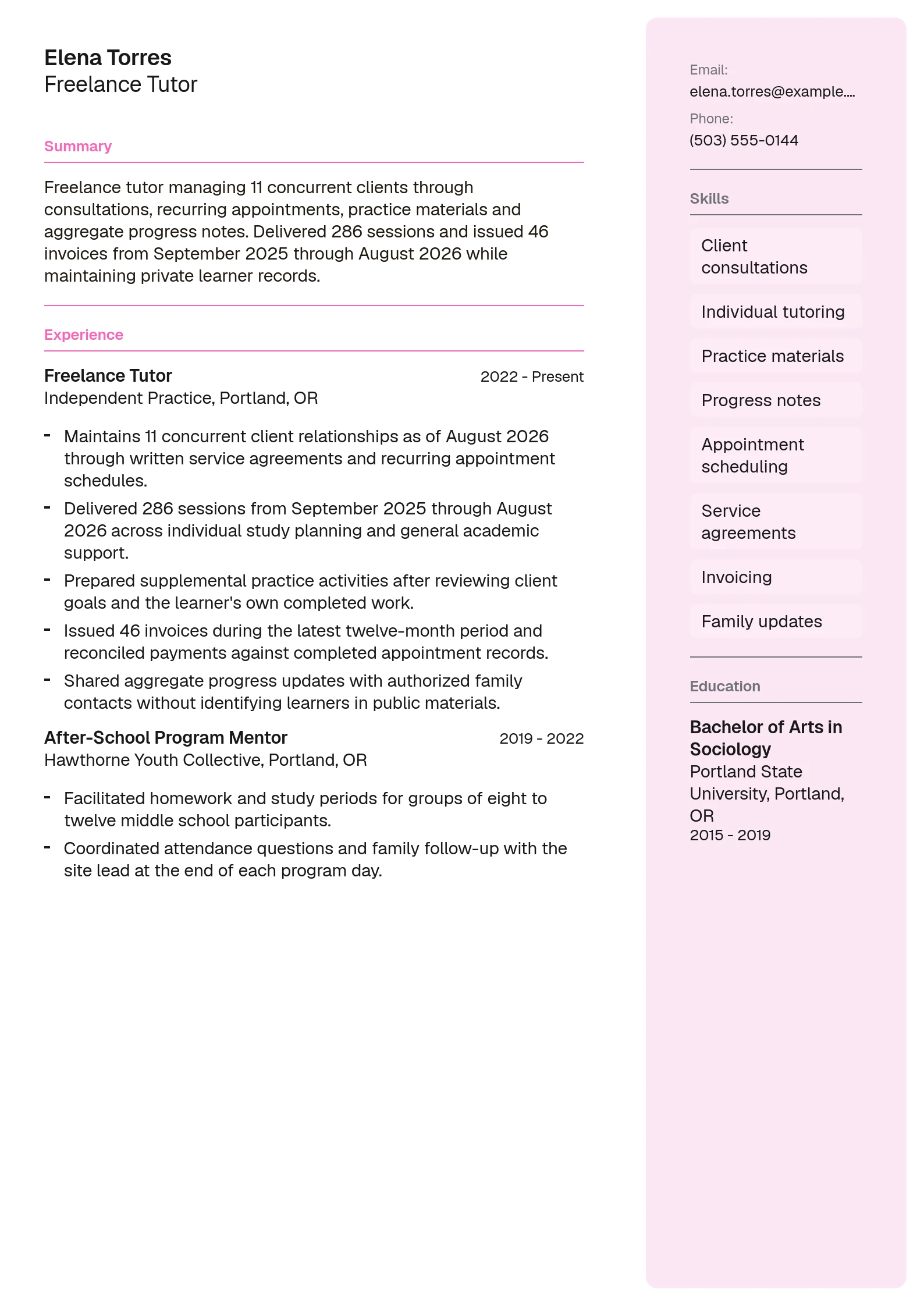
Elena's freelance entry has the records that make independent work easy to understand: 11 concurrent clients, 286 completed sessions and 46 invoices. Intake, written service agreements and scheduling explain the practice; aggregate progress notes describe the tutoring without naming a learner or family. For an independent tutor, both sides of that record deserve room.
Establishes freelance scope with clients, sessions and invoices.
Uses aggregate records to protect learner identities.
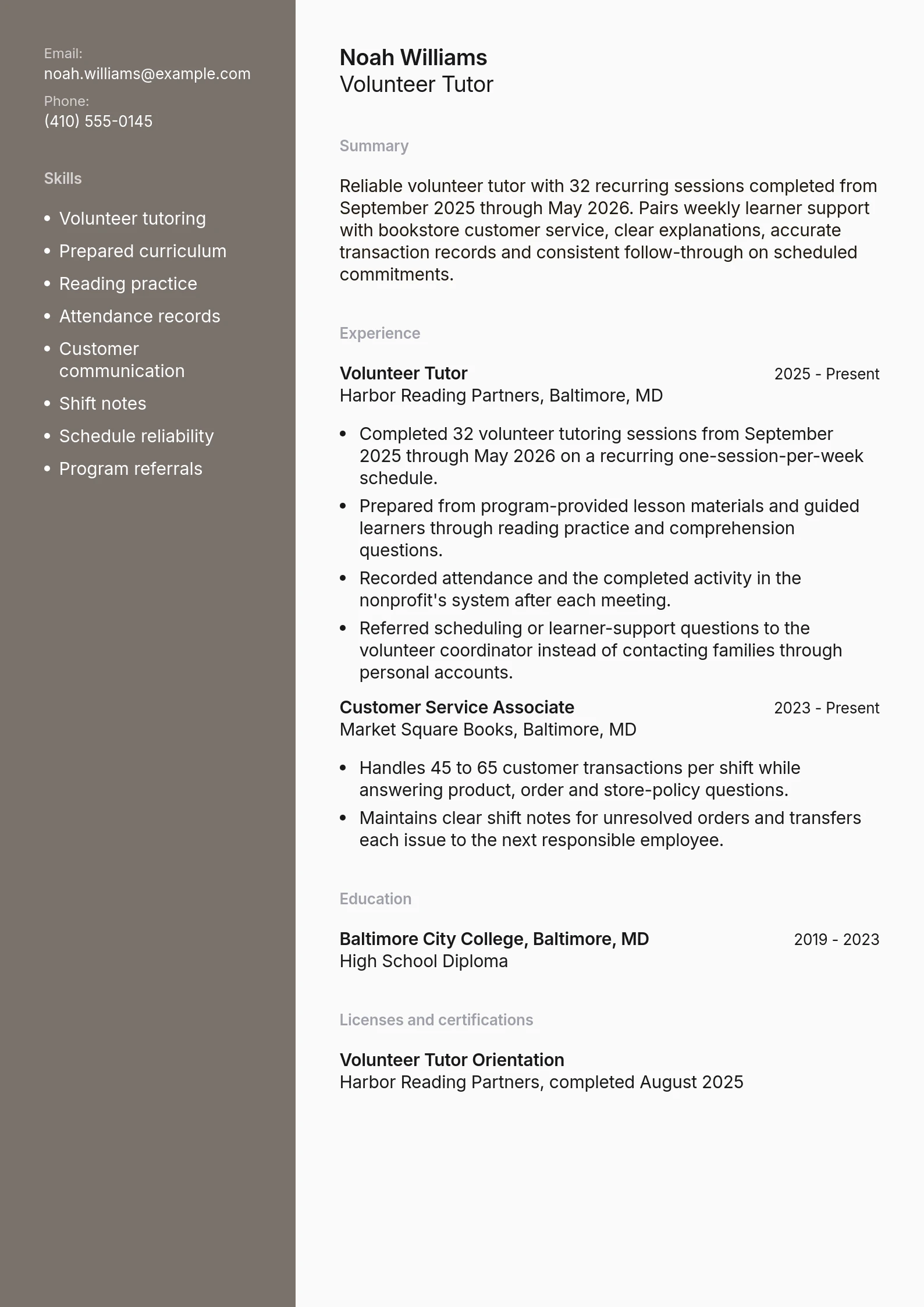
Volunteer Tutor Resume Example
Noah has a real tutoring record, but it is volunteer experience: 32 sessions on a recurring weekly schedule. His paid bookstore role adds 45 to 65 customer transactions per shift and evidence of calm public-facing service. The two entries support a first tutoring application without turning unpaid work into employment or attaching an academic outcome to it.
Separates recurring volunteer service from paid work.
Uses schedule reliability and customer volume as supporting evidence.
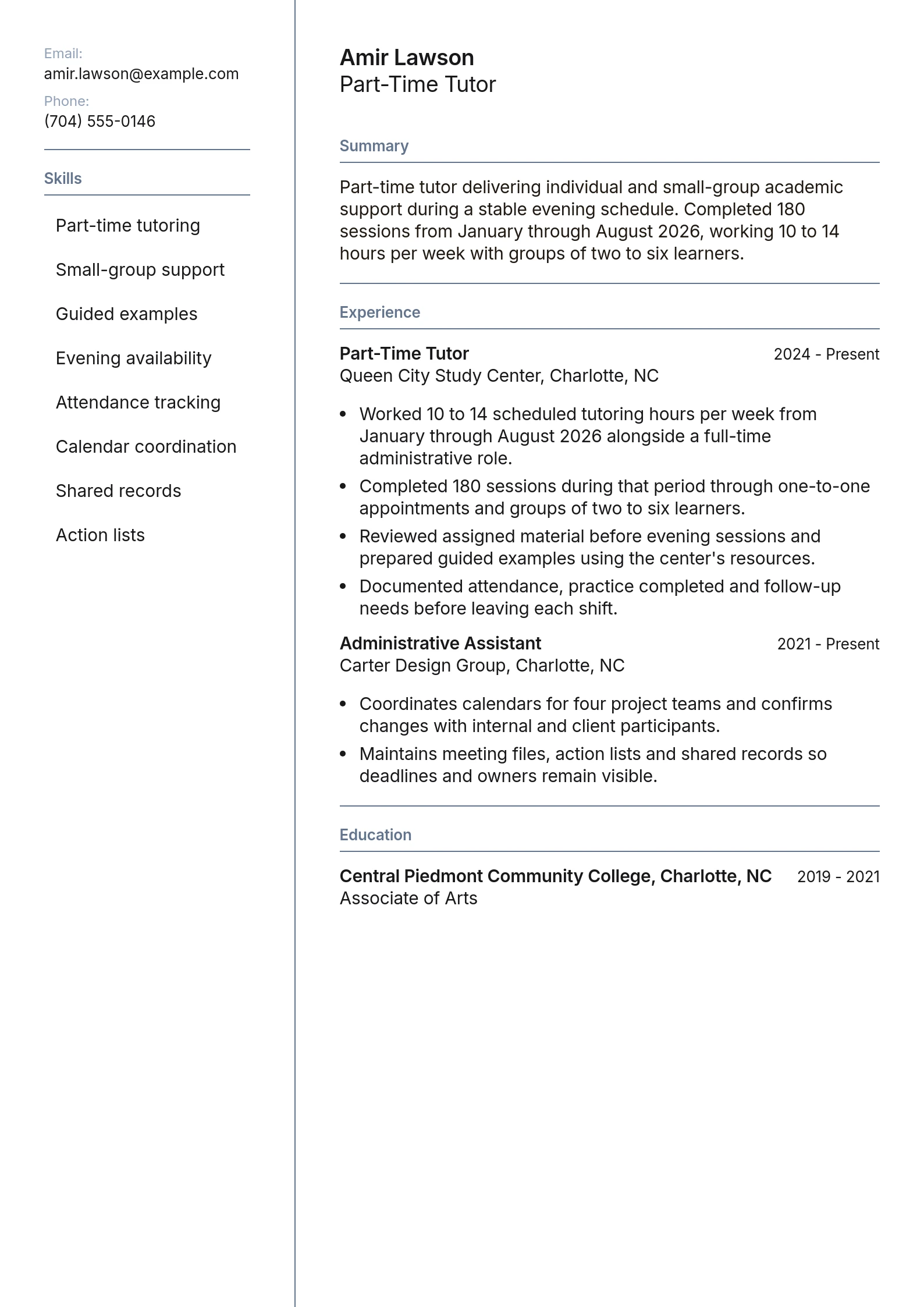
Part-Time Tutor Resume Example
Two current jobs can look confusing unless the dates and schedules are plain. Amir gives each role its own entry, then defines the tutoring with 10 to 14 scheduled hours a week, 180 completed sessions and groups of two to six. The range records work he already did; it does not promise that another employer will assign those hours.
Makes concurrent roles easy to follow.
Reports the schedule as a historical range, not a future guarantee.
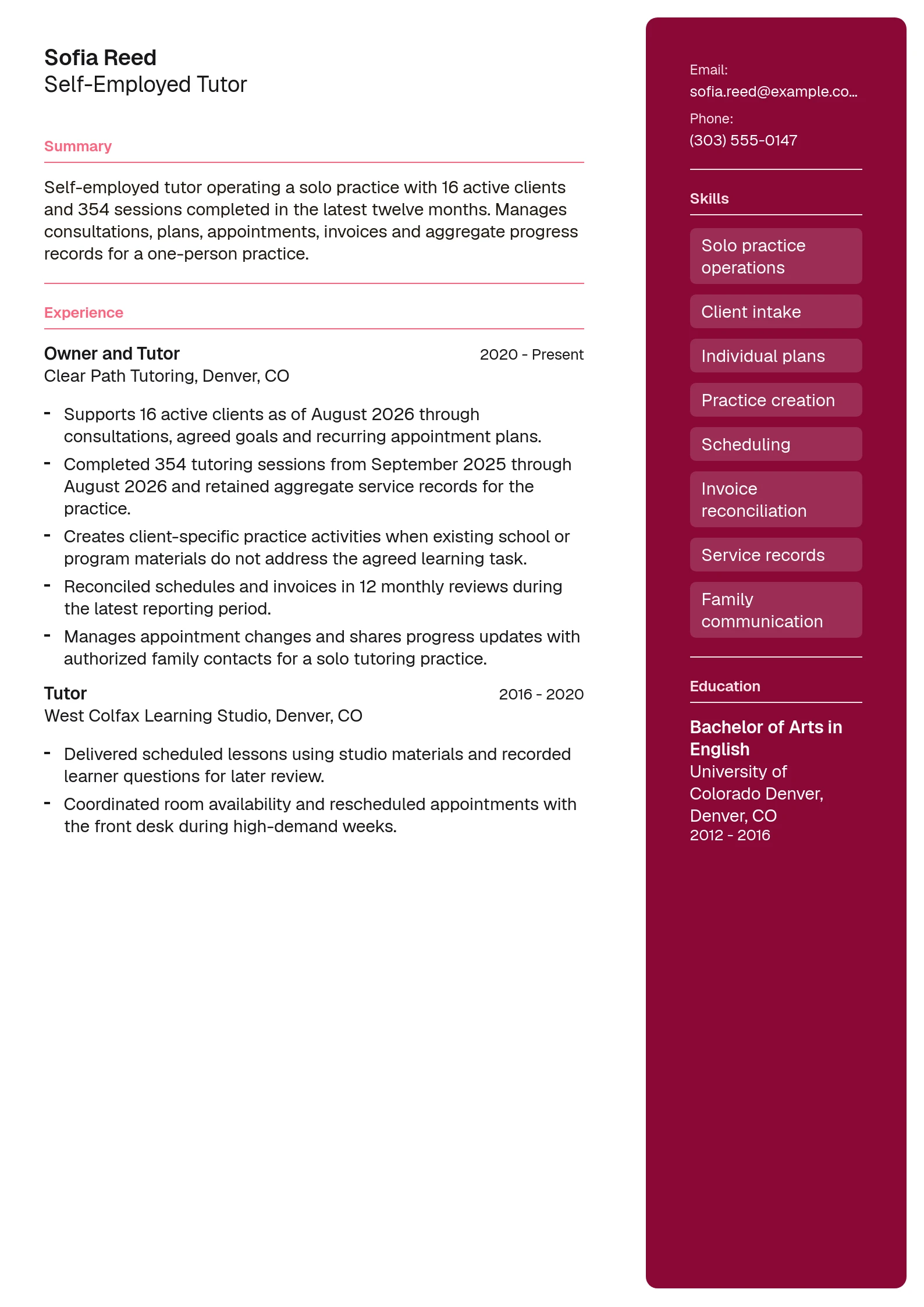
Self-Employed Tutor Resume Example
Sofia's one-person practice includes 16 active clients and 354 completed sessions. Her entry gives consultations and instruction room, then shows appointment changes, records, invoices and 12 monthly reconciliations. Owner and Tutor fits the work she actually does. It does not imply employees, premises or a large budget, and the resume never tries to make the practice look bigger.
Gives instruction and solo-practice administration equal credibility.
Keeps staff, revenue and company-size claims out.
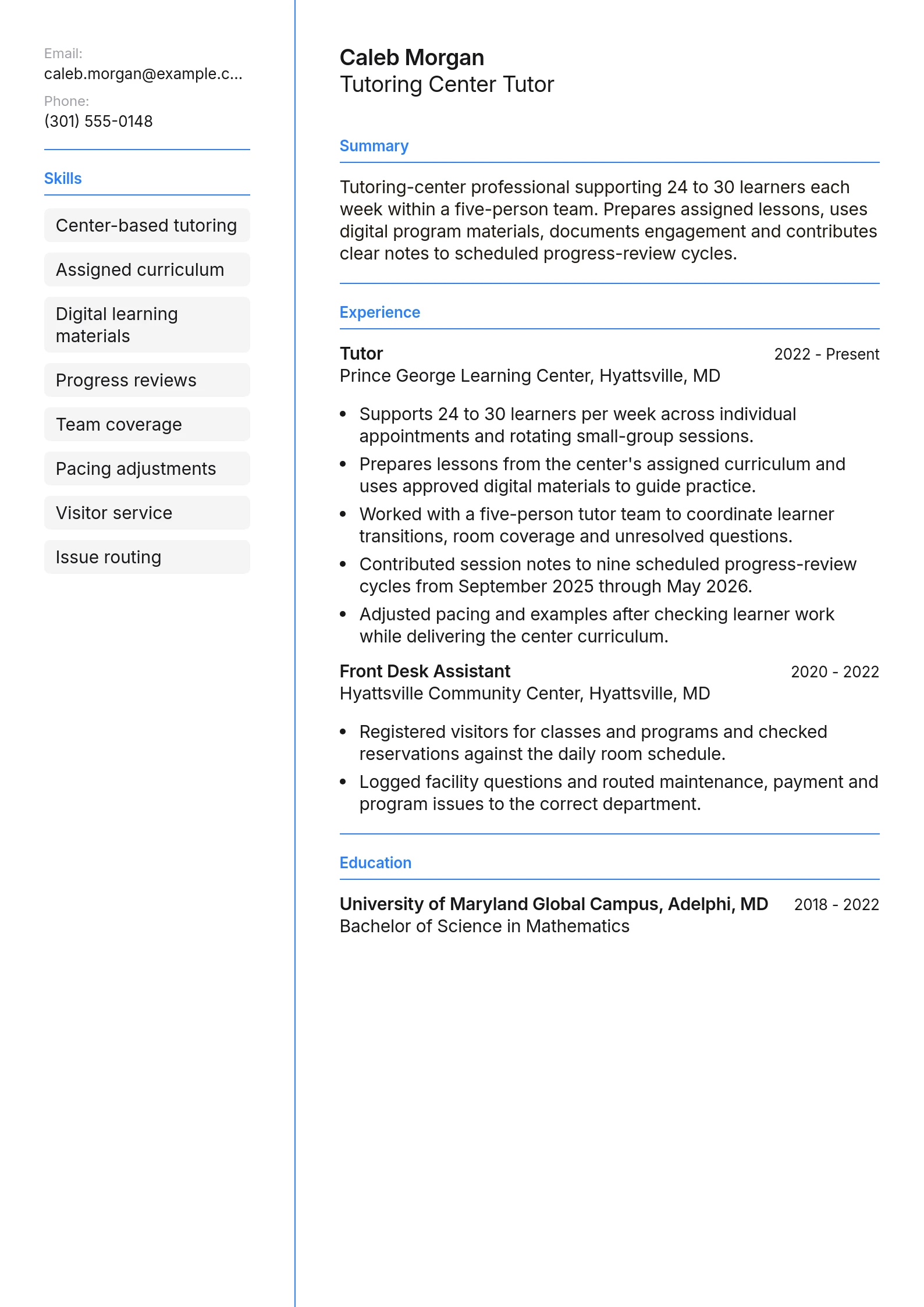
Tutoring Center Resume Example
Caleb works with 24 to 30 learners each week on a five-person center team. He prepares assigned lessons, uses the center's digital materials and contributes notes to nine scheduled review cycles. The delivery decisions are his; the curriculum is the center's. That distinction makes this example useful for tutors who teach from a program rather than writing it.
Credits the center for its curriculum.
Connects learner volume with team delivery and review work.
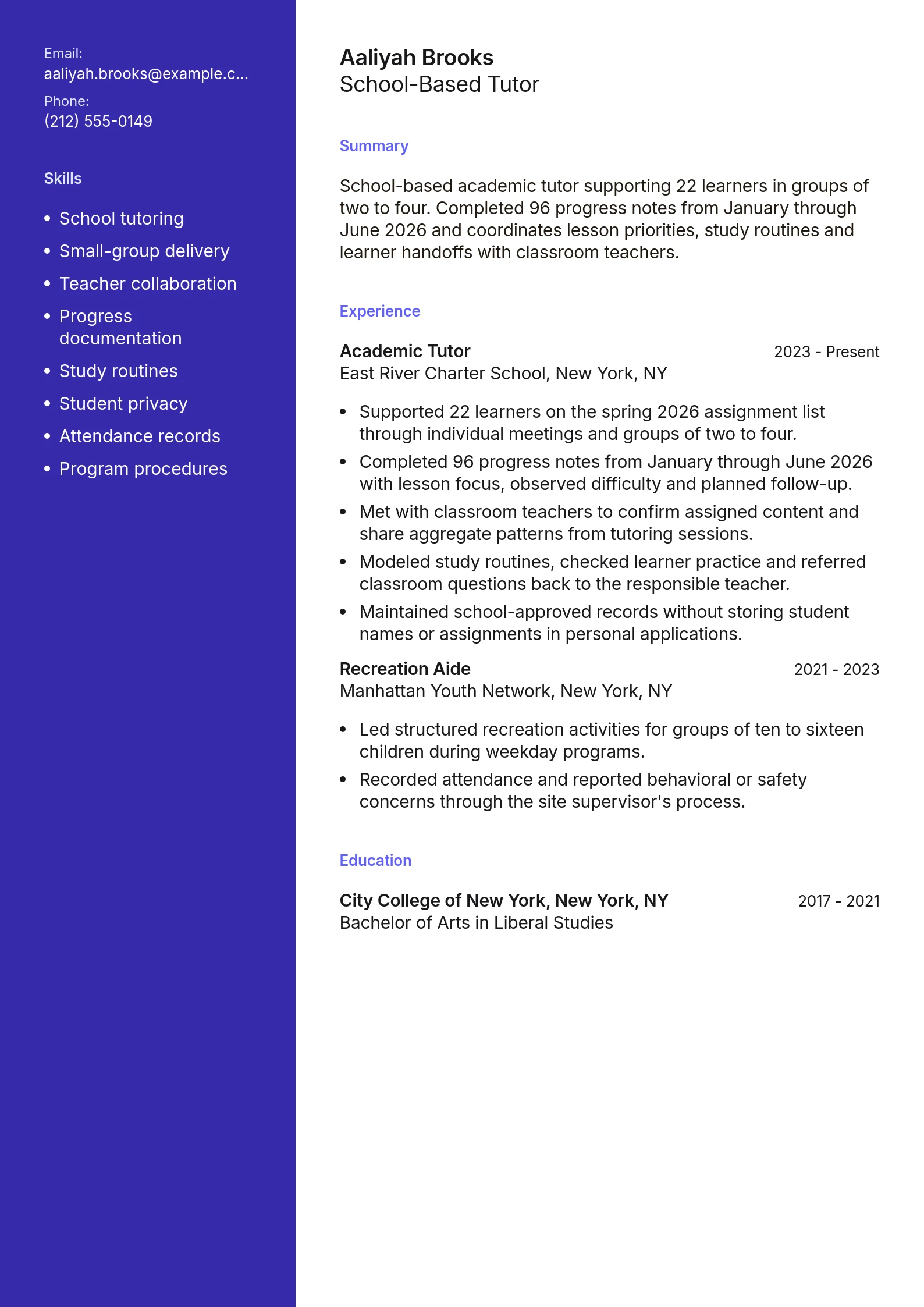
School-Based Tutor Resume Example
Aaliyah's school-based work is easy to picture: 22 learners in spring 2026, groups of two to four and 96 completed progress notes. Teacher planning meetings show how tutoring connects with the classroom, while study-routine bullets keep her own work visible. She does not hold a teaching-assistant credential in this fictional record, so the resume leaves it out even though one employer may prefer it.
Shows the teacher handoff as part of the job.
Leaves out a credential the candidate does not hold.
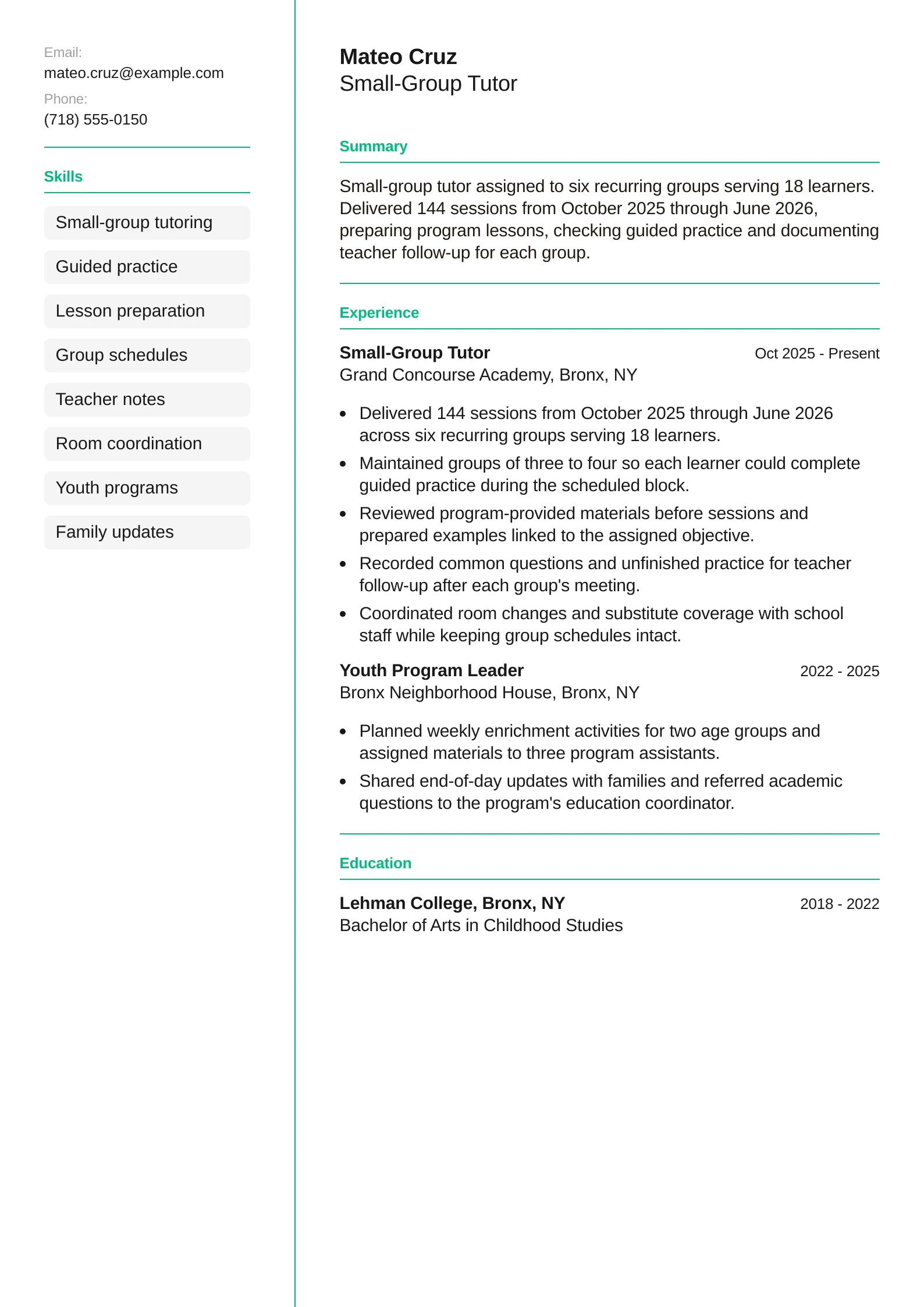
Small-Group Tutor Resume Example
Mateo's schedule is built around six recurring groups serving 18 learners, with three to four people in each group. He completed 144 sessions during the school year and prepared from lessons supplied by the program. Those records explain the job without a vague success claim. The model fits tutoring where group rhythm, preparation and teacher handoffs matter.
Makes the recurring group structure immediately clear.
Uses session records instead of claiming a learner outcome.
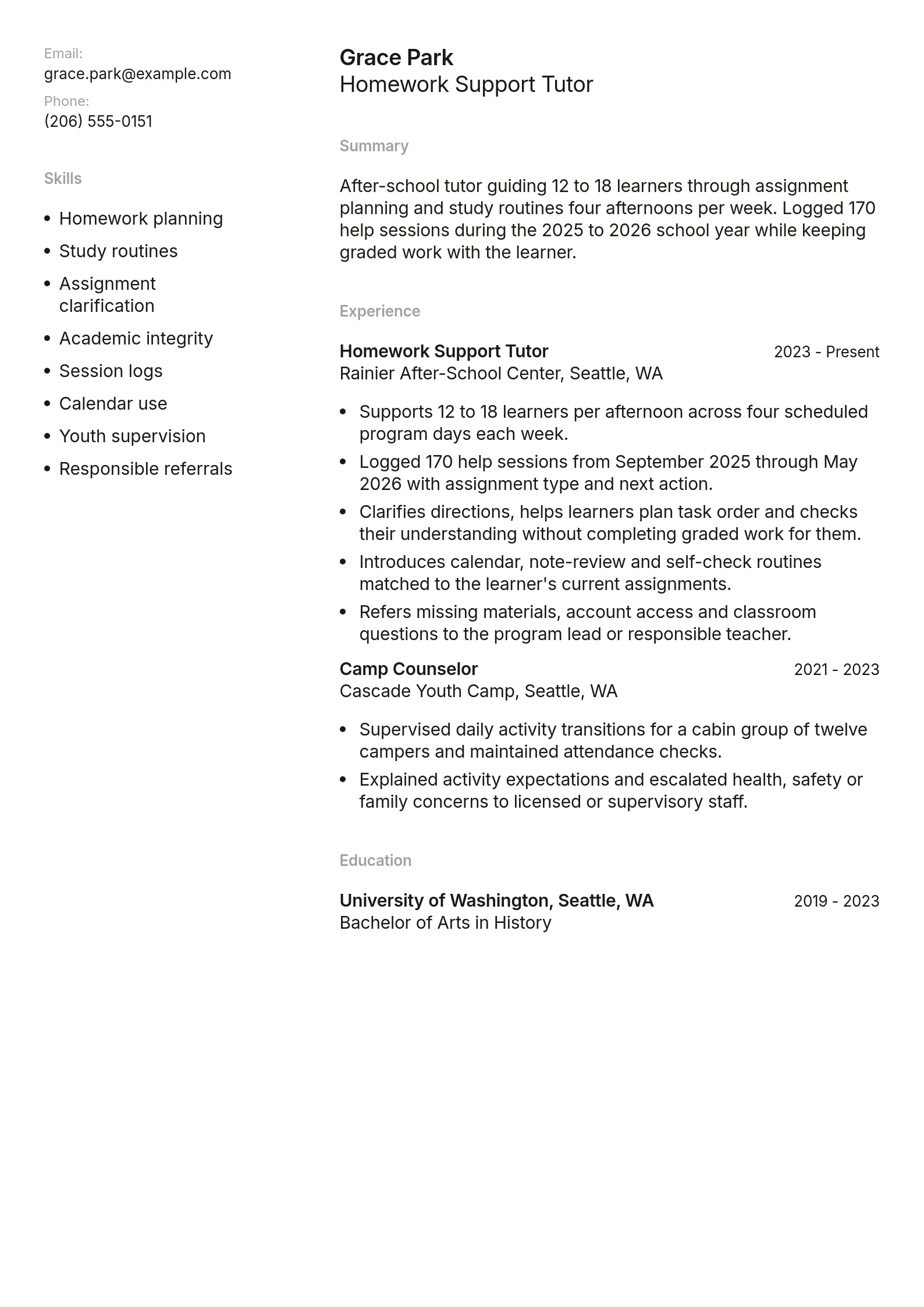
Homework Support Tutor Resume Example
On each of four afternoons, Grace supports 12 to 18 learners and has recorded 170 help sessions. Her bullets show the actual method: clarify the assignment, plan the next step and check understanding. Learners remain responsible for their graded work. Written that way, academic integrity sounds like part of good tutoring rather than a warning pasted onto the resume.
Defines guidance without taking over graded work.
Uses afternoon workload and session records to show scope.
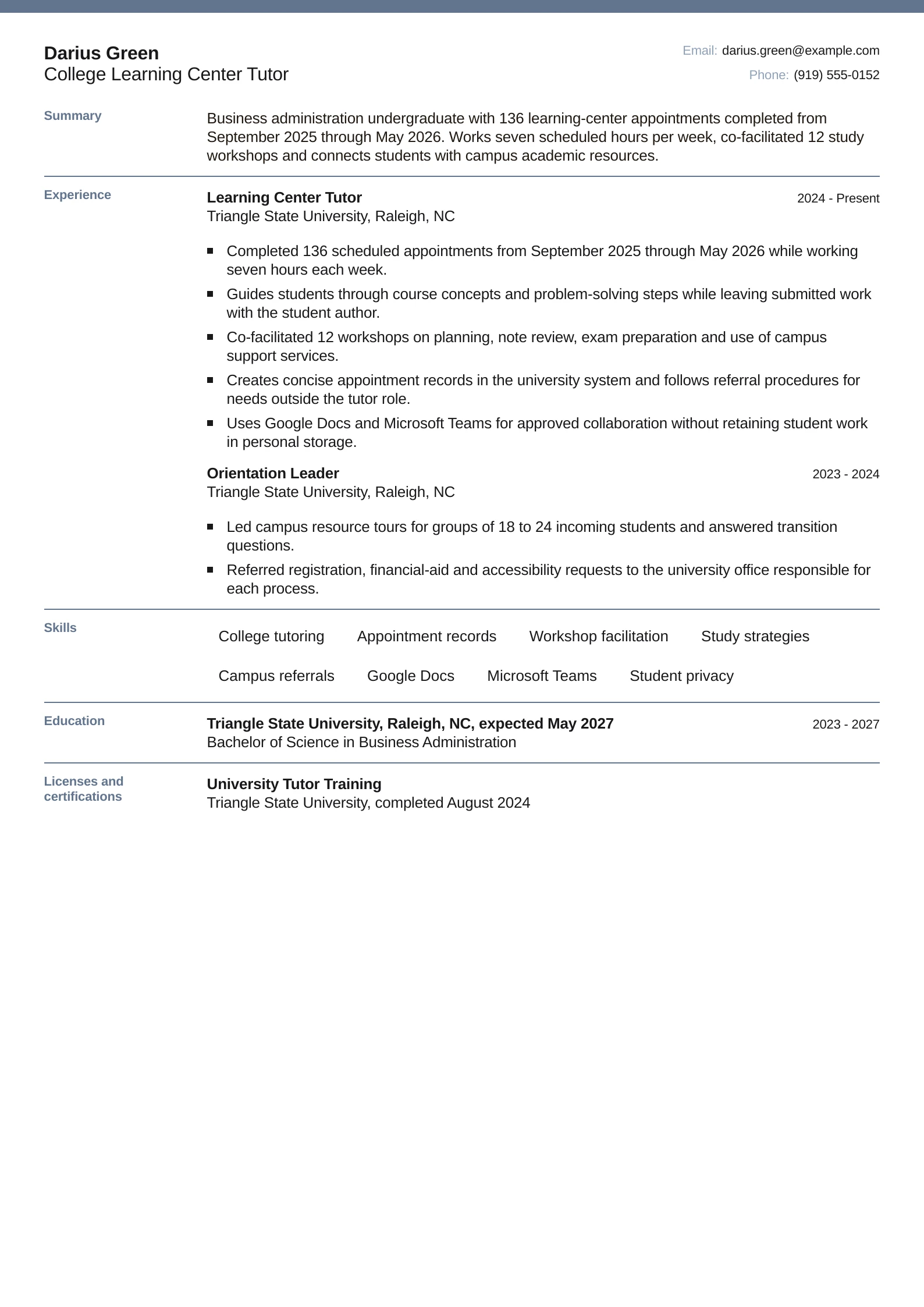
College Learning Center Tutor Resume Example
Darius has 136 learning-center appointments, seven scheduled hours a week and 12 workshops he co-facilitated. His degree is still expected in May 2027. The training line names Triangle State University instead of turning university training into direct CRLA certification. This balance suits campus tutors whose appointments, referrals and workshops say more than a long list of subjects.
Keeps institution-issued training distinct from CRLA certification.
Shows appointments, co-facilitation and referrals together.
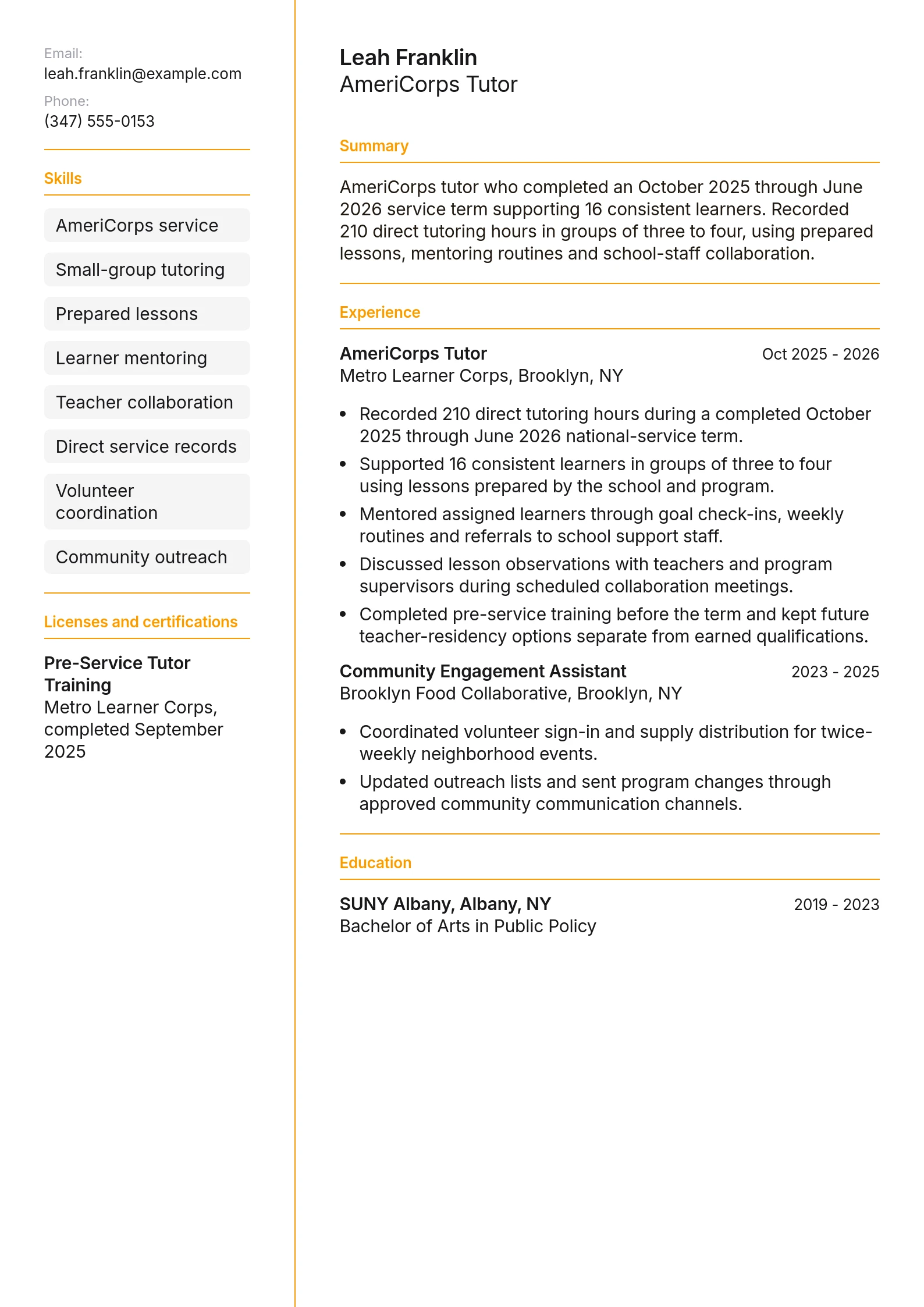
AmeriCorps Tutor Resume Example
Leah completed her AmeriCorps term in June 2026. Between October 2025 and June 2026, she supported 16 consistent learners in groups of three to four and recorded 210 direct tutoring hours. Her pre-service training belongs with that term. A possible later teacher residency is not an earned qualification and stays off the resume.
Closes the service term at the correct date.
Does not turn a future pathway into an earned qualification.
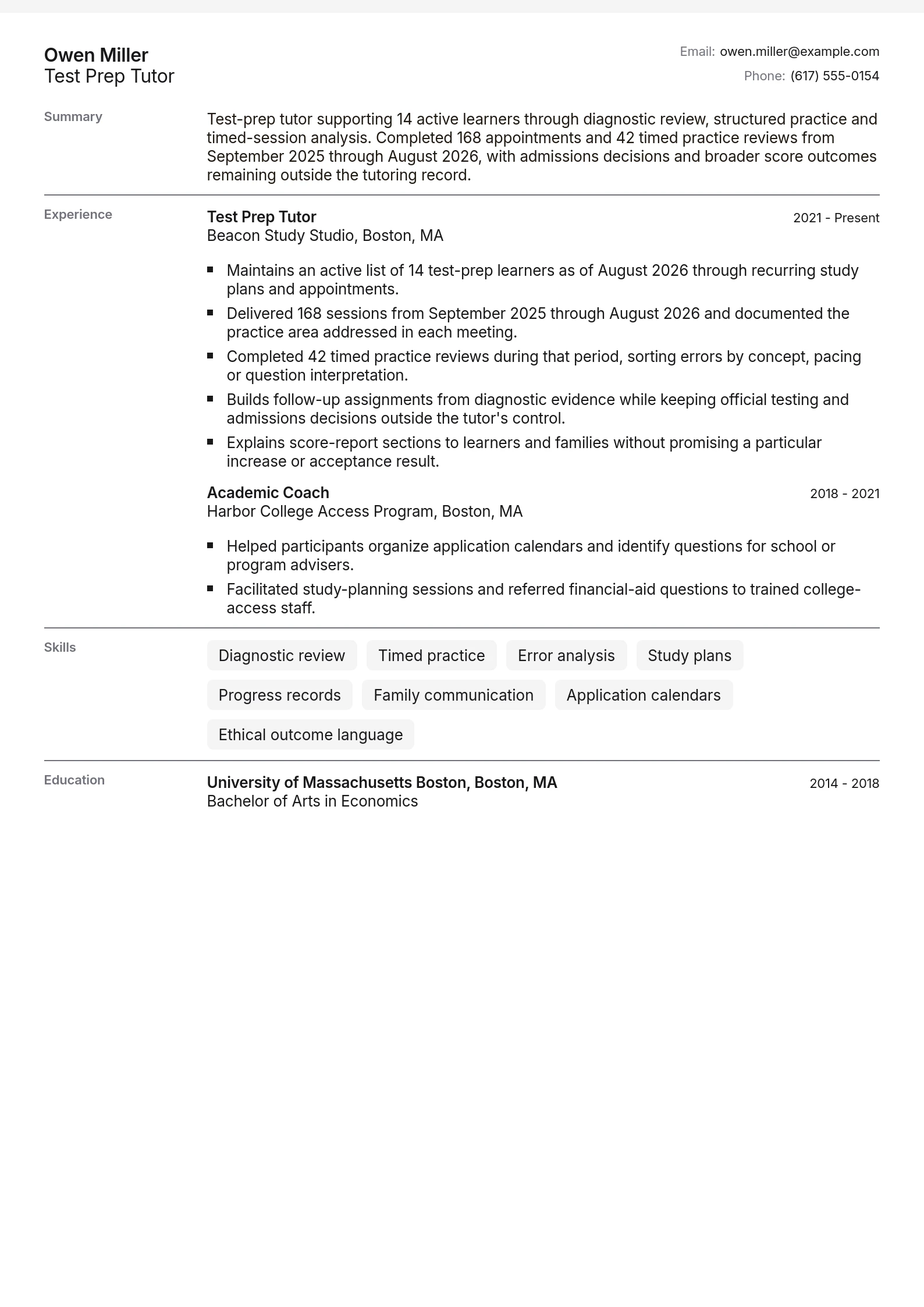
Test Prep Tutor Resume Example
Owen shows a disciplined test-prep process through 14 active learners, 168 completed sessions and 42 timed practice reviews. Diagnostics, practice plans and error analysis are the proof. He neither promises admission nor takes sole credit for a score change, because the final result has several contributors. The claim stays proportionate to his role.
Uses diagnostics and review records as the proof.
Avoids admissions promises and sole-cause score claims.
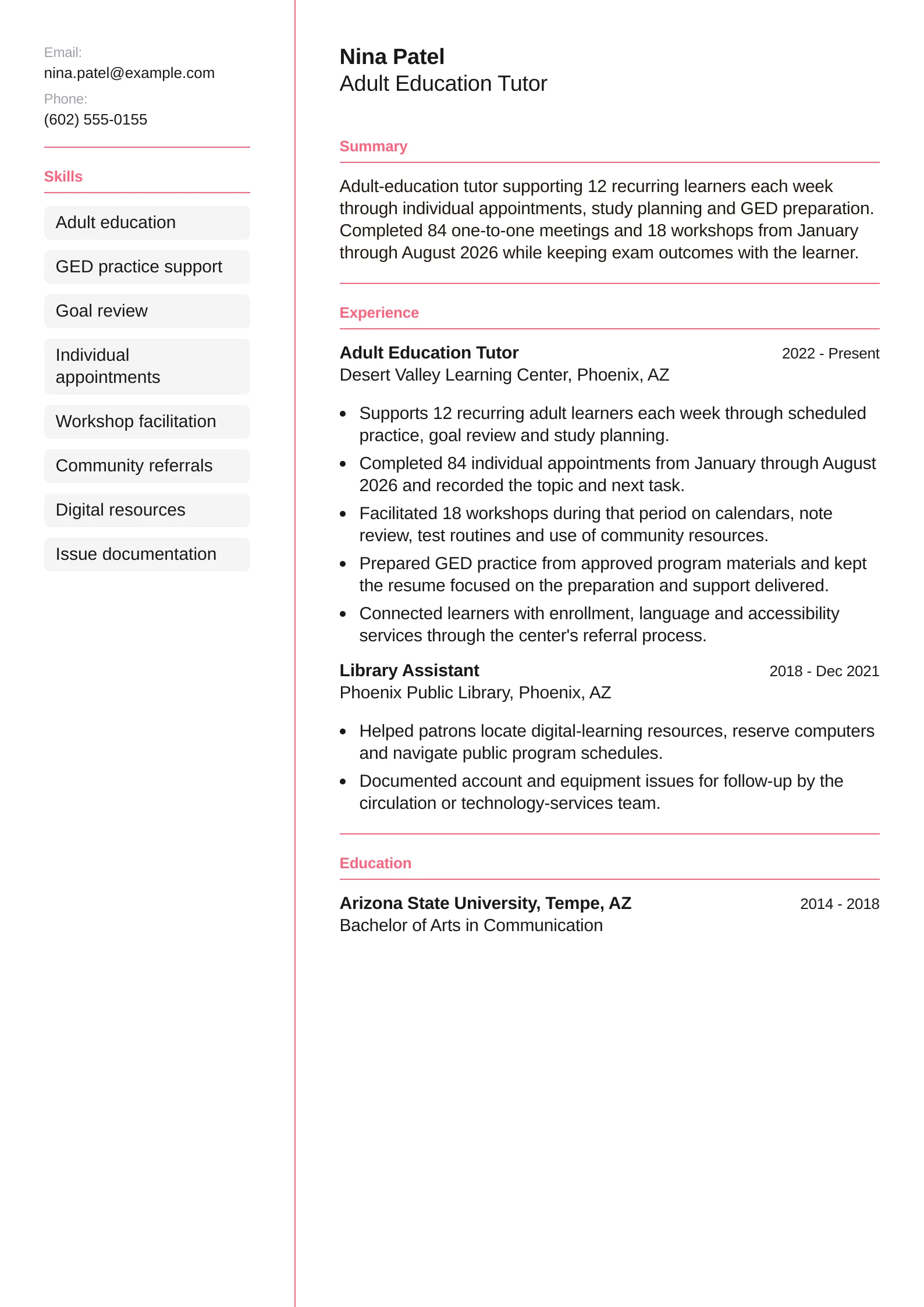
Adult Education Tutor Resume Example
Nina supports 12 recurring adult learners each week. From January through August 2026, she completed 84 one-to-one appointments and 18 study-planning workshops. Goals, practice, scheduling and referrals carry the entry. GED preparation is part of her job; exam completion belongs to the learner. That leaves her with specific, useful evidence and no invented pass result.
Explains adult-learning scope through appointments and workshops.
Leaves exam completion with the learner.
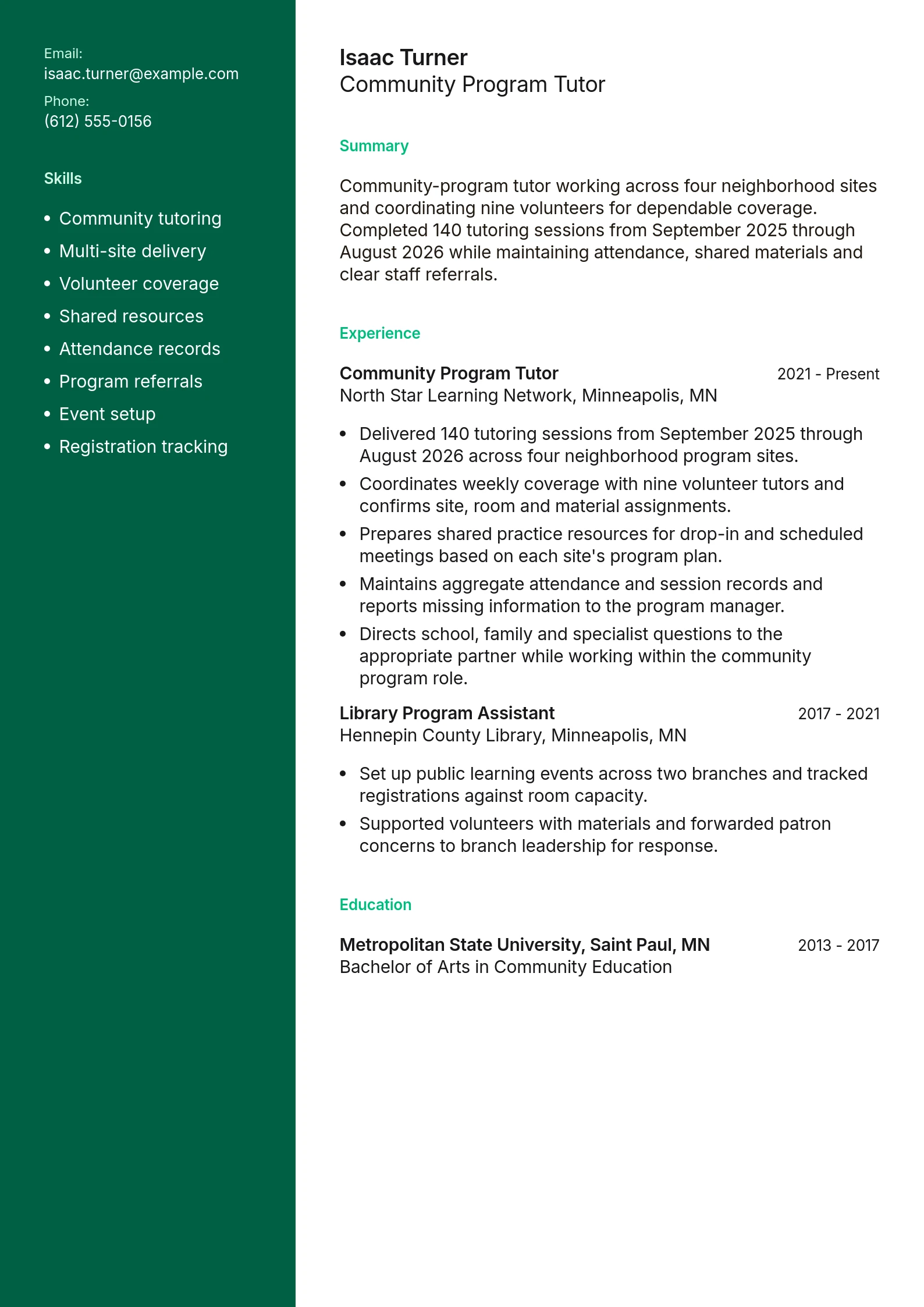
Community Program Tutor Resume Example
Isaac works across four neighborhood sites rather than one center. He completed 140 sessions in the latest year and coordinates coverage with nine volunteers, while program staff retain formal authority. Shared materials, attendance records and referrals show the work between appointments. The resume keeps community coordination separate from school authority and from the results of other volunteers.
Connects multiple sites to coverage and session records.
Keeps volunteer coordination within the program's authority structure.
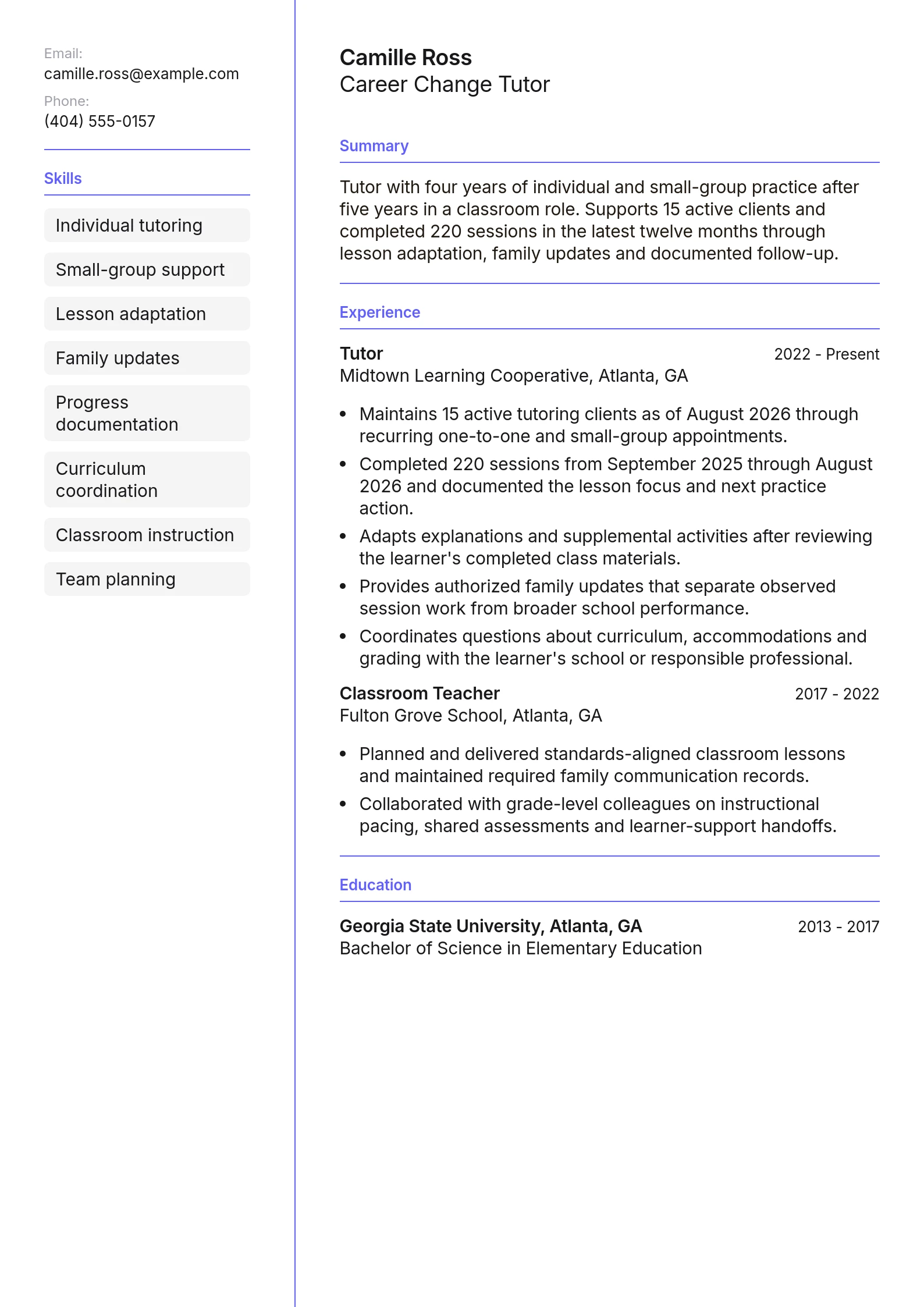
Career Change Tutor Resume Example
Camille's current record comes first: 15 active tutoring clients and 220 completed sessions. Five earlier years as a classroom teacher still add curriculum knowledge and family communication, but they do not guarantee results in a different setting. This order works for a career changer who has real evidence on both sides and does not need to disguise either role.
Leads with the work Camille does now.
Uses classroom experience as context, not a promised outcome.
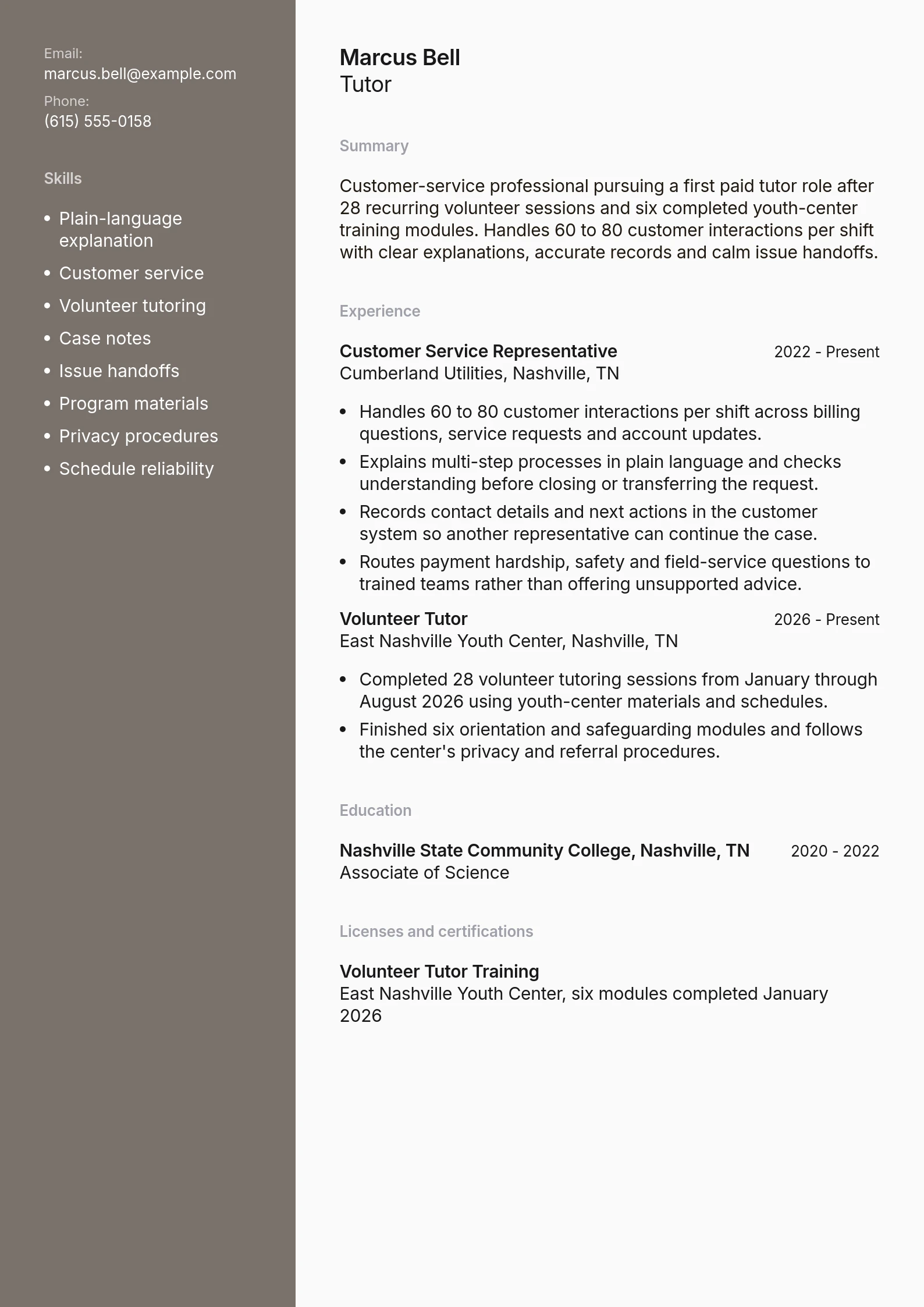
Tutor Resume with Customer Service Experience
Marcus has a full-time customer-service job with 60 to 80 interactions per shift and a smaller record of 28 volunteer tutoring sessions. The paid role supplies evidence of listening, explanation and record accuracy. Six completed volunteer modules add preparation. The resume connects those sources without calling them years of professional tutoring or an earned credential.
Keeps transferable skills attached to their real source.
Presents the volunteer record at its actual size and status.
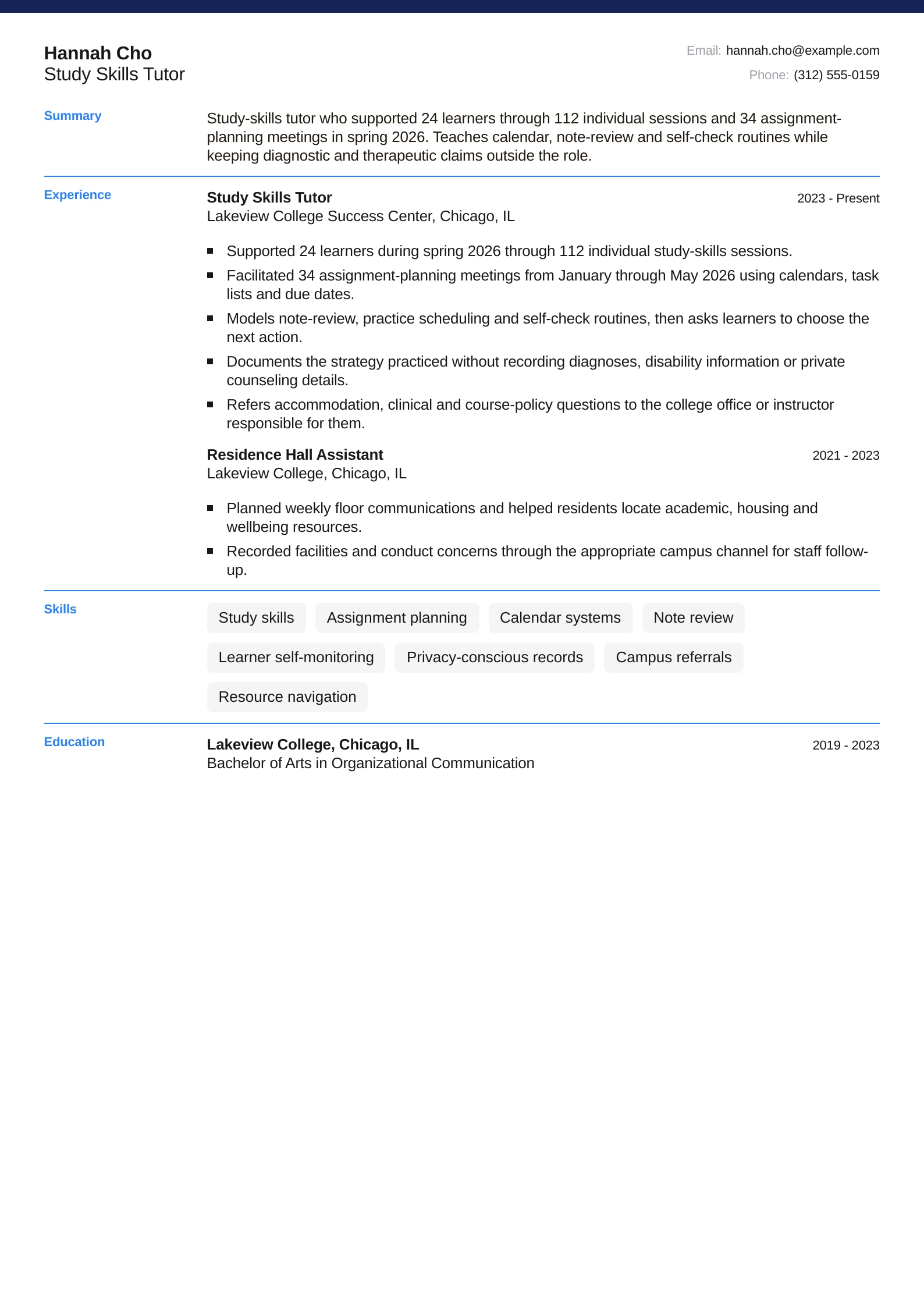
Study Skills Tutor Resume Example
Hannah supported 24 learners in spring 2026 through 112 individual sessions and 34 assignment-planning meetings. Her evidence is practical: calendars, note review, study routines and learner self-monitoring. The language stays inside academic support and never implies assessment or therapy. Take the same care when a familiar coaching term could suggest a clinical duty you did not perform.
Names the planning work instead of relying on coaching jargon.
Keeps diagnosis and therapy outside the role.
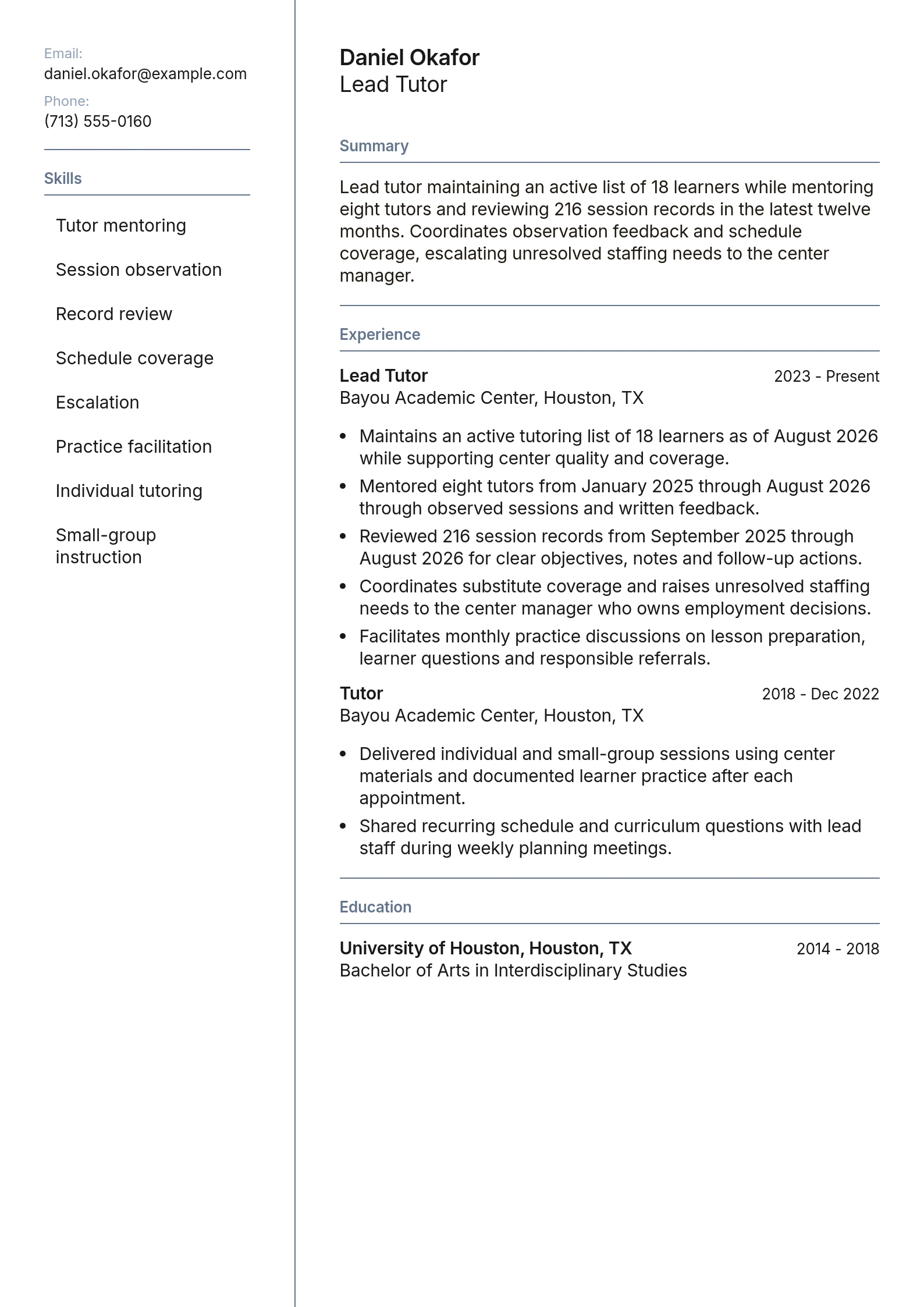
Lead Tutor Resume Example
Daniel balances direct tutoring for 18 active learners with mentoring eight tutors and reviewing 216 session records. Observation, written feedback and schedule coverage support the Lead Tutor title. Hiring and budget decisions remain with other people. He escalates unresolved staffing needs to the center manager instead of using a stronger verb that would overstate his authority.
Defines the lead role through mentoring and review work.
Keeps hiring and budget authority with the proper owner.
Tutoring Program Coordinator Resume Example
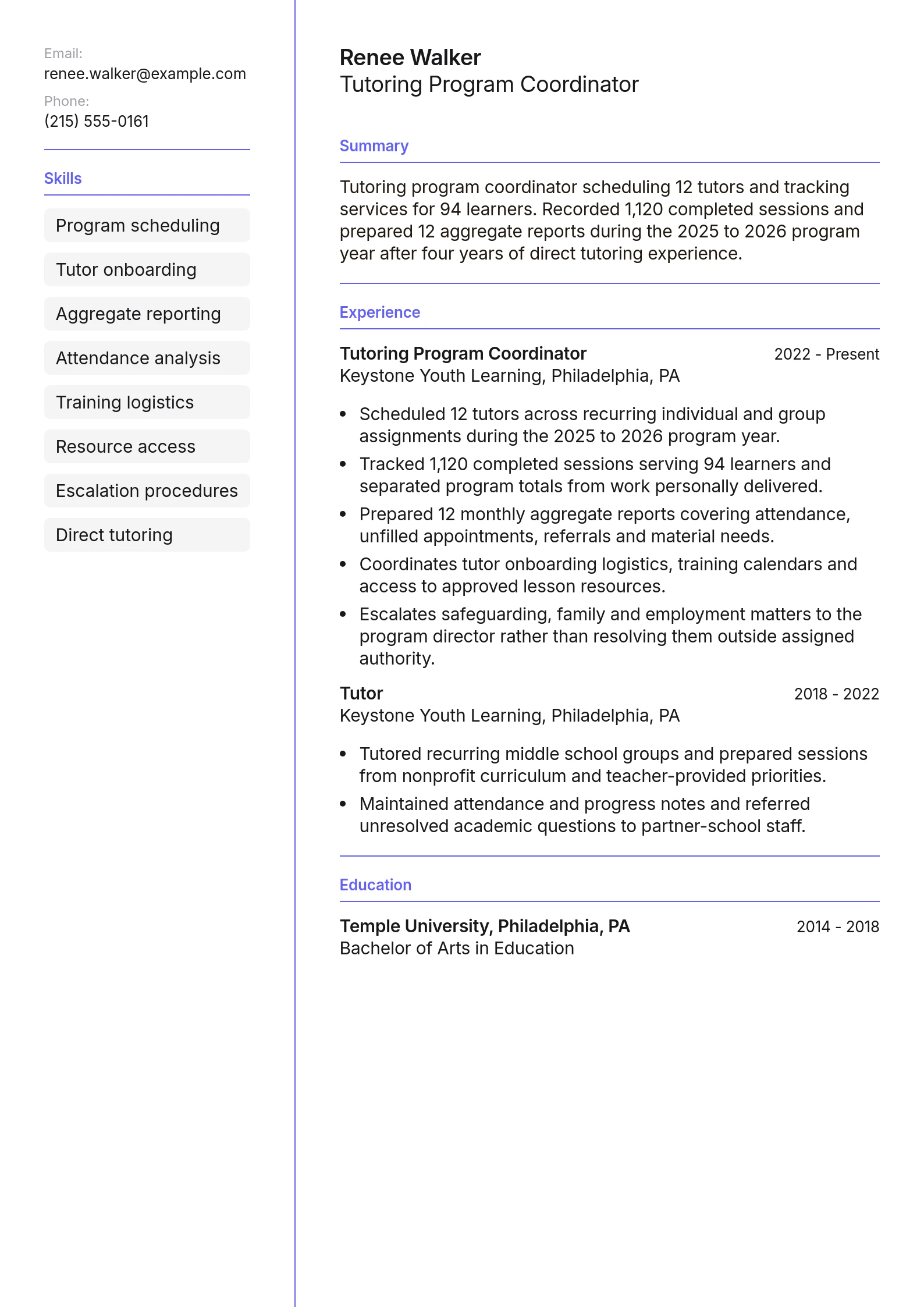
Renee schedules 12 tutors in a program that served 94 learners through 1,120 completed sessions during the year. Those figures belong to the program, not to her personal tutoring output. Her own work appears in schedules, 12 monthly aggregate reports, training logistics and unresolved handoffs. The earlier Tutor entry remains visible and shows how direct service led into program operations.
Attributes service totals to the whole program.
Shows progression from direct tutoring into coordination.
Choose the tutor resume that matches your actual work
Subject is only one way to choose an example. Start with the working relationship. A first-time applicant, current student, center employee and self-employed tutor may cover similar material, but their proof comes from different places. One has supervised practice, another has campus appointments, and the independent tutor also has client administration to show.
Setting changes the paperwork. A school tutor works through teacher handoffs and progress notes. A college center uses appointments, referrals and institution-issued training. Community work may span several sites, while an independent practice produces service agreements, calendars and invoices. Choose the example that gives the records you really have a sensible place on the page.
Next, look at the delivery model. One-to-one tutoring can include intake, recurring appointments and individual practice plans. Small-group work needs the usual group size and meeting rhythm. A coordinator should separate personal work from the service volume of the whole team. That last distinction keeps a strong program total from becoming a misleading personal claim.
For subject depth, use the relevant math, English, writing, reading, science, language, online, home or private tutor page. The purpose here is the broader employment story. Once its structure fits, replace the fictional subject and learner group with your own.
Cover the bottom half of an example and read what remains. Can you tell whether the candidate is an employee, student, volunteer, freelancer, owner or lead? Is the degree complete or still expected? If those answers are unclear in your draft, rearrange the sections before polishing sentences.
Write a tutor resume when your experience is new
A short tutoring history does not need camouflage. Use the experience you can document and label it accurately. Supervised practice can show lesson preparation and response to feedback. Recurring volunteer sessions establish consistency. Youth programs and customer service may prove patient explanation or careful records, but they remain youth work and customer service.
Lead with the record that best answers this application. Noah puts weekly volunteer tutoring first because it is his clearest match. Marcus has a smaller volunteer record, so the substantial customer-service role comes first and 28 tutoring sessions follow. Both choices make sense. The evidence, not a fixed format rule, decides the order.
An objective can connect the pieces when the relationship is not obvious. Keep it factual. Priya might write: 'Computer science undergraduate with 112 campus tutoring appointments and 14 completed tutor-training modules.' She has no reason to call herself highly experienced or to make a degree expected in May 2027 sound complete.
Coursework earns space when it produced relevant work. Name the course or project, the method and what you created. Attendance alone is education. A grade or GPA may meet a particular campus requirement, but it does not prove that you have taught the subject successfully.
Training needs an exact label too. 'Tutor Practicum, completed May 2026' says what Jordan finished and no more. It is not a professional certification or an independent client history. If training is underway, use that status only when it is true and helpful.
Put requested availability in the application field in most cases. A past evening schedule or steady weekly pattern can still support reliability on the resume. Offer only hours you can maintain. The employer controls assignments, so possible hours must not read like guaranteed work.
Build bullets around the tutoring cycle
A weak tutor entry often stops at 'helped students.' Go back to the session record. What did you prepare, what did the learner attempt, how did you explain the work, and what did you note for next time? Spread those details across the role. One sentence does not need to carry the entire routine.
Group size and schedule make the work easier to picture. 'Prepared assigned materials for six recurring groups of three to four learners' says far more than 'provided personalized support.' Add the 144 completed sessions or a teacher handoff where it belongs. Richer detail still does not make Mateo the author of the program's lessons.
Use the same evidence in the summary. Maya can lead with 26 active learners, 420 sessions and progress reviews because those records define her recent work. Jordan's case comes from supervised practice, youth-program communication and a degree completed in 2026. Generic enthusiasm would make these two applicants sound interchangeable.
Plain verbs work well when the object is specific. Prepare the lesson. Model a method. Review practice. Record the next step or refer a concern. Variety comes from covering another part of the job, not from cycling through grander synonyms.
Handoffs deserve a line when they show judgment. A note may go to a classroom teacher, a learner-support question to program staff, or an absence to the front desk for rescheduling. Each example marks the point where the tutor's responsibility ends and another person's begins.
Read the role aloud. If every bullet begins with 'helped,' every sentence claims improvement or the learner has disappeared from the work, return to the records. Tutoring often depends on preparation and follow-through. Make both visible.
Turn a vague tutor bullet into useful evidence
The stronger line shows who was supported, the scale of the work and what the tutor recorded for the next meeting.
Specific work you can verify
Prepared assigned materials for six groups of three to four learners, completed 144 sessions during the school year and recorded the next practice step after each meeting.
An outcome with no usable record
Helped every student achieve outstanding academic success through personalized tutoring.
Use progress evidence without claiming the whole result
Be cautious with grades, scores and admissions decisions. A learner's result may also reflect classroom teaching, independent study and family support. Before using it, find the baseline, later measure, dates, learner group and source. If the record is incomplete, leave the percentage out rather than rebuilding it from memory.
Workload is often safer evidence and may be more useful. Active learners at a named date, sessions completed during a semester, normal group size, timed-practice reviews and progress notes all describe what the tutor handled. Those are records an employer can ask about without needing a causal story.
A genuine outcome still needs its measurement and period. Nina's safer line is: 'Supported 12 recurring adult learners each week through GED practice, goal review and study planning.' It tells us what she did. It does not invent a pass count or make the learner's exam completion her result.
Numbers are optional. You might explain how you changed an example after reviewing practice, flagged a misconception for the teacher or referred a learner to another service. That shows professional judgment even when the program did not turn it into a metric.
Program totals need careful ownership. Renee tracked 1,120 completed sessions, scheduled tutors and prepared aggregate reports. She did not personally deliver all 1,120. Verbs such as coordinated or tracked can be accurate when the sentence makes that relationship clear.
Attach a period to every count. Twenty-six active learners as of August 2026 is not the same as everyone served over several years. A school-year session total is not a weekly workload. The date keeps an honest number at its real size.
Show supplied curriculum and original materials honestly
Teaching a supplied lesson still takes judgment. You may review it before the session, choose practice from approved materials, slow an explanation or note where a learner became stuck. Claim those decisions and the delivery you completed. Credit the program for the curriculum.
Authorship verbs are not interchangeable. 'Prepared and delivered lessons from the center's curriculum' does not mean 'designed the curriculum.' If you made one supplemental worksheet or review guide, name that item and its purpose. It does not make you the author of the whole program.
Adaptation can be narrower than a rewrite. Perhaps you changed the pace, tried another example or added guided practice while staying within the supplied method. Describe that choice. 'Fully personalized every lesson' is harder to support and tells the reader less about what happened.
Employer materials stay private. You can describe a worksheet or assessment without reproducing it. If a teaching sample is requested, share material you created and have the right to use. A former center's worksheet or answer key does not belong in your portfolio.
Present freelance and self-employed tutoring clearly
Independent tutoring should look like a job, not a list of families. Explain how clients begin, how appointments are arranged, what the service includes and which records you keep. Elena's 11 concurrent clients, 286 sessions and 46 invoices establish a real scale without identifying anyone.
Choose a title that the records support. Freelance Tutor fits services delivered independently across clients. Owner and Tutor may fit a consistently operating practice. Neither title proves that you employ staff, rent a center or control a large budget. A one-person practice is credible at its actual size.
Use one date range for an overlapping client list. Aggregate figures are clearer than separate family entries and safer for privacy. A contract needs its own entry only when identification is permitted and the assignment differs materially from the rest. Most family names should never appear on a public resume.
Keep business operations and tutoring distinct enough to scan. Consultations, invoices and appointment completion show how the practice runs. Sessions, prepared materials and progress notes show the service delivered. Use revenue or retention only when the records are reliable and the figure can be discussed without revealing private terms.
A tool needs a visible purpose. Booking software can explain scheduling; a video platform can explain delivery or follow-up. A software list with no related action says little about the practice or the tutoring.
Make online tools and availability useful
Zoom by itself is not much of a bullet. Tell the reader what happened through it. Perhaps a learner worked in a shared document, used the whiteboard for a problem and left with a recorded next step. The tool matters because it explains the session workflow.
Systems vary by employer. One current opening names video, audio, screen sharing, whiteboard and chat for groups of one to three. Another asks for detailed weekly availability. Those details belong to those jobs rather than a universal tutor checklist. List technology only when you have used it.
Requested availability usually belongs in the application field. A previous evening schedule, stable part-time pattern or complete service term can support reliability on the resume. Do not offer hours you cannot keep or describe variable assignments as guaranteed work.
Remote tutoring creates its own privacy risks. Leave names, login details, chat excerpts, screenshots and identifiable assignments out of resumes and portfolios. Aggregate session records and approved systems can show the scale without taking a learner's digital workspace with you. That context matters.
List education and training at the status you hold
Education requirements differ across tutor jobs. Current enrollment may be enough for one peer role, while another employer asks for a completed degree, course result or state credential. Read the required and preferred lists separately, then write the education you actually hold.
An unfinished degree needs the school, degree and expected graduation date. Priya and Darius both use expected May 2027 because neither degree has been awarded. A completed degree gets its actual award date. Coursework may support subject knowledge, but it cannot replace a required degree or prove teaching experience.
Name the training issuer. Darius completed Triangle State University's tutor training, so his resume says exactly that. He does not call himself CRLA certified. CRLA's ITTPC recognizes tutor-training programs; the individual's wording still has to match the institution's own record.
Treat teaching-assistant and educator credentials the same way. Use the official title plus the correct issue or validity information. A qualification preferred by one charter school is not a national requirement for tutors.
Background checks, fingerprinting and work authorization are application conditions rather than professional certifications. Follow the employer's process and answer accurately. A completed screening step is not a credential badge; keep routine hiring paperwork out of the credentials section. Use the same status wording in the summary and education section.
Protect learner privacy and academic integrity
Use aggregate evidence on a public resume. Session counts, usual group size and progress-note totals can show workload without identifying a learner. Remove names, contact details, student numbers, disability information and family messages. Ordinary facts can identify someone when combined, so read the whole bullet rather than searching for names alone.
Learners remain the authors of graded work. A tutor can ask questions, model a method, give feedback and support revision. Do not claim to have written the essay, completed the homework or taken the exam. Accurate wording here makes the resume more believable and gives you a sounder interview answer.
Apply the same care to a portfolio. Marked assignments, platform screenshots and progress reports usually stay private unless you have the explicit right to share them and have removed identifying content properly. A new sample lesson or fictional practice exercise is often simpler to defend.
Sensitive learner categories need exact language. You may say that you followed an approved accommodation or referred a concern through the program process when that happened. Diagnosis, therapy, special-education authority, ABA treatment and clinical judgment require the right role, supervision and credentials. This general tutor page does not provide them.
Read the resume once from the learner's side. Could that person recognize themselves? Does the bullet imply that the tutor completed work belonging to the learner or a licensed professional? Bring the sentence back to the tutor's observable action before you send it.
Match the resume to the employer and posting
Tutor postings overlap on basic duties, but schedules, platforms and qualifications change by employer. Borrow their wording only where your own record supports it.
What the posting asks for
What your resume can show
Where to be careful
Individual or small-group tutoring
Learner count, usual group size, meeting rhythm and preparation
A group program is not private one-to-one work
Provided curriculum
Assigned lessons, your preparation, delivery choices and notes
Use designed only for material you created
Progress monitoring
The assessment, note or review you completed and the next action
Do not take sole credit for a grade or score
Subject or course knowledge
Relevant coursework, degree, exam result or previous role
An employer's threshold applies to that opening
Online platform
How video, whiteboard, screen sharing or chat supported the session
A tool name by itself proves very little
Consistent availability
An evening, term or weekly schedule you have maintained
The employer still controls assignments and hours
School collaboration
Teacher meetings, progress handoffs, records and referrals
Tutoring does not create classroom-teacher authority
Training or credential
Exact issuer, title, status and date
Read preferred and required qualifications separately
Learner privacy
Aggregate counts and records from approved systems
Remove names, private messages and identifiable work
Keep the resume readable and easy to verify
A familiar order is usually enough: contact details, a brief summary or objective, experience, skills, education and relevant training. A current student may move education higher. A lead tutor should keep recent tutoring and leadership above an older degree. Nobody should have to hunt for the current role or strongest evidence.
One page works for many students and early-career applicants. Use a second when genuine progression, independent-practice records or program leadership needs space. Remove repeated duties before shrinking the type. Plain headings, comfortable spacing and consistent month-and-year dates are more useful than decorative skill bars.
Check every role labeled Present. Amir's part-time tutoring overlaps another job, so each has a separate entry and date range. Leah's AmeriCorps term ended in June 2026 and must not look current. Expected graduation belongs in education, never in an employment date field.
Keep a copy of the submitted resume beside the posting. Before an interview, verify learner counts, session totals, credential wording and dates against the records used to write it. If a number cannot be recovered, replace it with accurate scope. Rebuilding it from memory in the interview is a bad plan.
Search for every title and status word at the end. Volunteer, student, employee, freelance, self-employed, AmeriCorps and lead describe different relationships. Completed, expected and in progress do too. Check those labels before you spend time on layout polish.
Check the first half before you send it
Cover the bottom half of the page and read what remains.
Top tip
Can you tell what kind of tutor this is and whether the work is paid, student, volunteer or independent? Find one session measure, one preparation decision and the exact education or training status. Move the clearest evidence higher if any of those details are buried.
Tutor resume questions
Answer these ten questions before you polish the final draft.