Compare five elementary teacher resumes for new, experienced, upper-grade, interstate and private-school candidates. Start with the example closest to your classroom and license status, then use the guidance to describe instruction, assessment, family communication and curriculum work without overstating student results or authority.
Start with an elementary teacher resume that matches your classroom
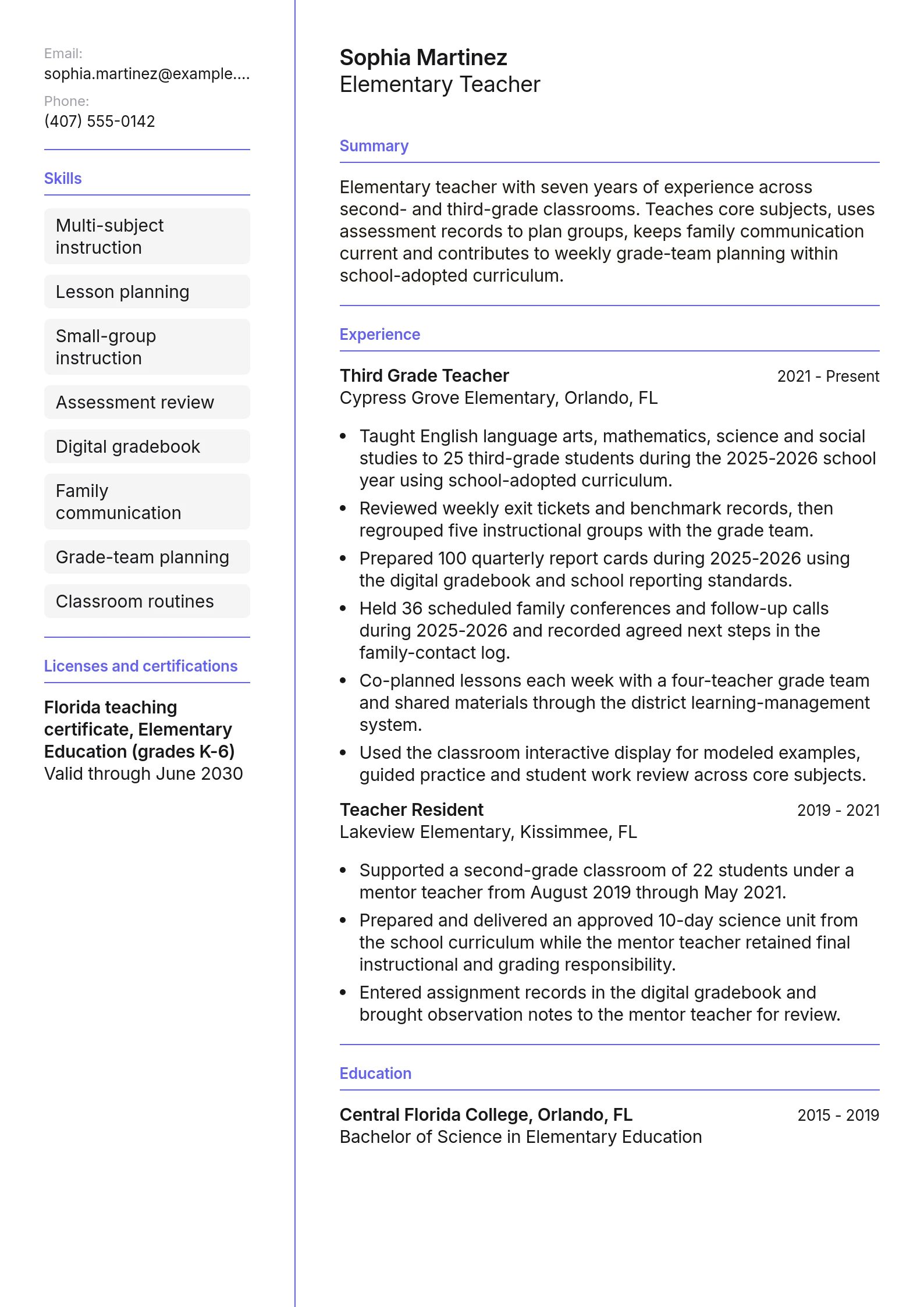
Sophia offers the best starting point for an experienced elementary classroom teacher. The first role quickly establishes a class of 25 third-grade students, all four core subjects and the 2025-2026 school year. From there, the bullets show weekly exit-ticket review, five instructional groups, quarterly reports, family conferences and grade-team planning. Her Florida teaching certificate keeps its exact Elementary Education (grades K-6) title.
The wording also respects how a school works. Sophia teaches from school-adopted curriculum, prepares lessons within that framework and plans with a four-teacher team. She never recasts collaboration as supervision or claims that every learner result came from her work alone. The resume is detailed because the underlying records are detailed.
Compare 5 elementary teacher resume examples
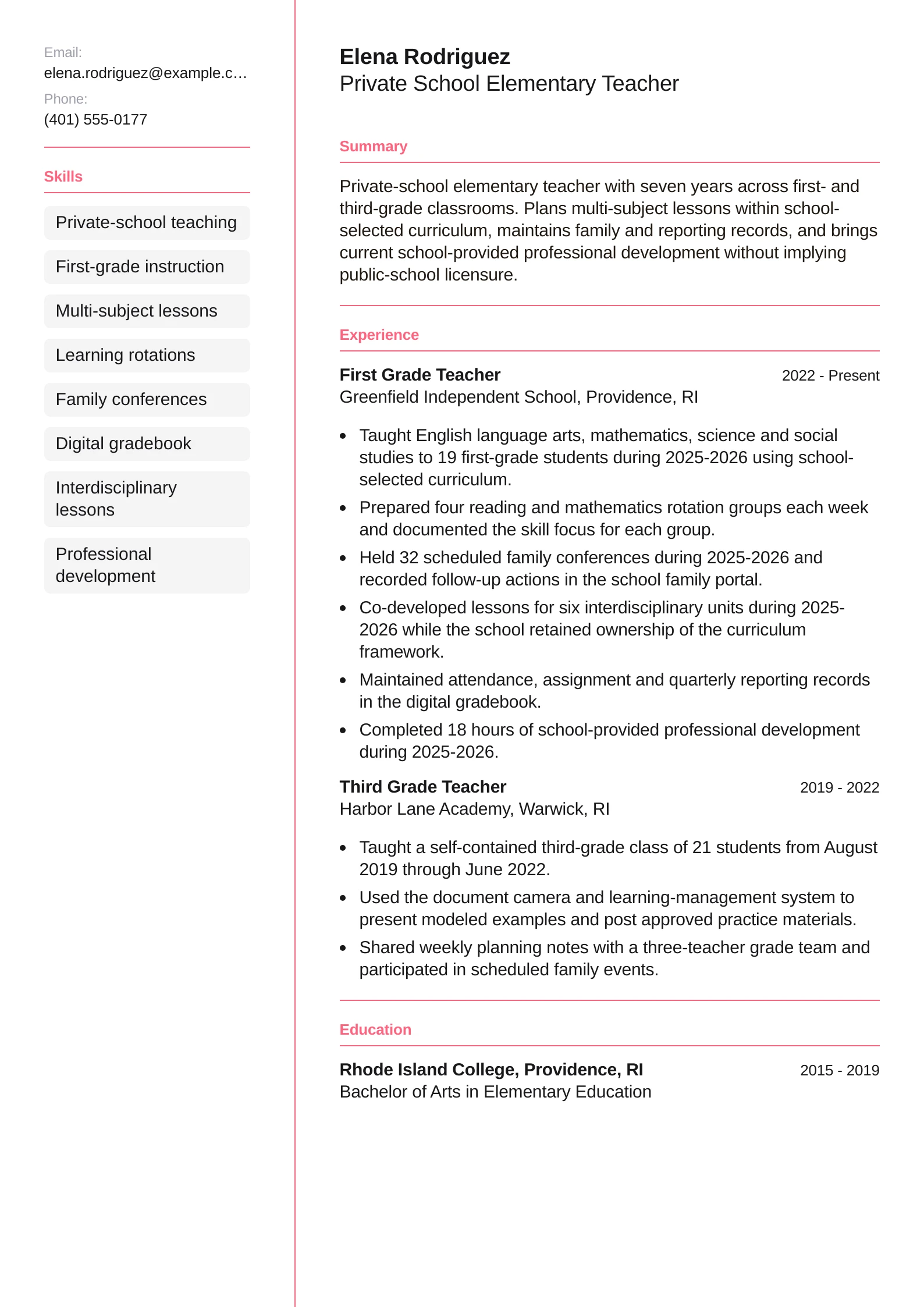
Start with the career story that resembles yours. Maya is moving from supervised student teaching into a first full-time role. Daniel has a longer upper-elementary record. Amina is changing states, while Elena teaches in a private school without listing a state license. Those differences matter more than a small overlap in daily duties.
The candidates, schools and numbers are fictional. Borrow the organization, not the facts. Replace every class size, date, platform and credential with something in your own records. If your target is special education, ESL, Montessori, reading intervention, art, music, physical education or curriculum development, use the dedicated occupation page and the credentials that belong to that work.
Entry-Level Elementary Teacher Resume Example
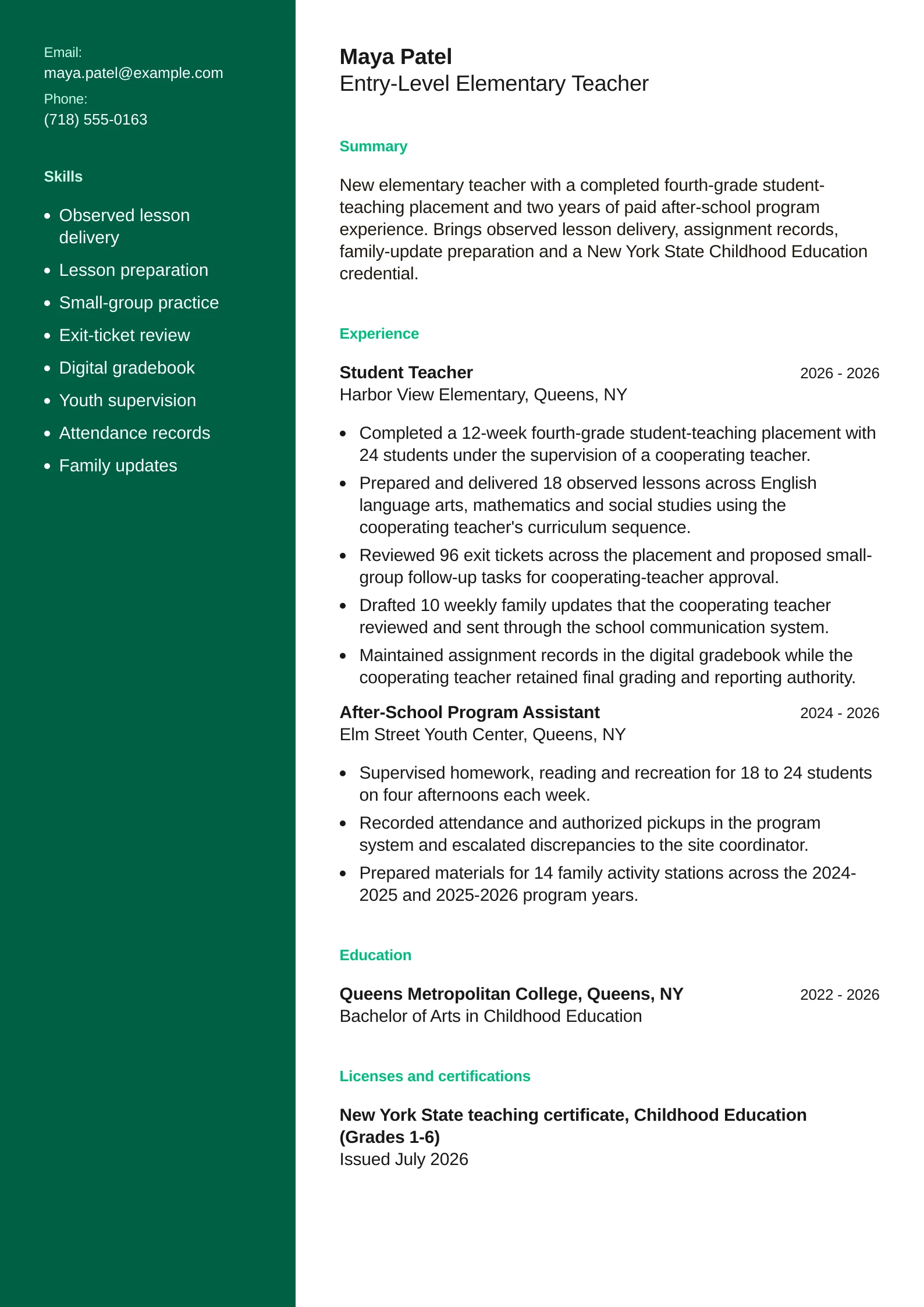
Maya's strongest classroom evidence comes from a 12-week student-teaching placement, so the resume labels it plainly instead of presenting it as paid employment. Eighteen observed lessons, 96 reviewed exit tickets and 10 drafted family updates give the placement useful scale. Each relationship stays intact: the cooperating teacher owned the curriculum sequence, approved follow-up tasks and sent the family messages.
Makes supervised student teaching easy to identify
Uses placement records instead of invented student gains
Keeps final classroom authority with the cooperating teacher
Upper Elementary Teacher Resume Example
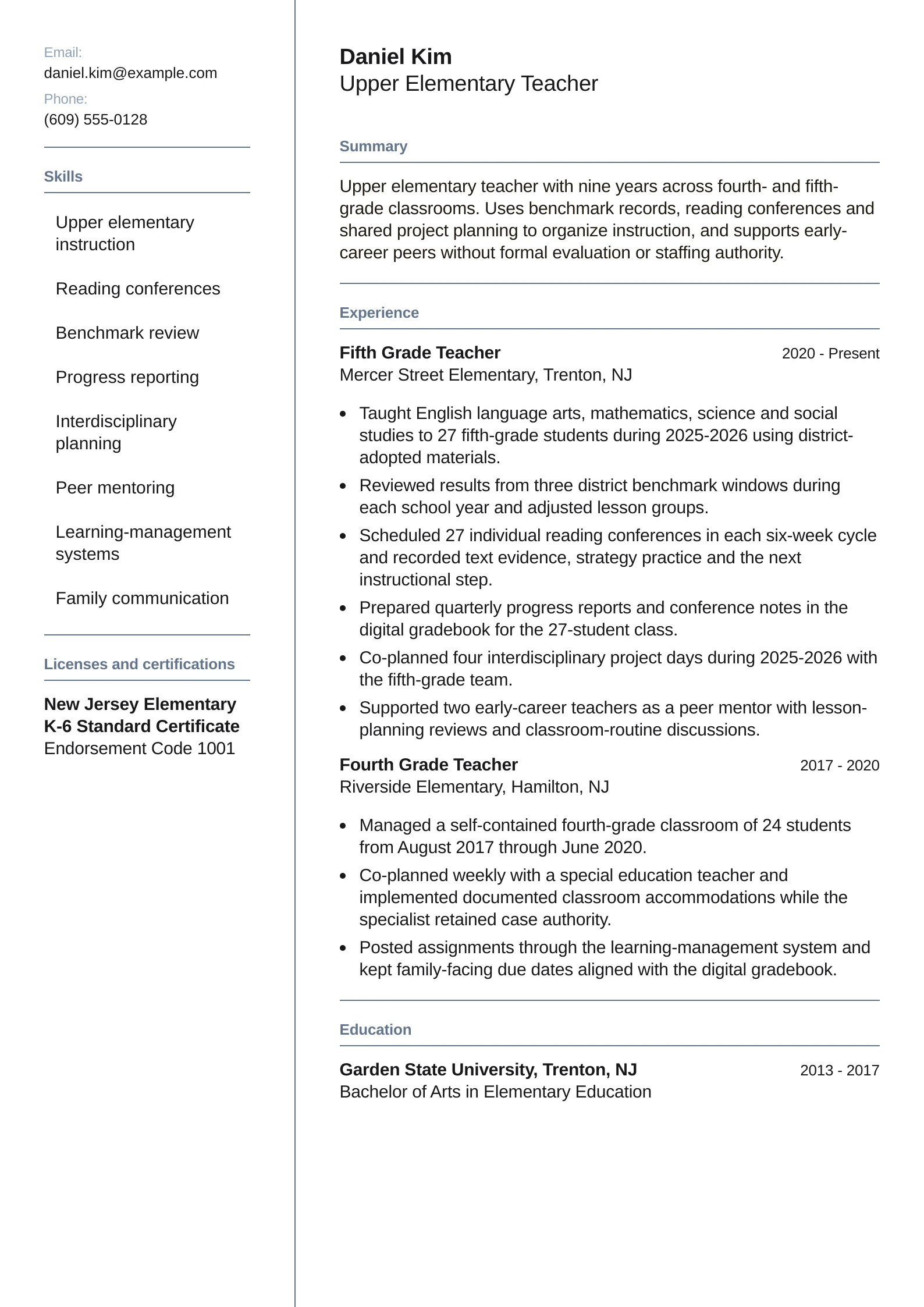
Daniel's nine years in fourth- and fifth-grade classrooms need little decoration. His recent role covers 27 fifth-grade students, three district benchmark windows each year and reading conferences in every six-week cycle. The New Jersey Elementary K-6 Standard Certificate sits near education, while two peer-mentoring relationships remain limited to lesson planning and classroom routines.
Shows the recurring assessment and conference cycle
Uses the exact New Jersey endorsement label
Defines peer mentoring without inflating authority
Elementary Teacher Moving States Resume Example
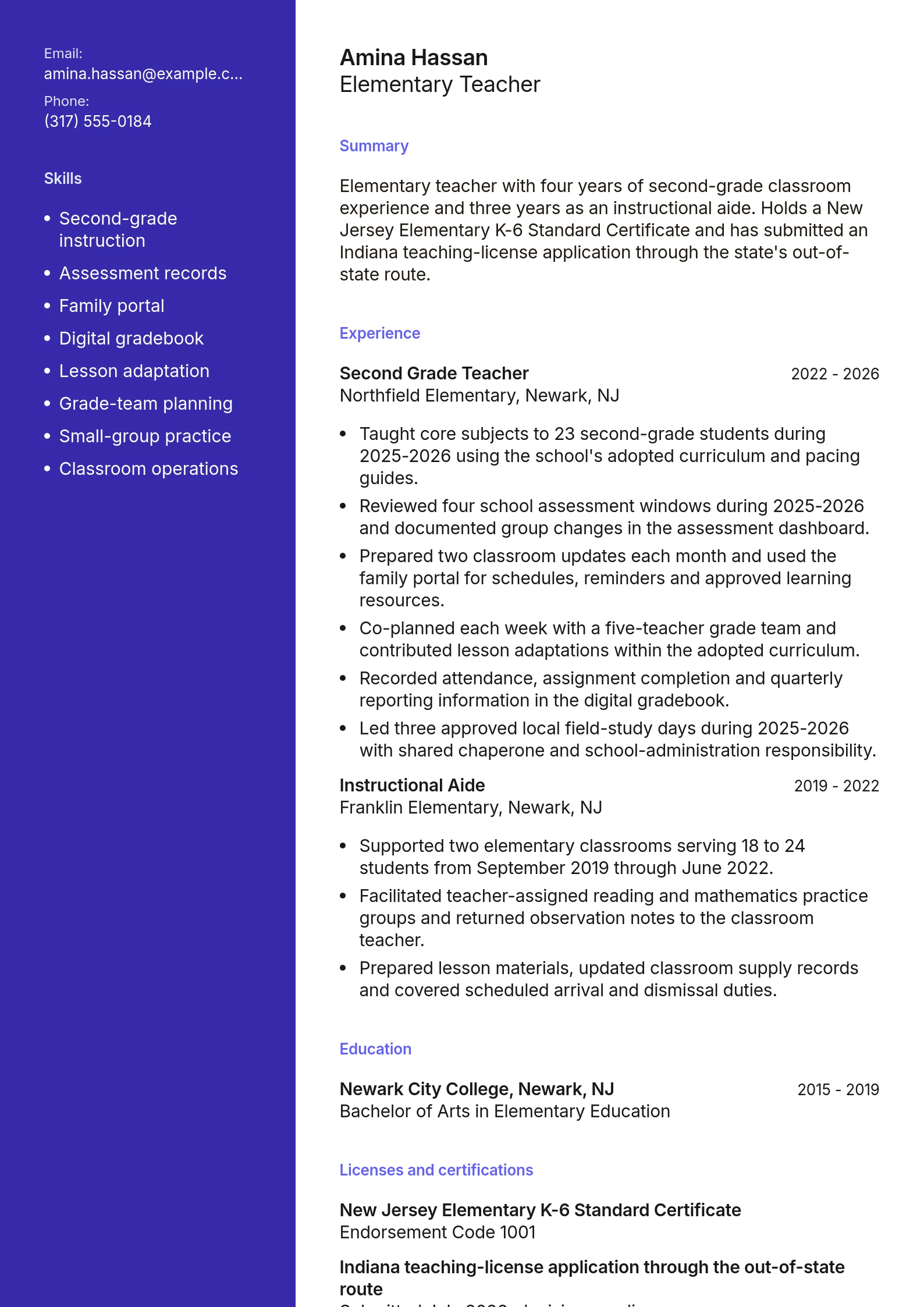
Amina spent three years as an instructional aide before teaching second grade in New Jersey for four years. She holds a New Jersey Elementary K-6 Standard Certificate and is now applying in another state. The Indiana application went through the out-of-state route in July 2026. Its status is still pending, so her current credential and future destination remain separate everywhere on the resume.
Separates the current credential from the pending application
Keeps the relocation story inside a normal chronology
Avoids any promise of automatic reciprocity
Private School Elementary Teacher Resume Example
Elena has seven years of genuine private-school classroom experience and no state credential in this fictional record. Her resume does not apologize for either fact. It builds the case from 19 first-grade students, weekly learning rotations, 32 family conferences, six interdisciplinary units and 18 hours of school-provided professional development. Public-school eligibility is left for roles whose stated requirements she actually meets.
Builds credibility from real classroom records
Labels school training without turning it into a credential
Keeps public-school eligibility out of the claim
Choose by career stage, grade setting and credential status
A matching title can still point to the wrong example. Check who owned the classroom work. A student teacher works under a cooperating teacher, while a classroom teacher handles day-to-day instruction within school and district policy. A peer mentor can review a colleague's planning without evaluating that colleague. Your verbs should make those relationships clear.
Then compare the grade and teaching model. Many elementary teachers cover several core subjects in one classroom; some upper grades are organized by subject. Describe the assignment you actually held. Teaching a daily mathematics block does not make you a math specialist, and implementing accommodations with a specialist does not give you special education case authority.
Your situation
Evidence to bring forward
Boundary to keep clear
First full-time role
Student-teaching length, grade, observed lessons, school tools, paid youth work and issued credential status
Keep supervised placement separate from paid employment and final classroom authority
Experienced self-contained teacher
Grade, class size, core subjects, assessment cycle, reporting, family contact and grade-team planning
Implementing curriculum is not the same as owning it; team results stay shared
Upper elementary teacher
Grades 4 or 5, core subjects taught, reading or assessment records, projects and collaboration
A core-subject assignment does not automatically create a specialist credential
Moving between states
Current license title and state, destination-state application route, submission date and exact pending status
Reciprocity is not automatic and a pending application is not an issued license
Private-school teacher
Grades, class records, school curriculum, family work, reporting and employer-provided training
Do not imply public-school eligibility when you do not hold the required state credential
Turn an ordinary teaching week into credible evidence
Open the experience section with a classroom someone can picture. Name the grade, subjects and class or cohort size, then give the school year when it matters. Sophia's line about 25 third-grade students and four core subjects does far more work than a broad claim about engaging instruction.
After that, show how teaching moved from preparation to review. A lesson might begin with adopted materials, continue through modeling and guided practice, and lead to an exit-ticket check or a change in groups. Reports and family conversations can show what happened next. Spread that work across separate bullets instead of packing the whole cycle into one sentence.
The operational parts of teaching deserve space when they establish responsibility. Attendance, dismissal, materials, conference notes and report deadlines explain how the room ran. Pick the records that distinguish your work. Copying every routine duty from a posting will bury the evidence that belongs to you.
Be concrete about collaboration. 'Co-planned each week with the fifth-grade team' tells the reader both the partner and the cadence. 'Collaborated with stakeholders' tells them almost nothing. Name the cooperating teacher, grade team, specialist, instructional coach, family or site coordinator when the relationship is relevant and safe to disclose.
Read only the first two bullets of each recent role. Can you identify the grade, teaching model and scale of the work? If not, move those facts up. Group planning, project days, reporting systems and school duties make more sense after the classroom itself is established. That order gives the reader a classroom before asking them to absorb its smaller routines and records.
Use classroom numbers without inventing student results
Most elementary teacher resumes do not need a test-score claim. Class size, grade band, instructional groups, lesson counts, conferences and reporting windows already show the scale of the job. You can usually trace those figures to a schedule, gradebook, calendar or planning record, which makes them easier to explain in an interview.
Use a learner outcome only when the evidence is strong enough for the claim. You need the measure, comparison period, student group and a fair account of your contribution. Prior instruction, attendance, support services, assessment conditions and the learner's own work may all matter. The five fictional resumes here deliberately avoid claiming a learner gain.
Even a process number needs a period and relationship. Maya reviewed 96 exit tickets during a 12-week placement, then proposed follow-up tasks for cooperating-teacher approval. Daniel's three benchmark windows recur during each school year. Without that context, the reader cannot tell whether a figure describes one week, one term or an entire career.
Treat tidy percentages with suspicion when the underlying calculation is missing. If several teachers or services contributed, describe the shared work rather than claiming the result as your own. And if disclosing the outcome could expose a learner, leave it off. The instruction, review and handoff can still make a strong bullet.
Cadence is often more informative than a large total. Weekly grade-team planning, quarterly reports and four assessment windows describe different parts of the job. Use the rhythm your records support and name the period. One unusually busy month should not become a yearly average, and a single project should not become a recurring program.
Replace an outcome claim with evidence you can defend
The record and period are clear
Reviewed four school assessment windows during 2025-2026 and documented group changes in the assessment dashboard.
The outcome has no supporting record
Transformed student performance and raised achievement across the classroom through data-driven teaching.
Write your teaching credential exactly as the state does
Elementary teaching credentials are issued by states, not through one national license. The U.S. Department of Education directs candidates to the state where they plan to teach and notes that no certification is accepted everywhere. On your resume, use the jurisdiction's title, grade coverage and current status. 'Certified elementary teacher' is too vague when the exact record is available.
State titles differ. Florida uses Elementary Education (grades K-6), while New York uses Childhood Education (Grades 1-6). Daniel and Amina hold a New Jersey Elementary K-6 Standard Certificate, Endorsement Code 1001. Copy the wording from your own record instead of translating it into another state's title.
For a move between states, show what you hold now and what is still being reviewed. Indiana offers an out-of-state route, but the state's guidance does not promise that every requirement will be waived. Amina submitted her application in July 2026; the decision remains pending. Until Indiana issues a credential, her resume should not say that she is licensed there.
Check this section each time you apply. Issue dates, expiration dates, renewals and pending decisions can change, and the resume should match the application form. A background check belongs here only if an issuing body treats it as a portable credential. Routine employer screening does not become a professional qualification just because a job requires it.
Situation
Accurate resume treatment
Do not write
Florida holder
Florida teaching certificate, Elementary Education (grades K-6), with the actual validity date
National elementary certification or an unearned specialist endorsement
New York holder
New York State teaching certificate, Childhood Education (Grades 1-6), with the actual issue or validity status
Generic K-6 license if that is not the state title on the record
New Jersey holder
New Jersey Elementary K-6 Standard Certificate, Endorsement Code 1001
Reading, special education or leadership credentials not shown on the certificate
Indiana out-of-state applicant
Existing state credential plus Indiana out-of-state application submitted on the real date, decision pending
Indiana licensed, reciprocal license approved or requirements waived before issuance
No state credential held
Omit the credential and target roles whose current requirements you meet
Eligible for public-school teaching unless the state has actually confirmed that status
Build a first elementary teacher resume from supervised experience
A supervised placement can anchor a first teacher resume when the label and reporting relationship are clear. Give the school, grade and dates, then name the cooperating teacher relationship. Follow with lessons delivered, records reviewed and classroom tools used. Keep the placement under supervised experience rather than presenting it as salaried classroom employment.
Maya has enough detail to avoid inflated language. Her 12-week placement included 18 observed lessons and 96 exit tickets. She also drafted 10 weekly family updates, but the cooperating teacher reviewed and sent them. Those facts show readiness for a first role without turning one semester into years of classroom leadership.
Related paid work can support the application for a different reason. Maya's after-school role shows four afternoons of weekly supervision, attendance and authorized-pickup records, and materials for 14 family activity stations. Keep the After-School Program Assistant title. Work with elementary-age students is relevant, but it is not the same as licensed classroom teaching.
Make an issued teaching credential easy to find. If yours is genuinely pending, give the application route and real submission date, then keep the status pending until the state decides. Use awarded and expected education dates carefully. A school background check is usually an application step, not a credential you can carry to another employer.
The summary only needs to connect the record. Name yourself as a new elementary teacher, identify the completed placement and state the issued credential area. Let the experience entries show the rest. Coursework, youth employment and student teaching can all help, but adding their dates together does not create extra years of classroom-teacher experience.
Separate curriculum use from material you designed
Most teachers plan within a curriculum, pacing guide or set of adopted materials. Use verbs that fit that arrangement: implemented, adapted, prepared from or taught from. 'Developed the curriculum' claims wider ownership of the sequence, materials and decisions. Save it for work that truly carried that responsibility.
You can still be specific about what you created. Elena co-developed lessons for six interdisciplinary units within her school's curriculum framework. During residency, Sophia prepared and delivered an approved 10-day science unit from the school curriculum. Those are concrete contributions, and neither requires a claim of owning the wider program.
A named curriculum or platform earns space only when you used it and the detail helps the application. Product lists quickly crowd out the teaching. Connect the tool to the task instead: post approved practice materials through the learning-management system, or review benchmark records in the assessment dashboard before changing groups.
Curriculum development is a separate occupation when the work includes standards research, product decisions, reviews and publication across classrooms or schools. That is different from implementing the resulting materials with one class. A classroom resume should not reach for the broader title to make ordinary planning sound more senior.
Read the verbs in the posting carefully. 'Implement curriculum,' 'prepare lessons' and 'adapt resources' describe classroom delivery. 'Lead adoption,' 'design district curriculum' or 'publish units across schools' points to wider ownership. Match your resume to the part you actually did, even when both jobs use the word curriculum.
Show family and team work without exposing a learner
Show the family-communication process, not a child's private story. A conference count, update schedule, portal task or follow-up record can establish the work. Names, diagnoses, family circumstances, discipline history and recognizable anecdotes do not belong on a public resume.
Keep each handoff with the person who owned it. Maya drafted updates that her cooperating teacher reviewed and sent. A classroom teacher may hold a conference and record agreed next steps. An instructional aide can return observations to the teacher. These relationships explain how information moved and prevent an assistant or trainee from sounding like the final decision-maker.
General classroom collaboration with special education staff needs equally careful wording. A classroom teacher may co-plan instruction and implement documented accommodations. That does not create a special education credential, case-management responsibility or authority over an individualized education program. Name the specialist relationship without borrowing the specialist's role.
Aggregate counts usually give enough scale. Daniel schedules 27 reading conferences in each six-week cycle. Elena held 32 family conferences during one school year. Neither example identifies a learner. In a very small group, even a number may reveal more than intended, so use a broader description when privacy is uncertain.
Apply the same judgment to portfolios and links. Do not attach gradebook screens, assessment exports, family messages or student work to prove a bullet. A lesson plan may be shareable if you own it or have permission, but remove learner information and school-confidential material first. When the permission is unclear, describe the work and keep the file private.
Put classroom tools beside the work they supported
The skills section may include a digital gradebook, learning-management system, assessment dashboard, family portal, interactive display or document camera. Put the important tools in a bullet as well. 'Entered quarterly reporting information in the digital gradebook' explains the work. A platform name on its own does not.
Use a product name only when it is accurate and relevant to the posting. Another teacher's software list is not evidence that you used the same systems. And even genuine familiarity does not make you the owner of assessment policy, curriculum decisions or schoolwide data administration.
Keep technology behind the teaching story. Grade, subject, learner context, lesson delivery, small-group planning and family communication should be visible before a long software list. Otherwise, the reader may know which tools you touched but still have no clear picture of your classroom.
For systems that hold sensitive records, describe the task rather than the information inside the account. Maintaining quarterly reporting records is enough. Screenshots, student names, login details and descriptions of individual cases add risk without making the resume stronger.
Keep the chronology easy to verify
Give every teaching, residency, student-teaching and aide role a month and year. The title should show the real relationship. A supervised placement must not read like a salaried classroom-teacher job, and a past role should not remain marked current after you leave.
One page is often enough for a new teacher or a tightly focused recent history. An experienced teacher may need two pages when another grade band, setting, credential or responsibility changes the application. Remove repeated classroom duties before reducing the type size or pushing the credential out of sight.
Use a familiar order: contact details, focused summary, reverse-chronological experience, education, exact credentials and a short skills section. A headshot, rating bar or decorative chart takes space without proving classroom work. By the middle of page one, the reader should know the grade, recent setting, credential status and strongest evidence.
Compare the finished resume with the application line by line. Titles and dates should agree. Recheck the credential status, especially if a renewal or interstate application is in progress. An old summary that names another grade or state can make a careful chronology look careless.
Elementary teacher resume final check
Check this before you apply
The target title and grade setting match the posting. My state credential uses its exact title, coverage and current status. Any pending application still says pending. Student teaching is labeled as supervised experience. Class sizes, lesson counts and reporting periods come from my records. Learner outcomes are supported or omitted. Curriculum use stays separate from curriculum ownership. Family and student details remain private. Tools appear beside work I performed. Titles and dates agree with the application.
Elementary teacher resume questions
Settle these questions before you send the resume.