Choose from five complete sales resume examples covering outbound prospecting, inside sales, field territories, mid-market deals and enterprise accounts. Each one shows how to connect the buyer and sales cycle with CRM activity, handoffs and results, helping you find the structure closest to your work.
See how an inside sales resume connects the cycle and results
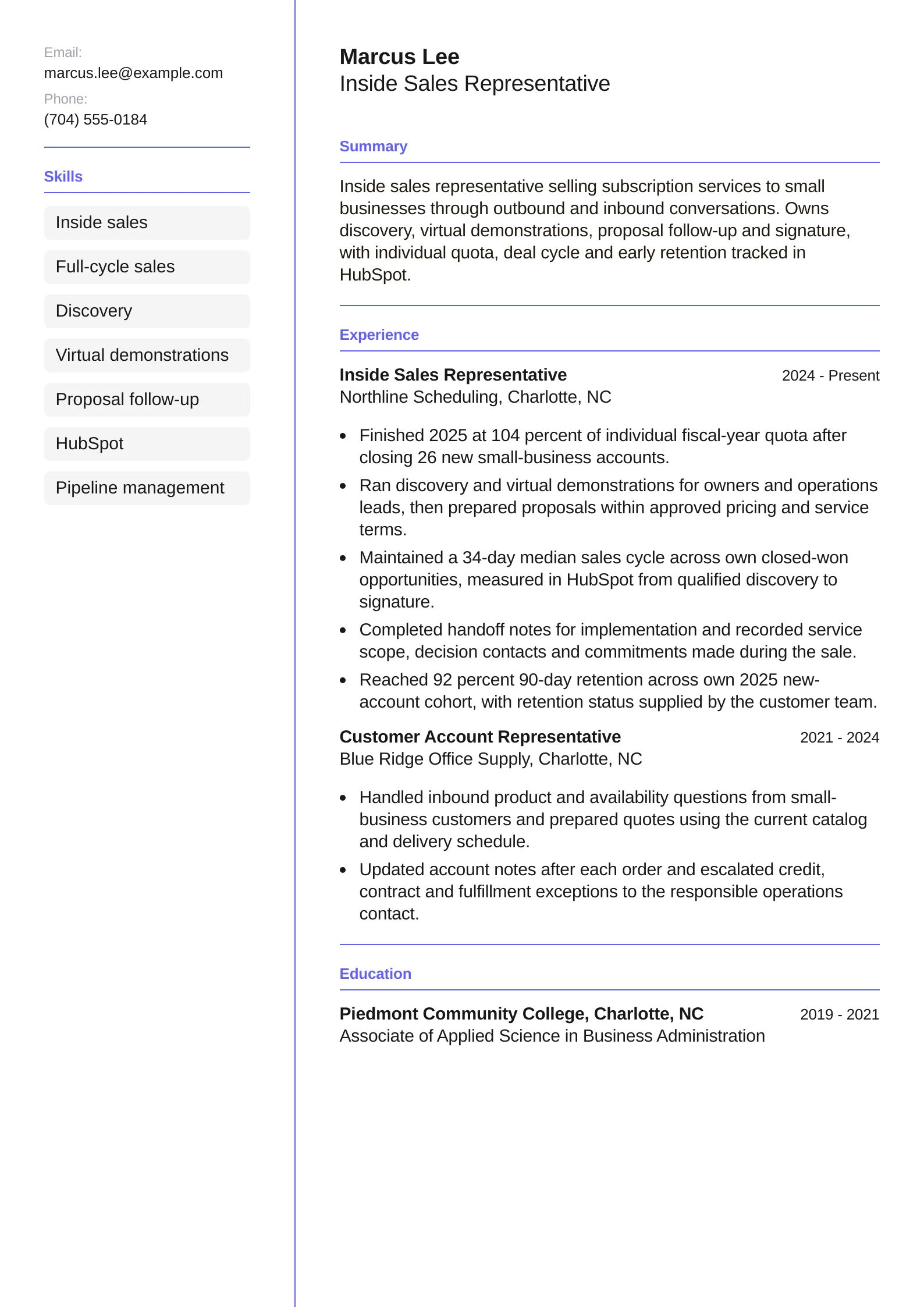
Marcus sells a subscription service to small businesses, handling discovery, virtual demonstrations, proposals and signature. His first bullet leads with 104 percent of individual quota and 26 new accounts, then the next lines explain the work behind those results.
The 34-day median cycle comes from Marcus's closed-won opportunities in HubSpot, and the customer team supplies the 90-day retention status for his 2025 accounts. Start here when you run a mostly remote, full-cycle sale with a shorter buying process.
Find the sales resume that matches your motion
The same sales title can describe very different work. One account executive may close simple deals in a week, while another spends months working through legal, security and several buyers. Match the example to what you sold, who bought it and the part of the cycle you handled.
Keep your own title and dates. Use the example's order and level of detail to decide what belongs near the top, then replace its territory, tools, quota, pipeline and results with your experience.
Entry-Level Sales Representative Resume Example
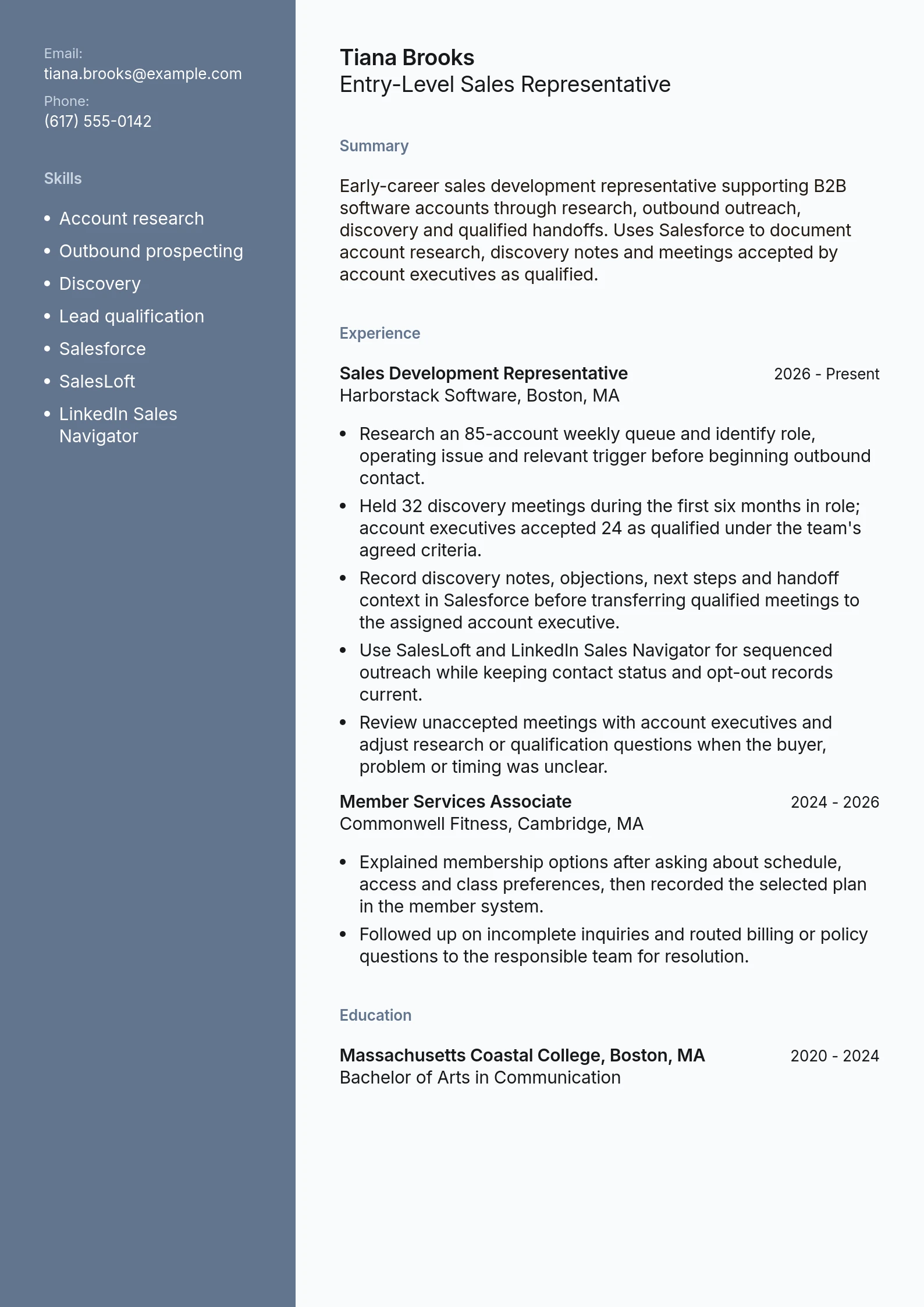
Tiana researches an 85-account weekly queue, runs sequenced outreach and holds 32 discovery meetings in her first six months. Account executives accept 24 of those meetings as qualified, which gives the handoff a concrete result. Use this example when account research, discovery and clean Salesforce notes matter more than a closing history.
Shows the research and discovery work behind an SDR handoff.
Compares held meetings with the 24 accepted as qualified.
Territory Sales Representative Resume Example
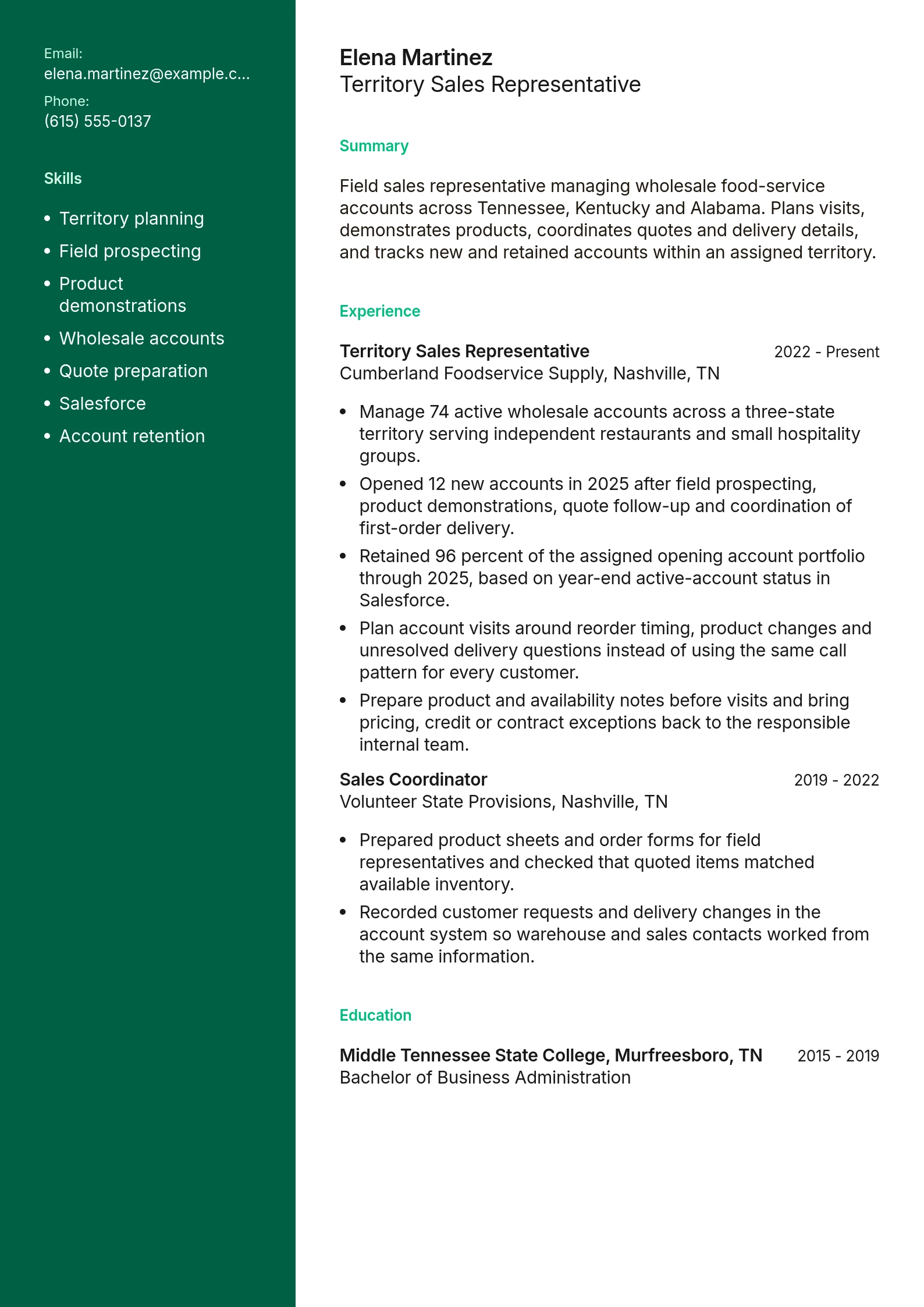
Elena manages 74 active wholesale accounts across Tennessee, Kentucky and Alabama. Product demonstrations, visit planning, stock conversations and order handoffs show what happens between prospecting and renewal. The 12 new accounts and 96 percent retention rate give acquisition and account care separate results. Use this version when geography and repeat business shape the role.
Makes geography and portfolio size visible.
Connects retention to the opening 2025 account portfolio.
Mid-Market Account Executive Resume Example
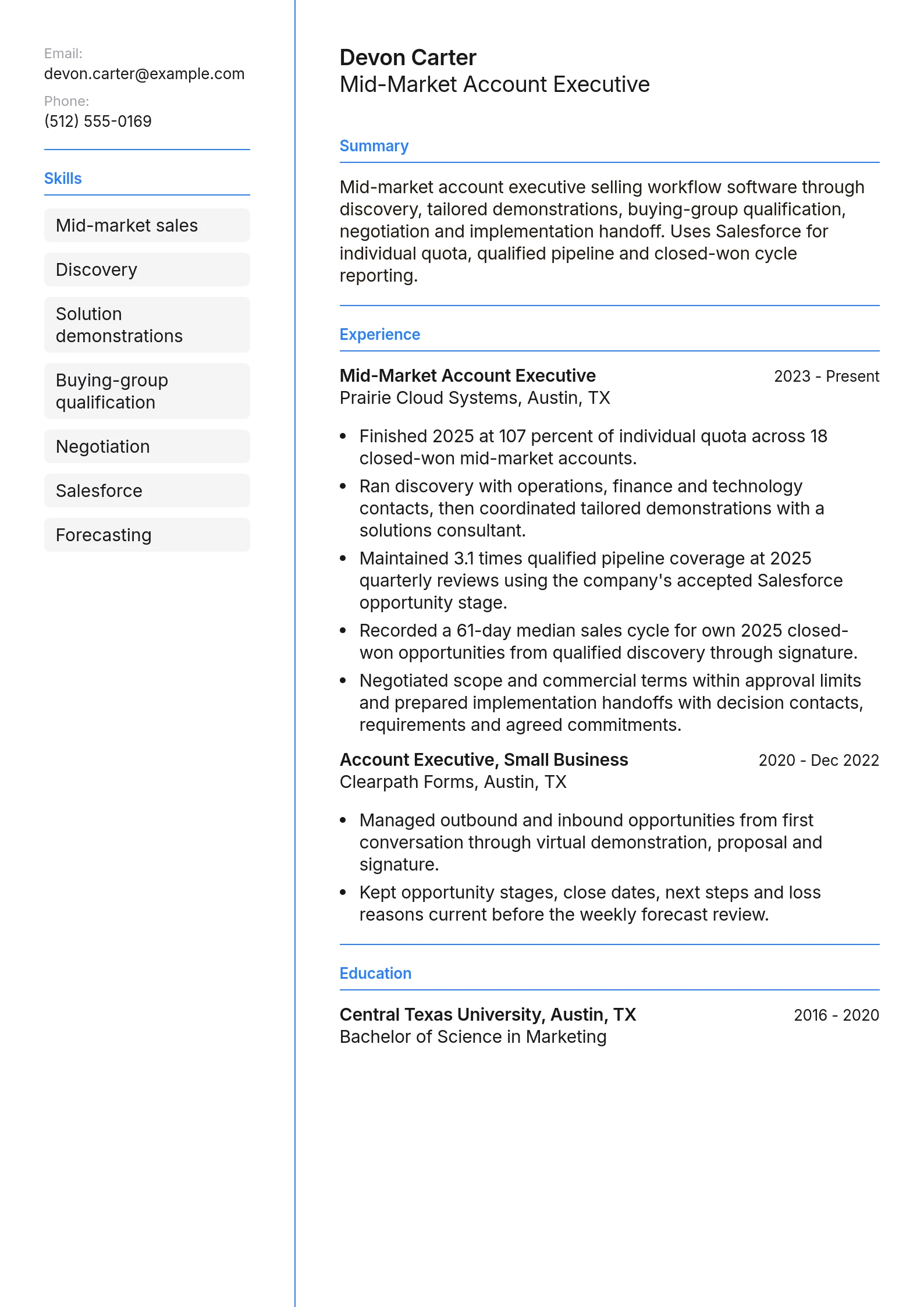
Devon works a consultative software cycle with discovery, tailored demonstrations, buying groups, negotiation and implementation handoff. The resume reports 107 percent of 2025 quota across 18 closed-won accounts, a 61-day median cycle for those wins and 3.1 times qualified pipeline coverage at quarterly reviews. Use it for full-cycle B2B work where deal quality matters more than raw activity volume.
Connects full-cycle work to a defined mid-market segment.
Uses defined Salesforce stages for cycle and pipeline figures.
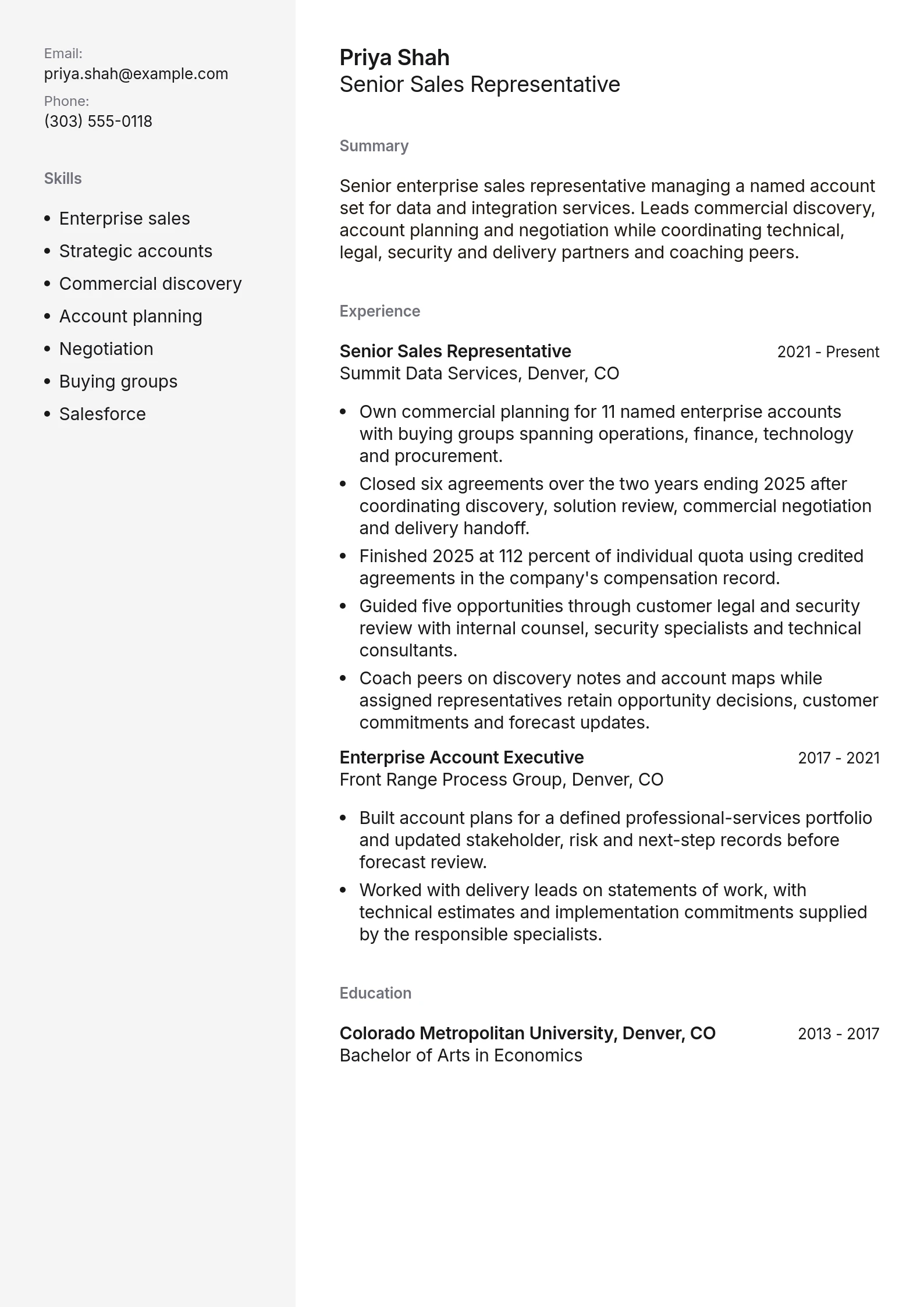
Senior Sales Representative Resume Example
Priya's senior resume covers 11 named enterprise accounts and six closed-won agreements over two years. Five opportunities required legal and security review, so the buying process and internal coordination are easy to picture. Account planning, negotiation and peer coaching complete the story. Choose this example for complex enterprise sales with several decision makers and internal partners.
Shows enterprise complexity through legal and security review.
Combines named-account selling with practical peer coaching.
Start with the sales motion you know
Start with the point where you enter the funnel. An SDR may research target accounts, open conversations and qualify meetings before an account executive takes over. An inside representative may prospect, discover, demonstrate and close within one seat. Those are different stories, even when both people use Salesforce and speak with the same buyers.
Next, match the customer and cycle. High-volume small-business sales may involve many concurrent conversations and decisions in days or weeks. Mid-market work often needs more discovery, a tailored demonstration and several participants. Enterprise sales can add procurement, legal, security, technical evaluation and a longer handoff. Name the motion instead of relying on a title to explain it.
Channel changes the evidence too. Inside sales can show call or meeting load, response follow-up, virtual demonstrations and CRM discipline. A field territory role should make geography, travel rhythm, account visits, product samples, local market knowledge and delivery coordination visible. Neither channel is more senior by default. Scope comes from the customer, complexity, responsibility and results.
The best example is the one that gives your real work a useful order. If the customer, cycle and handoff feel familiar, you can adapt the structure without forcing your experience into another person's sales process. Move the closest evidence forward and keep the details that make your motion distinct.
Write the handoff as clearly as the win
A strong sales bullet makes the process easy to picture. Say where the opportunity came from, what you did and what happened next. That might be researching a named account, qualifying a problem, running discovery, preparing a proposal, negotiating terms, completing an order or handing a signed customer to implementation.
For an SDR, the handoff is often the result. Separate scheduled meetings from the meetings that happened, then show how the team marked one as qualified. Tiana's resume uses 32 held discovery meetings and 24 accepted by account executives. That tells the reader far more about prospecting quality than a large booked-meeting total on its own.
Closing roles need more than a final number. Show the customer segment, source of pipeline and steps you actually carried. A full-cycle inside representative may own outreach, discovery, a virtual demonstration, proposal follow-up and signature. A mid-market account executive might coordinate a product specialist or legal reviewer. The deal is easier to understand when those steps sit beside the result.
Post-sale work belongs when it was part of the role. An order confirmation, implementation handoff, account check-in or renewal conversation can show follow-through. Write the action you took: prepared the implementation notes, introduced the delivery lead, surfaced a renewal risk or qualified an expansion conversation.
Replace duty-list language with the buyer, reason and system behind the work. "Contacted prospects and built relationships" could belong to almost any sales resume. "Researched the operating model of assigned logistics accounts, opened discovery with operations leaders and recorded the agreed next step in Salesforce" gives the reader something concrete.
Put the source beside the sales number
A result with enough context
Finished 2025 at 107 percent of individual quota across 18 closed-won mid-market accounts; Salesforce reports a 61-day median cycle for that closed-won group.
A large result with no context
Drove millions in company revenue, built a huge pipeline and transformed customer retention through high-impact sales leadership.
Explain what each sales metric measures
A useful quota line identifies the quota owner and period. "Reached 104 percent of individual fiscal-year quota" is clear. If you shared a territory or received credit through a split arrangement, use the figure reported in your compensation or CRM record and name the arrangement when it helps explain the result.
Pipeline needs a stage and date. Open opportunities, qualified pipeline and weighted forecast are different populations. State which one you mean and compare it with the right denominator, such as quarterly quota. A snapshot from the final day of the quarter should not be written as if you maintained that coverage all year. If you built only part of the pipeline yourself, separate self-sourced and assigned opportunities.
Conversion rates need both ends of the calculation. An SDR can report that 24 of 32 held meetings were accepted as qualified. That is different from 24 qualified meetings out of every message sent. A closer may track proposals to signed agreements or qualified opportunities to closed-won accounts. Keep the stage names your employer used so the calculation remains clear.
Retention needs a cohort and window. A 92 percent 90-day retention rate across your own new accounts is reviewable. A company-wide annual renewal figure is not your personal result simply because you touched some of the customers. When customer success owns renewal, describe the handoff, risk you surfaced or expansion lead you qualified unless you also carried the renewal target.
Cycle time can explain the motion when the start and end stages stay consistent. Identify the group, such as your 2025 closed-won opportunities, and consider the median when one unusually long deal would distort an average. When the calculation is unavailable, describe the buying stages and leave the duration out.
Make a territory feel like real work
A territory is more than a region name. Show the geography, customer type and size of the account set when those details are not confidential. Elena's example covers 74 wholesale accounts across three states. That tells the reader she planned travel and repeat contact across an established portfolio, rather than working a single retail counter or an unrestricted national list.
Field sales bullets should show what happened during the visit. You may have demonstrated a product, reviewed stock and reorder timing, discussed a new location, prepared a quote or resolved a delivery question. These details explain how product knowledge and customer judgment led to an order. A count of miles driven or calls made rarely does that on its own.
Separate acquisition from account care. New accounts, retained accounts, reopened accounts and expanded accounts answer different questions. If you retained 96 percent of the customers assigned at the start of 2025, state that opening cohort and follow the grouping used in the employer's report.
A territory plan earns a bullet when it changed what you did. Explain how you grouped accounts, selected visit priorities or coordinated stock and delivery with internal teams. Account lists, order records and visit plans usually give you better material than a broad claim about the region.
Retail sales, automotive sales, real estate, insurance, pharmaceutical sales and sales engineering each involve a different transaction, credential or technical story. Tailor the evidence to that specialist setting when it defines the job. The examples here focus on broad business-to-business and service sales.
Show what you did inside the CRM
Start with the posting, then check your own history. Current sales roles repeatedly mention pipeline management, discovery, demonstrations, proposals, negotiation, forecasting, account planning and CRM accuracy. Choose the terms that match your work. A skills section can make them easy to find, but the experience bullets should show the customer, record or decision behind the important ones.
Name a CRM where it helps explain the work. Salesforce or HubSpot can sit in a bullet about qualification notes, stage updates, next steps, pipeline reviews, forecast changes or account handoffs. Use the system from your role and describe the record you maintained; standard sales use and CRM administration are different kinds of experience.
O*NET's current employer-posting data for a wholesale sales occupation names Salesforce, Microsoft Office, Excel, PowerPoint and Outlook most often among listed technologies. That is a market pattern, not a required bundle. A field representative may use Excel for account planning and PowerPoint for product presentations. An SDR may rely more on Salesforce, SalesLoft, ZoomInfo or LinkedIn Sales Navigator. Match the role in front of you.
Add a sales methodology when you used it in real opportunities. If the posting names MEDDPICC, SPIN or Challenger, look for the discovery, qualification and buying-process work in your own history. A formal training record can support the term, but the bullets should still show how it shaped an opportunity.
Forecasting deserves a concrete description. State whether you reviewed your open opportunities, updated close dates, recorded risks or presented a commit category. "Kept opportunity stages and next steps current before weekly forecast review" shows the routine clearly. Add forecast accuracy only when you know the definition, period and calculation.
Keep soft skills out of a detached adjective pile. Listening becomes visible when discovery changes the proposal. Negotiation appears in a term or scope decision. Organization shows up in a clean territory plan and follow-up record. These examples are easier to trust than a list containing persuasive, driven and relationship-focused.
Show what makes the sale complex
Mid-market and enterprise resumes should make the buying path visible. Name the customer segment, typical stakeholders and stages that made the work complex. A legal review, security assessment, procurement process or technical evaluation can show why a deal took time. Deal size alone does not reveal whether the candidate navigated that work.
Internal partners matter when their contribution is clear. You might coordinate a solutions engineer for technical discovery, work with finance on pricing, ask legal to review terms or prepare customer success for onboarding. Name the decision or handoff each partner helped move, instead of collapsing the work into a line about cross-functional leadership.
Senior individual contributors can show account judgment, negotiation, repeatable practice and peer support. Priya's example covers 11 named enterprise accounts, five opportunities with legal and security review, and six closed-won agreements over two years. Her peer coaching adds another useful dimension to the senior role.
Mentoring belongs when you can describe it. Reviewing discovery notes, listening to a call, helping a peer map a buying group or sharing a territory-planning method are credible examples. If you managed a team, make that scope concrete with team quota, hiring responsibilities, performance reviews and the number or roles of the people you led.
Company results often involve product, marketing, delivery and customer success as well as sales. Lead with your individual quota record, attributed agreements or named contribution. When the outcome belongs to a team, add your part of the work and keep the company figure as context.
Write a sales summary with a customer, motion and result
Give the summary a specific job: explain what you sell, the customer segment and the motion you know. Two or three sentences are enough. Add one result with its period or account group, then let the experience section carry the detail.
For example: "Inside sales representative selling subscription services to small businesses through outbound and inbound conversations. Finished 2025 at 104 percent of individual quota across 26 new accounts." A territory rep might lead with geography and portfolio size; an enterprise seller may start with named accounts and a multi-party buying process.
An entry-level candidate can use the same space to explain the move into sales. Name the customer-facing work, research or outreach experience that transfers, then point to the strongest example below. If the summary only repeats your title and skills list, remove it and let recent experience start the story.
Keep the skills section compact. CRM, prospecting, discovery, demonstration, negotiation, forecasting, territory planning and account management can be useful headings when they match the role. List each idea once, then let the bullets show the terms that matter most.
One page often suits an early-career sales applicant. A senior representative with several relevant roles may need two pages when the second page shows progression, different segments or meaningful account scope. Remove repeated activity bullets and old unrelated work before shrinking the type or cutting evidence that explains a long sales cycle.
Use familiar headings, plain contact details and consistent dates. Check that exported text reads in the intended order and that page breaks do not separate a role from its bullets. The layout should make the customer, sales motion and strongest result easy to find.
Build an entry-level story from customer-facing work
A first sales resume can start with customer service, fundraising, campus outreach, appointment setting or another setting where you listened, explained an option, handled objections or followed up. Keep the original job or volunteer title, then write the parts of that work that transfer to the target sales motion.
For an SDR application, make research and communication easy to inspect. You might show how you built a target list for a class project, prepared questions before a customer conversation or kept follow-up notes in a student organization. If you practiced with a CRM sandbox or completed product training, state that learning context instead of presenting it as professional pipeline ownership.
Activity counts can help, but quality matters. Scheduled meetings, held meetings and qualified meetings are different. Without a formal qualification definition, describe the information you gathered and the handoff you made. A small, specific example gives an interviewer something useful to ask about.
Keep education and relevant training visible under their exact names. A bachelor's degree is not universal across sales jobs, and general sales certificates are different from industry licenses. For insurance or real estate, list each license you hold with its jurisdiction and current status.
Tailor by moving the closest evidence forward. A hospitality worker applying to inside sales may lead with customer conversations, booking follow-up and a measured service target. A student applying to field sales might emphasize presentations, travel planning and responsibility for materials. Keep the original job title while using the bullets to make the transition clear.