Compare nine complete Account Executive resumes designed for different career stages and sales segments. Focus on how each resume presents prospecting, pipeline generation, quota attainment, closed revenue, forecasting, and account expansion, while clearly attributing discounts, contracts, team results, and final approvals to the people responsible for them.
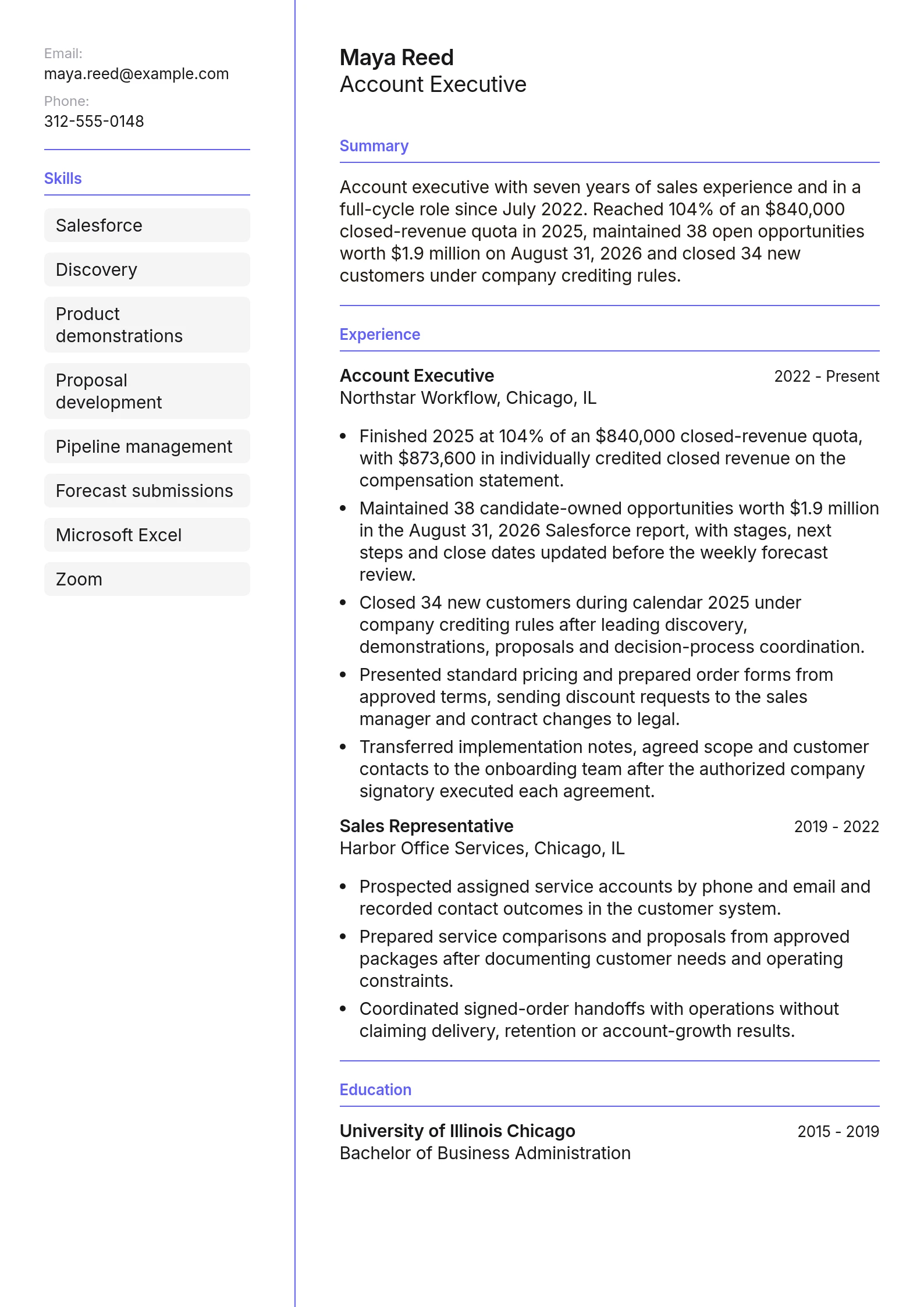
Maya is a useful broad starting point. Her resume covers prospecting, discovery, demonstrations, proposals, pipeline, closing and implementation handoff, but it never suggests that she controlled every commercial decision. Her 104% attainment also shows the math: an $840,000 quota and $873,600 in credited closed revenue for calendar 2025.
The rest of Maya's record follows the same rule. Her $1.9 million pipeline is an August 31 snapshot across 38 candidate-owned opportunities, not projected revenue. The 34 customers follow company crediting rules. Discounts go to her manager, contract changes go to legal and signature authority stays with the authorized company signatory.
Compare 9 Account Executive resumes by stage and segment
Start with the resume closest to your sales motion, customer segment and real authority. An associate needs promotion context and coached full-cycle work. An enterprise seller needs named-account, specialist and executive coordination. In expansion roles, the line between commercial work, customer success and renewals matters just as much as the number.
All people, employers and internal records on this page are fictional. Every number has a source record, period or snapshot, denominator and contribution boundary in the evidence ledger. Before you reuse a line, replace it with a figure from your own compensation statement, CRM report, activity log or approved company record.
Associate Account Executive Resume Example
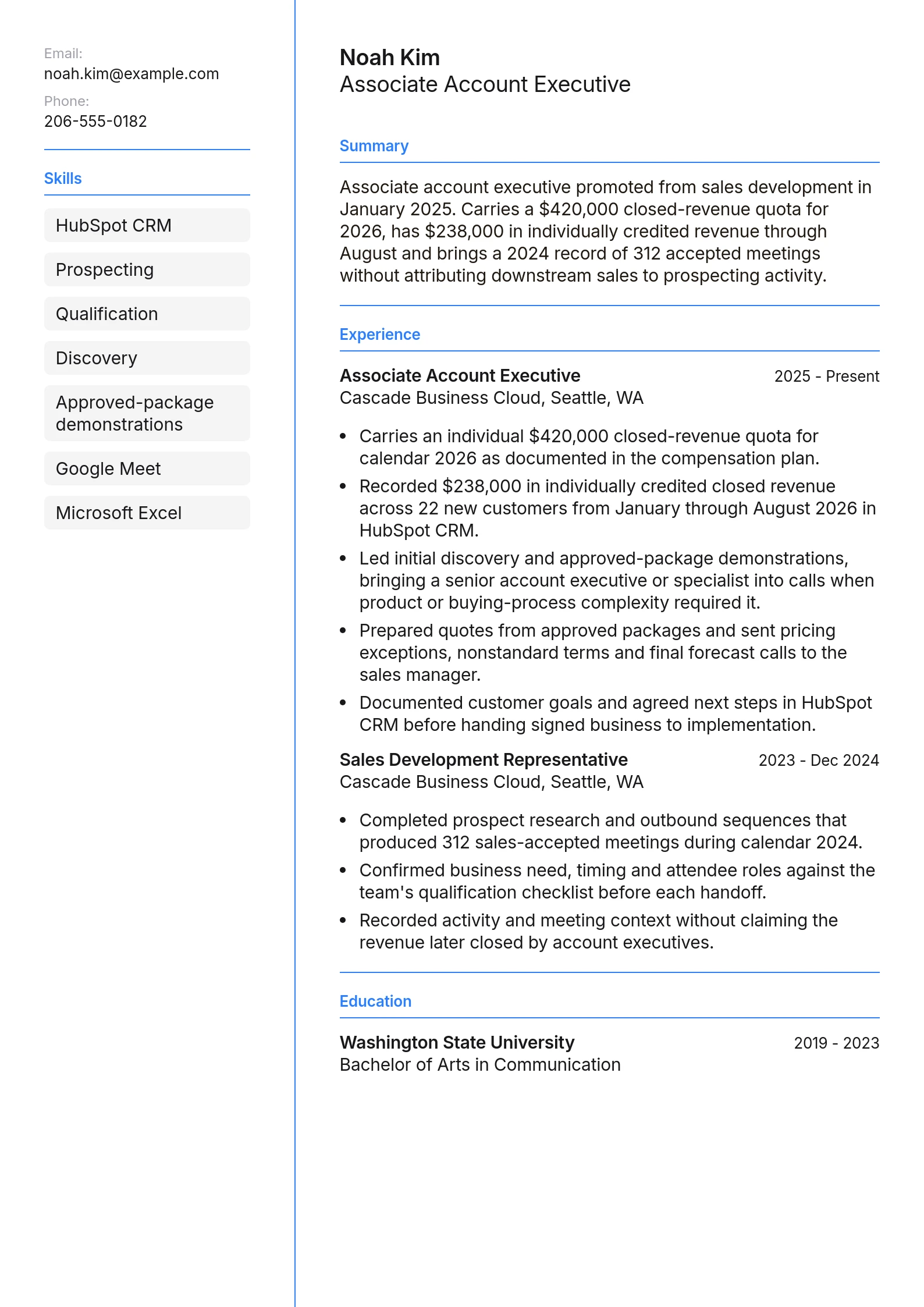
Noah's resume makes the promotion from sales development easy to follow. It shows a $420,000 quota for 2026 and $238,000 in credited revenue through August, then keeps his earlier 312 accepted meetings in the SDR role. That separation lets him show momentum without taking credit for revenue closed by the account executives he previously supported.
Shows promotion into closing.
Keeps 312 SDR meetings separate from the 22 customers credited after promotion.
First Full-Cycle Account Executive Resume Example
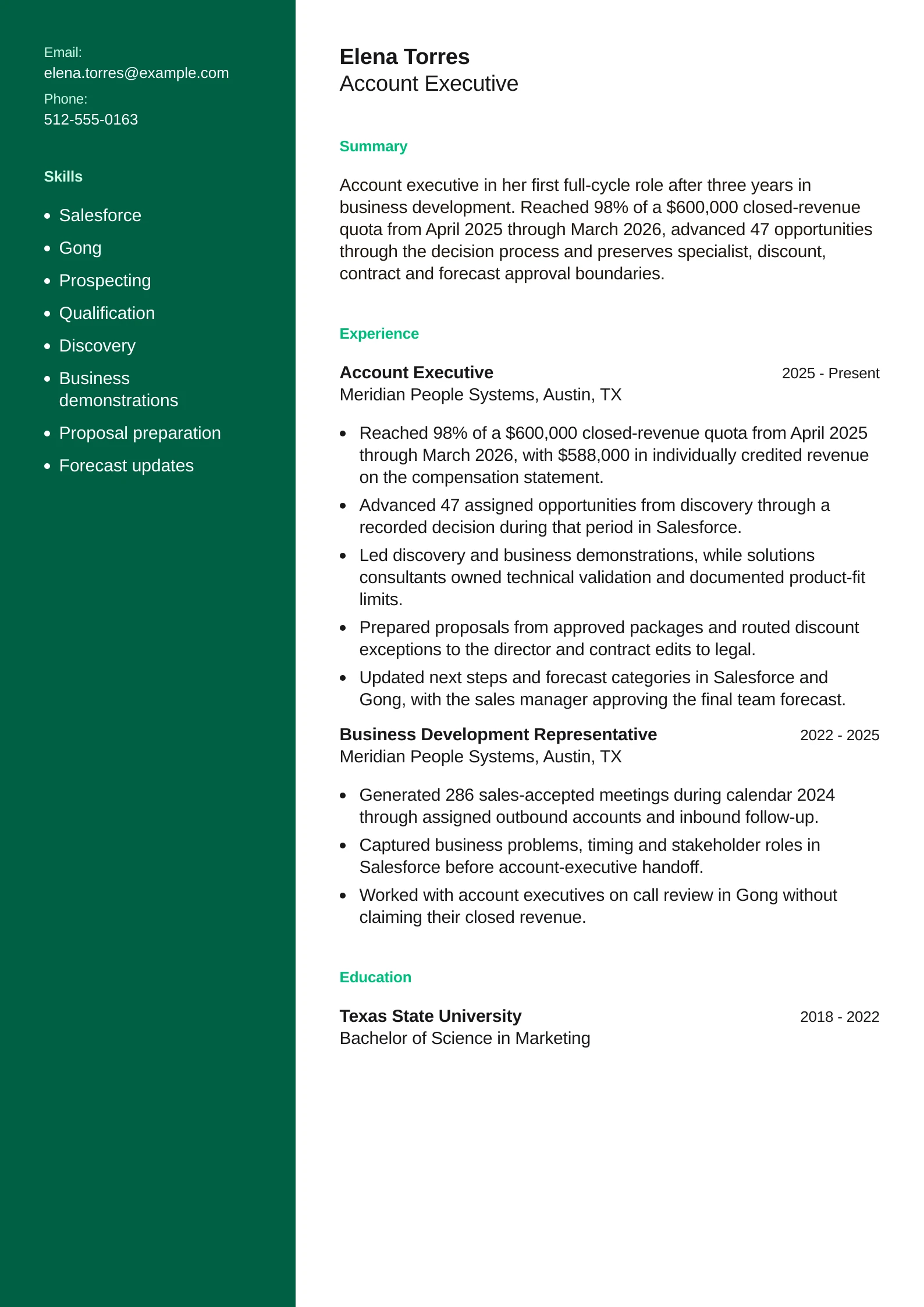
Elena is in her first full-cycle role, so the resume connects her earlier qualification work to new responsibility for discovery, demonstrations, proposals and forecast updates. Her 98% attainment names the $600,000 quota and $588,000 credited result for April 2025 through March 2026. Specialists, the director, legal and her manager still keep their approval roles.
Shows first full-cycle ownership.
Keeps technical validation, discounts, contracts and forecast approval with their documented owners.
Experienced Account Executive Resume Example
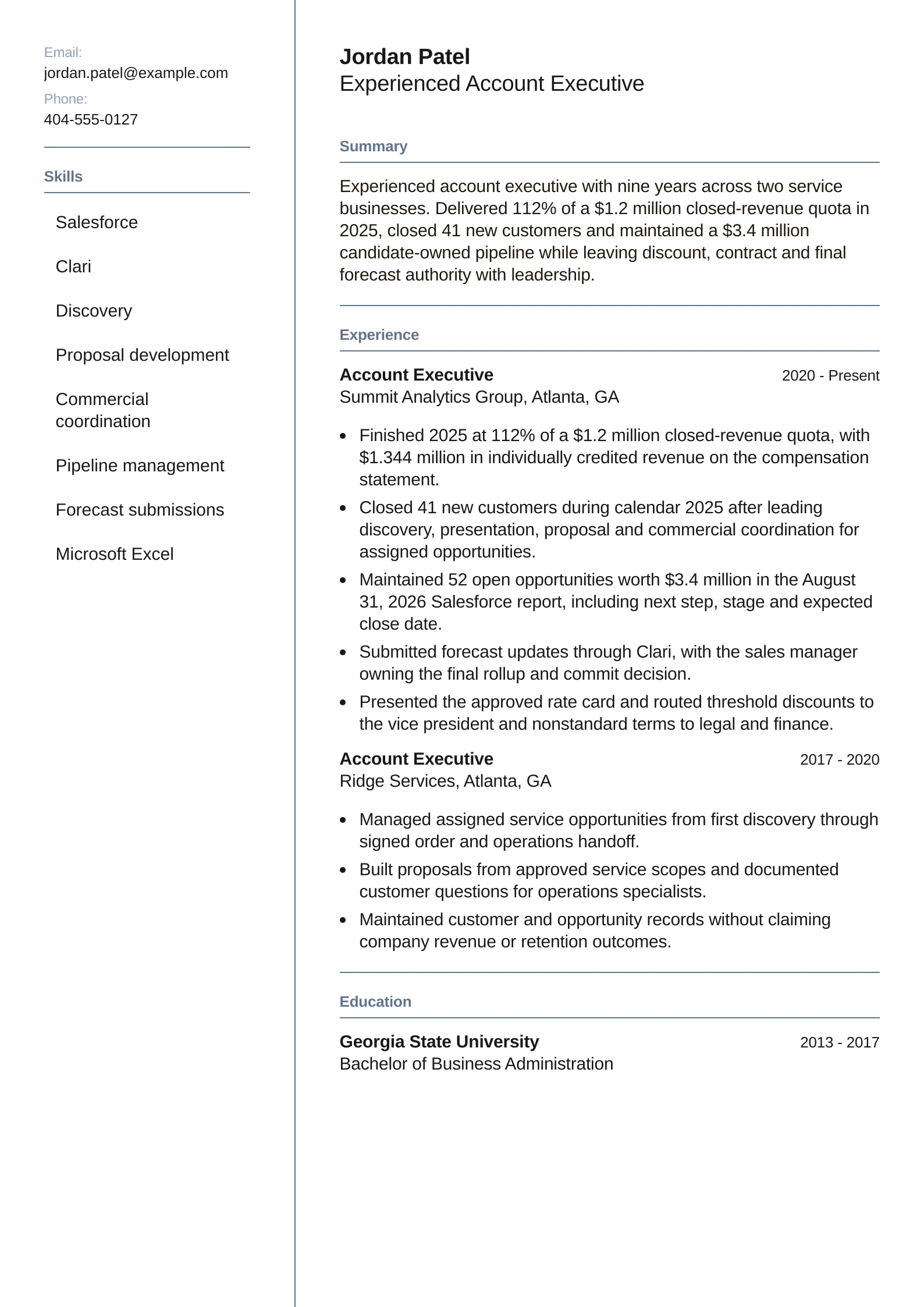
Jordan's nine-year record has enough history to lead with a full-year result: 112% of a $1.2 million quota and $1.344 million in credited revenue for 2025. The $3.4 million pipeline is correctly shown as an August 31 snapshot. Pricing exceptions, contract terms and the final forecast rollup stay with leadership, legal and finance.
Shows experienced full-cycle results.
Dates the $3.4 million pipeline separately from closed revenue and quota attainment.
Senior Account Executive Resume Example
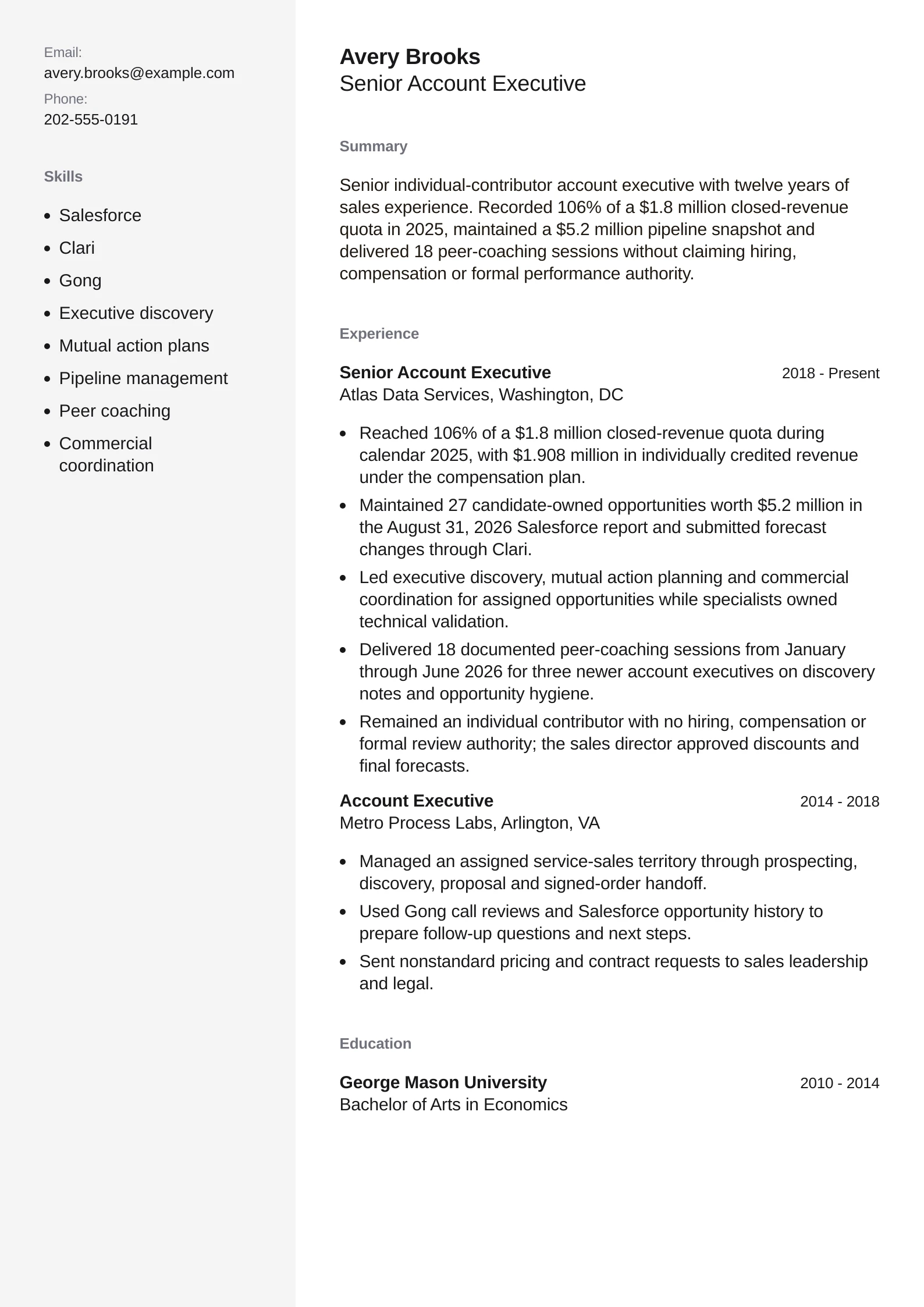
Avery is a senior seller, not a sales manager. The resume combines 106% attainment against a $1.8 million quota with a $5.2 million pipeline snapshot and 18 peer-coaching sessions. It also states that Avery had no hiring, pay or formal review authority, which keeps senior individual contribution distinct from people leadership.
Shows senior individual contribution.
Keeps 18 peer-coaching sessions distinct from hiring, pay and review authority.
Small Business Account Executive Resume Example
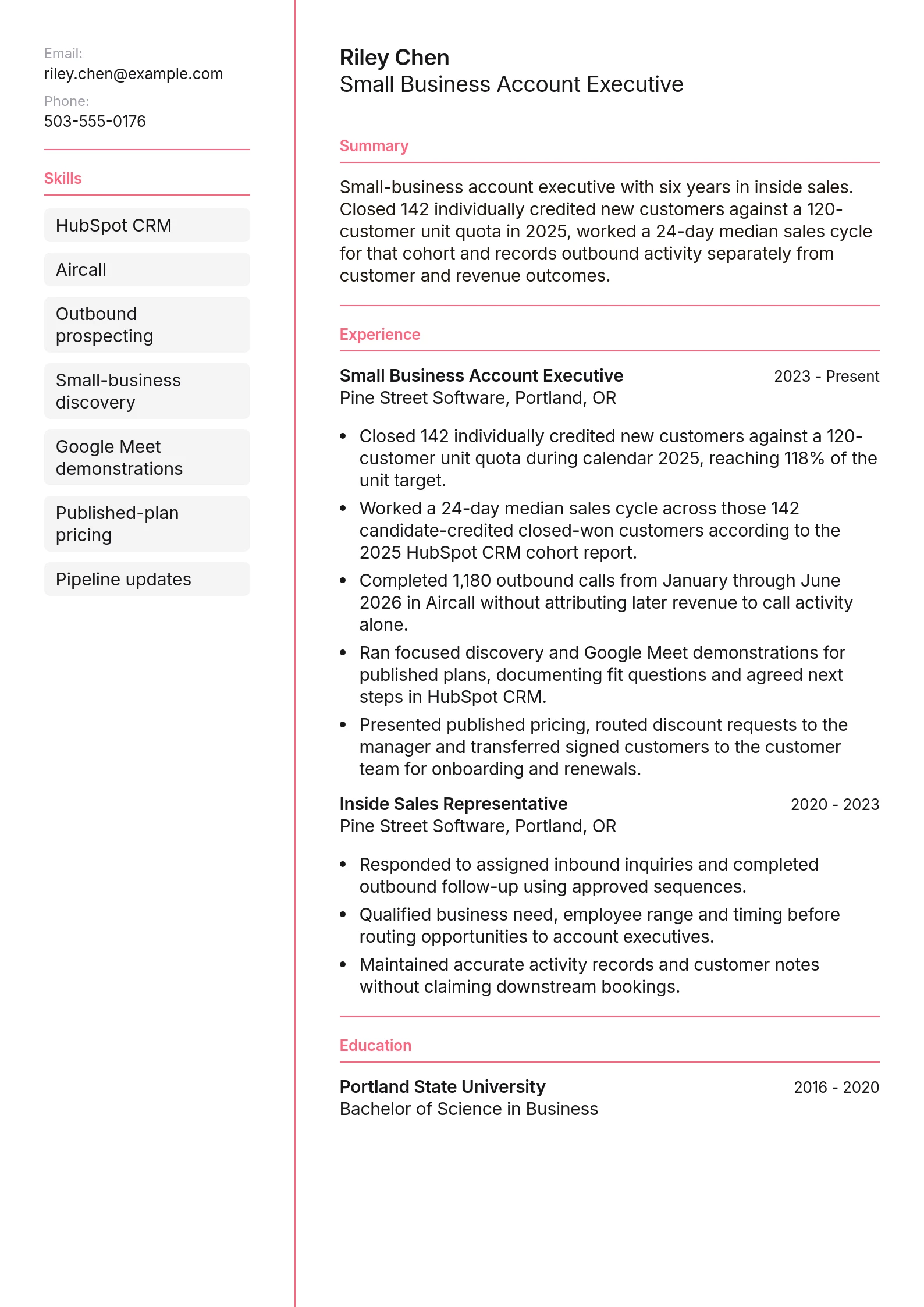
Riley's small-business resume uses the measures that fit a high-volume motion: 142 credited customers against a 120-customer unit quota, a 24-day median cycle for that same cohort and 1,180 outbound calls in six months. The call count remains activity evidence rather than a claim that every call caused a sale.
Shows small-business volume.
Treats call volume as activity, not proof of sales causation.
Mid-Market Account Executive Resume Example
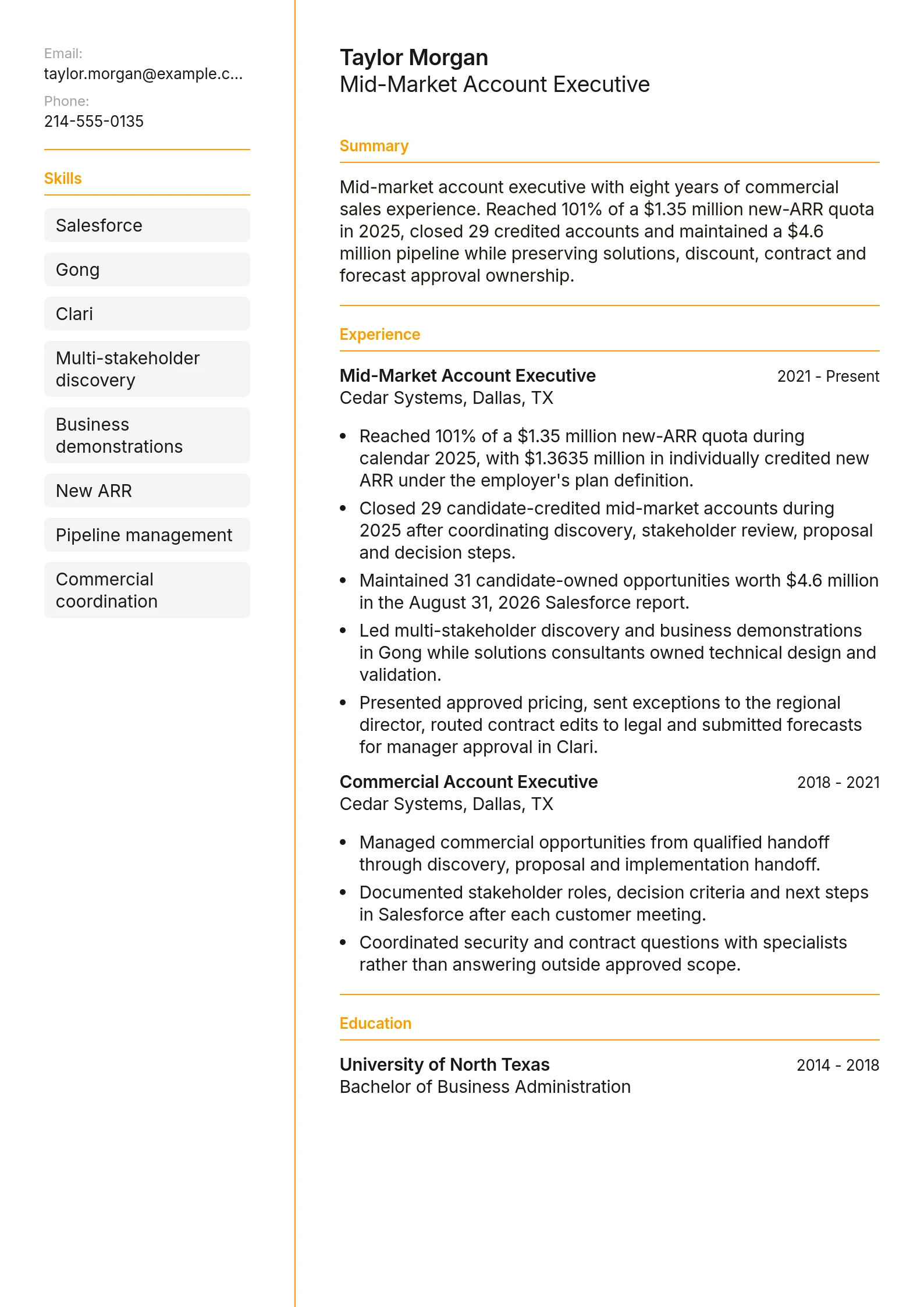
Taylor's mid-market example shows why segment matters. The resume pairs 101% of a $1.35 million new-ARR quota with 29 credited accounts and 31 open opportunities worth $4.6 million. Multi-stakeholder discovery is visible, while solution design, discount approval, contract language and the final forecast remain with their actual owners. That makes the scale easy to inspect.
Shows mid-market stakeholders.
Names the owners of solution design, discounts, contracts and forecasts.
Enterprise Account Executive Resume Example
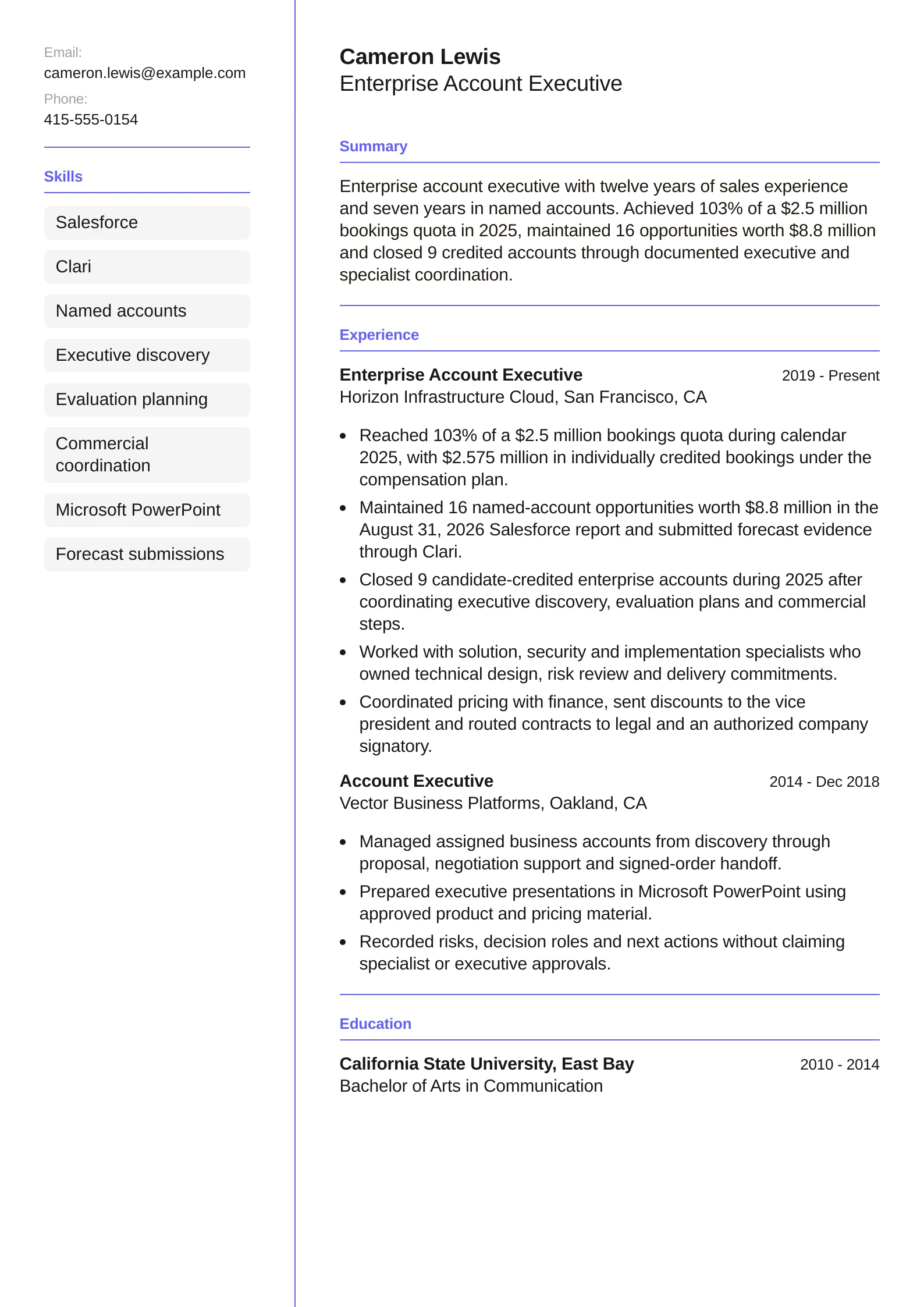
Cameron's enterprise record is built around 16 named-account opportunities, $8.8 million in open pipeline and 9 credited accounts. The 103% result uses bookings, not ARR or revenue, and names a $2.5 million quota. Solution, security, finance, legal and executive partners retain the approvals they handled. The complexity comes through in the process, not a borrowed team result.
Shows enterprise coordination.
Uses bookings, named opportunities, closed accounts and approval handoffs with exact scope.
Expansion Account Executive Resume Example
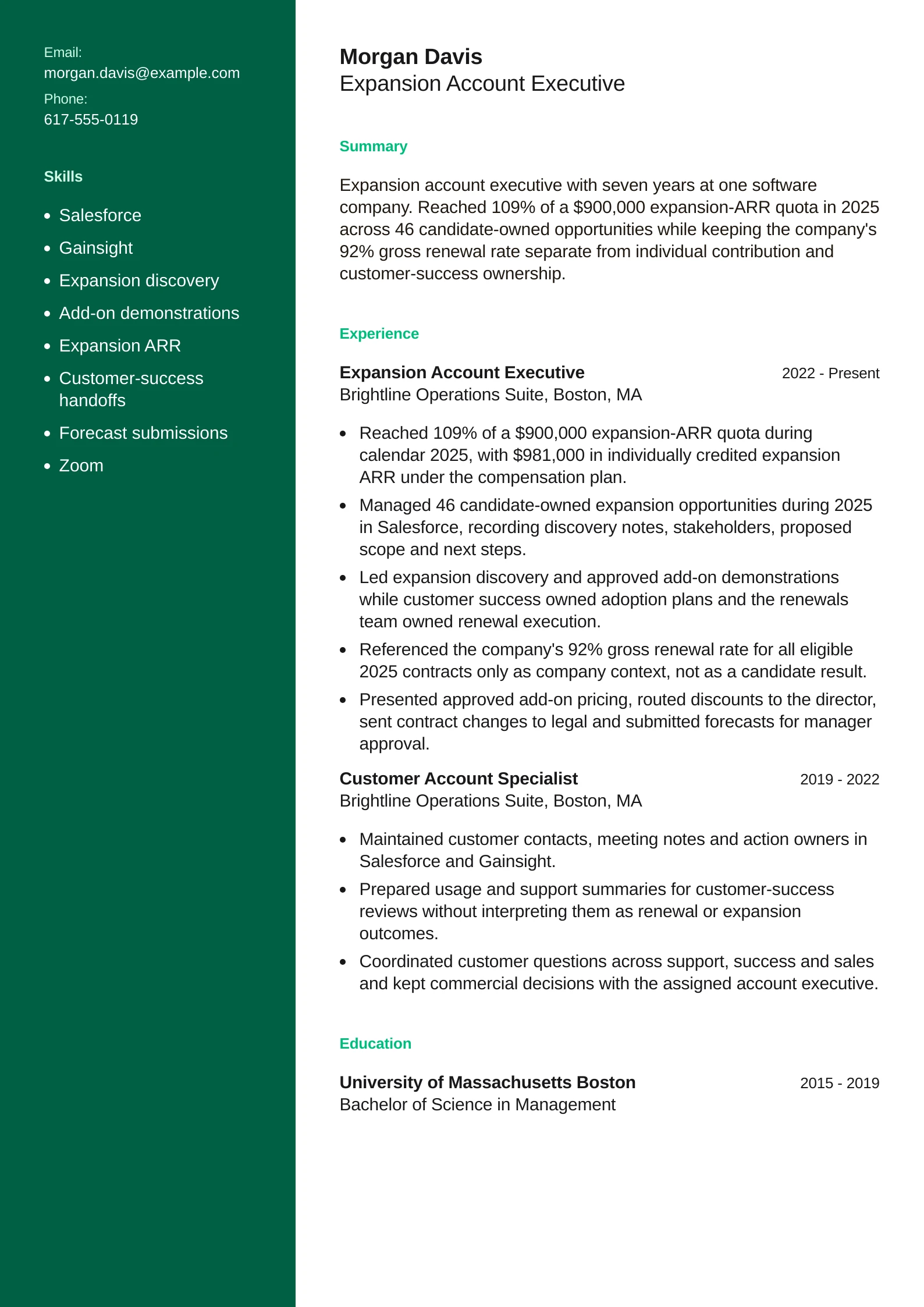
Morgan's resume is for expansion selling inside an existing customer base. It shows $981,000 in credited expansion ARR against a $900,000 quota and 46 candidate-owned opportunities. The company's 92% gross renewal rate is clearly labeled as company context, while customer success and the renewals team keep their own results. Commercial expansion and post-sale ownership stay distinct.
Shows expansion ownership.
Labels renewal performance as company context, not a personal result.
Choose the example by sales motion, segment and authority
Start with the work you actually owned, then check the segment. Small-business roles may involve many short-cycle opportunities and published plans. Mid-market sellers often coordinate several stakeholders and a solutions consultant. Enterprise sellers may carry fewer named opportunities but spend more time with security, finance, legal and executive buyers. The title by itself won't tell that story.
Career stage matters separately. An associate account executive can show a real promotion from sales development, a current quota and the part of discovery or demonstration already handled. A first full-cycle seller should connect earlier prospecting evidence to the new closing role without claiming the revenue of account executives supported in the past. A senior individual contributor can show complex opportunities and peer coaching while keeping hiring and performance authority out.
Then compare commercial ownership. Some roles focus on new customers, others on expansion within an installed base. If renewals, adoption or implementation belonged to another team, name the handoff. That boundary makes the resume more credible because the reader can see both the candidate's contribution and the operating model around it.
Give every sales metric a source, period and denominator
Quota attainment is useful only when the reader can see the math. Include the assigned quota, credited result, period and metric type. Maya's 104% means $873,600 in credited closed revenue against an $840,000 quota for calendar 2025. Taylor reports new ARR and Cameron reports bookings. Keep those definitions separate.
Treat pipeline as a dated view of open work. Give the snapshot date, amount, opportunity count and your role. An August 31 report showing $4.6 million across 31 candidate-owned opportunities describes scope, but it doesn't say the amount closed or that the candidate sourced every deal. Leadership still owns the final forecast rollup.
Activity measures need the same care. Calls, meetings and opportunities show work volume, but they do not automatically cause revenue. Noah's 312 accepted meetings belong to his sales-development record, and the resume explicitly avoids claiming what later closed. A median sales cycle should name the cohort behind it. A company retention rate can appear only as attributed context, never disguised as an individual's result. Keep the source close enough for a reviewer to verify.
Separate selling work from commercial approval
Prospecting and qualification
Accounts researched, contacts made, accepted meetings or qualified opportunities
Do not attribute later revenue without crediting evidence
Discovery and demonstrations
Questions led, stakeholders mapped and approved material presented
Specialists own technical design or validation when that was the model
Opportunity evidence and candidate forecast submitted
Sales leadership owns the final rollup or commit
Post-sale work
Implementation context or expansion handoff documented
Onboarding, customer success and renewals retain their results
Build Account Executive bullets from the sales record
Build the first sales bullet from the record, not from a generic action-verb list. A strong version might say: reached 101% of a $1.35 million new-ARR quota in calendar 2025, with $1.3635 million in individually credited new ARR. The period, denominator and crediting boundary are all visible.
For pipeline work, describe what you maintained: number of opportunities, snapshot value, date, stages, next steps and forecast submission. Avoid saying you generated the whole pipeline unless the CRM and crediting rules support that claim. Sourced or inherited opportunities can still demonstrate strong discovery and progression work when the resume describes them honestly.
Commercial-process bullets should name the next owner. Presented approved pricing and routed exceptions to the regional director is stronger than negotiated all pricing if the candidate had no discount authority. Coordinated contract edits with legal is accurate and valuable. It does not imply that the account executive approved legal language or signed for the company.
Show the move from prospecting into a closing role
Early in an Account Executive career, credibility matters more than scale. Lead with the promotion, current quota, credited revenue to date and the discovery or demonstration work already entrusted to you. Noah's 2026 quota and January-through-August revenue are presented as a partial-year record, not dressed up as full-year attainment.
Earlier SDR or BDR work should retain its own measures. Accepted meetings, qualified opportunities, call volume and research coverage are useful when they come from activity or acceptance reports. Keep downstream bookings with the account executive who received the opportunity unless the compensation system explicitly credits the earlier role.
For a first full-cycle move, show the connection between the two jobs. Elena brings qualification discipline forward, then adds discovery, demonstrations, proposals and forecast updates in the new role. She also names where solutions consultants, the director, legal and the sales manager enter the process.
Make small-business, mid-market and enterprise records genuinely different
For small-business sales, use the volume and cycle evidence the job actually produces. Riley shows 142 credited customers, a 120-customer unit quota and a 24-day median cycle for that exact cohort. Published plans and manager-approved discounts fit the role. Executive committees and custom contracts would not.
Mid-market evidence often adds more stakeholders and specialist collaboration. Taylor's record combines new ARR, 29 credited accounts, a dated pipeline and multi-stakeholder discovery. The solutions consultant owns technical design, the regional director owns exceptions and legal owns contract language. Those relationships give the resume texture without inflating the title.
Enterprise work should show complexity through the process, not only a bigger dollar figure. Cameron manages 16 named-account opportunities, coordinates evaluation plans and works with security, solution, finance, legal and executive partners. Nine closed accounts can be meaningful at this segment when the quota, bookings and crediting rules are stated clearly.
Keep expansion selling separate from renewals and customer success
Expansion selling starts with an existing customer, but it is still commercial work. The account executive may run discovery, present add-ons, prepare proposals and coordinate pricing or contracts. Adoption planning, renewal execution and the company's retention rate may belong to other teams.
Morgan's example reports $981,000 in credited expansion ARR against a $900,000 quota and 46 candidate-owned expansion opportunities in 2025. The company's 92% gross renewal rate is labeled as company context across all eligible contracts. The resume does not convert that rate into a personal retention achievement.
If your job blended expansion and renewal work, separate the measures anyway. Name the eligible account population, contract period, revenue definition and crediting method. Then state which team owned adoption, renewal processing, support and implementation.
Connect Account Executive tools to a real workflow
Salesforce or HubSpot CRM
Updated contacts, opportunities, stages, next steps and credited results
A skill entry by itself doesn't prove pipeline ownership
Clari
Submitted candidate forecast evidence and category changes
Final commit and team rollup may belong to leadership
Gong
Reviewed calls, recorded discovery evidence or coached peers
Call review doesn't prove AI expertise or a performance result
Gainsight
Maintained customer notes or prepared usage context
Do not claim renewal or adoption ownership automatically
Excel or PowerPoint
Analyzed approved sales records or prepared customer presentations
Name the actual task rather than an unsupported proficiency level
Use current job postings as patterns, not a universal checklist
Live postings from Accela, Higher Logic, Enumerate, AppDirect and Descript share a familiar core: pipeline development, discovery, demonstrations, proposals, CRM discipline, forecasting and cross-functional work. The details vary sharply by segment, product, experience and approval model.
Treat those differences as a tailoring prompt. If the target role stresses greenfield prospecting, move sourced-account work and new-customer evidence higher. If it stresses enterprise expansion, show existing-account discovery and stakeholder coordination. Do not borrow the employer's product name, industry expertise, methodology or tool unless it is genuinely in your record. Read the responsibilities before the qualifications and mark the work you can prove.
Read each requirement at the right level. A posting may ask for a particular experience range, travel pattern, location or product background. Those are conditions for that employer, not universal facts about account executives.
Keep adjacent sales and specialist account roles on their own pages
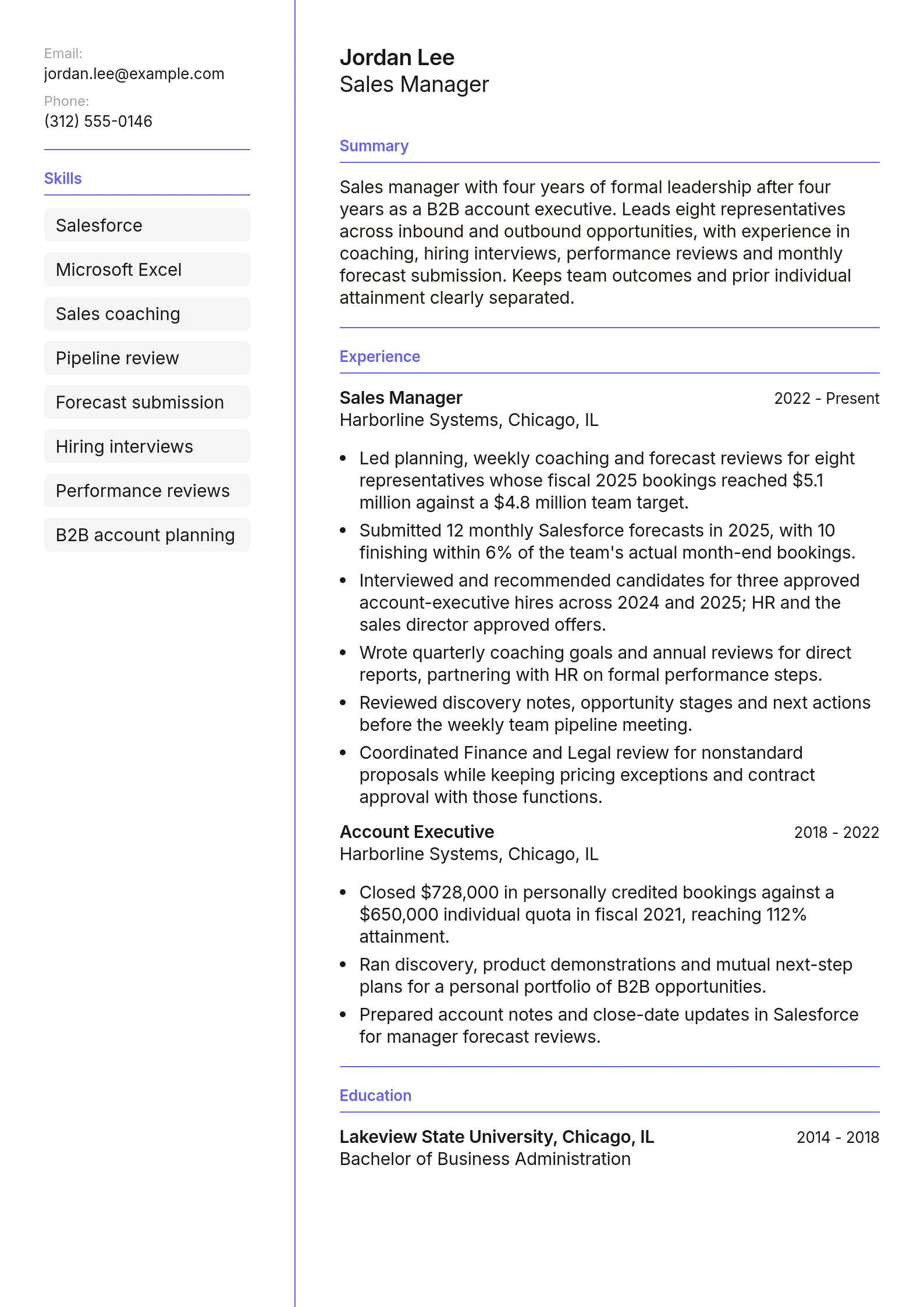
Stay on this page for broad Account Executive work and direct career-stage or segment variations. Move to Account Manager or Customer Success Manager examples when post-sale service, adoption, renewals or relationship ownership drive the role. Choose Sales Manager when the record includes hiring, performance management and team forecasts. SDR and BDR pages are better for qualification and accepted-opportunity evidence.
Advertising Account Executive and Assistant Account Executive intent also has separate canonical owners. Their media, campaign, agency and support workflows differ from the broad service-sales pattern here. Key Account Executive and Sales Account Manager pages likewise need their own account portfolios, relationship model and commercial boundaries.
Regulated or industry-specific titles should route rather than borrow generic claims. Insurance, financial-services, logistics, pharmaceutical, advertising and travel selling can introduce licenses, product rules or specialist knowledge that this broad page does not establish.
Use a format that makes the sales evidence easy to inspect
Use a familiar order: contact details, a short summary, experience, skills and education. In the summary, name the segment, experience shape and one or two sourced results. Put the current sales role first, with the clearest quota or credited outcome at the top of that entry.
One page often works for an associate or focused seller. Two pages may help when the candidate has real progression across segments, several employers or complex enterprise work. Remove repeated sales-process language before shrinking the type. A clear progression from SDR to associate or commercial to enterprise is worth preserving. Keep the evidence that explains the promotion, segment change or increase in commercial complexity.
Keep skills that you can point to in experience. Salesforce, HubSpot, Clari, Gong, Gainsight, discovery, demonstrations, proposals and forecast submissions all need a real task behind them. Leave out an employer's product, sales methodology or certification unless it belongs to your own record.
Check four sales records before you submit
Open the compensation statement, CRM opportunity report, activity log and approval policy behind the draft.
Top tip
Can each quota, revenue, ARR, bookings, pipeline, cycle and activity number be traced to one of those records? Does every result name its period and denominator? Are company and team figures attributed? Do the pricing, discount, contract, forecast, implementation, renewal and expansion verbs match the authority you actually held? If a number cannot survive that check, replace it with the customer, opportunity or process scope you can document.
Account Executive resume questions
Use these answers to tighten the final draft without inflating the sales record.