Compare six property manager resumes built around real operating scope: residential, onsite, commercial, multifamily and multi-property work. See how to describe leases, systems, credentials, budgets and vendor coordination while keeping accounting, maintenance, legal, broker and owner decisions with the people who made them.
Start with a residential manager whose operating scope is clear
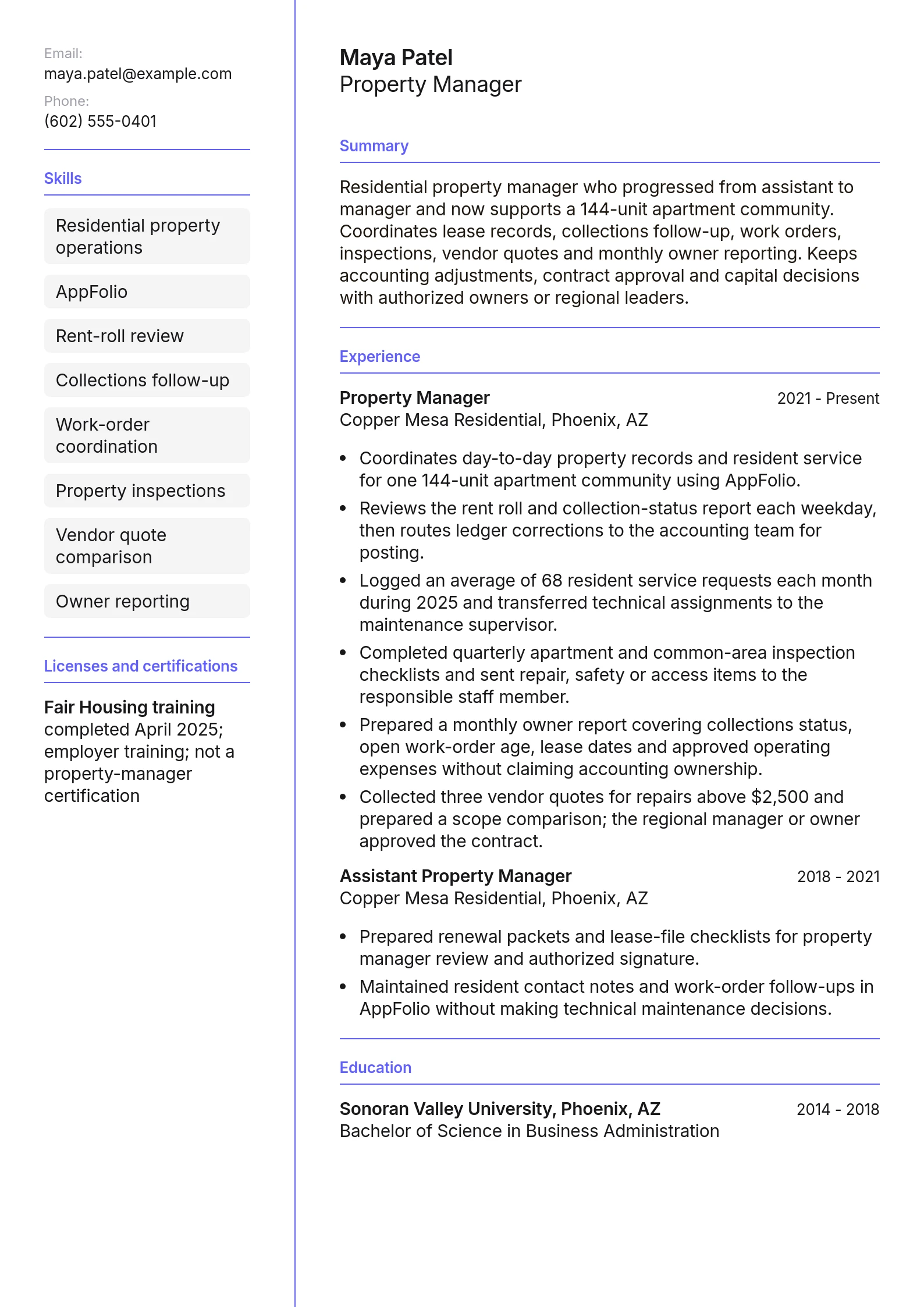
Maya's current role covers one 144-unit residential community. That fact comes first because it gives every later detail a useful frame. Her bullets then show rent-roll review, service requests, inspections, owner reports and vendor quotes, with AppFolio attached to the records she actually handles.
Notice where the decisions stop. Accounting posts adjustments, maintenance assigns technical work, and the regional manager or owner approves contracts. Maya still looks experienced because the resume shows the preparation, judgment and follow-through that belong to her. It never turns a recommendation into an approval.
Make a short evidence list before you adapt the example. Include the rent roll, lease calendar, inspection log, work-order report, invoice register, vendor file and credential record. Match every number to a source and note who approved the next step. This catches accidental overstatement before it reaches the resume.
Choose by property type, level and decision authority
Start with the example whose property type and authority look most like yours. Devon is preparing for a first manager role from an assistant position. Sofia runs onsite operations at one community. Jordan works with commercial leases and CAM schedules. Amina manages two multifamily communities, while Ethan coordinates a seven-property portfolio without claiming regional authority.
The fictional numbers show what useful scope looks like; they are not targets to copy. Use your own records for units, properties, square feet, renewals, requests, inspections, invoices and vendor comparisons. If you cannot verify a count, describe the work and the handoff plainly.
Assistant Property Manager to Property Manager Resume Example
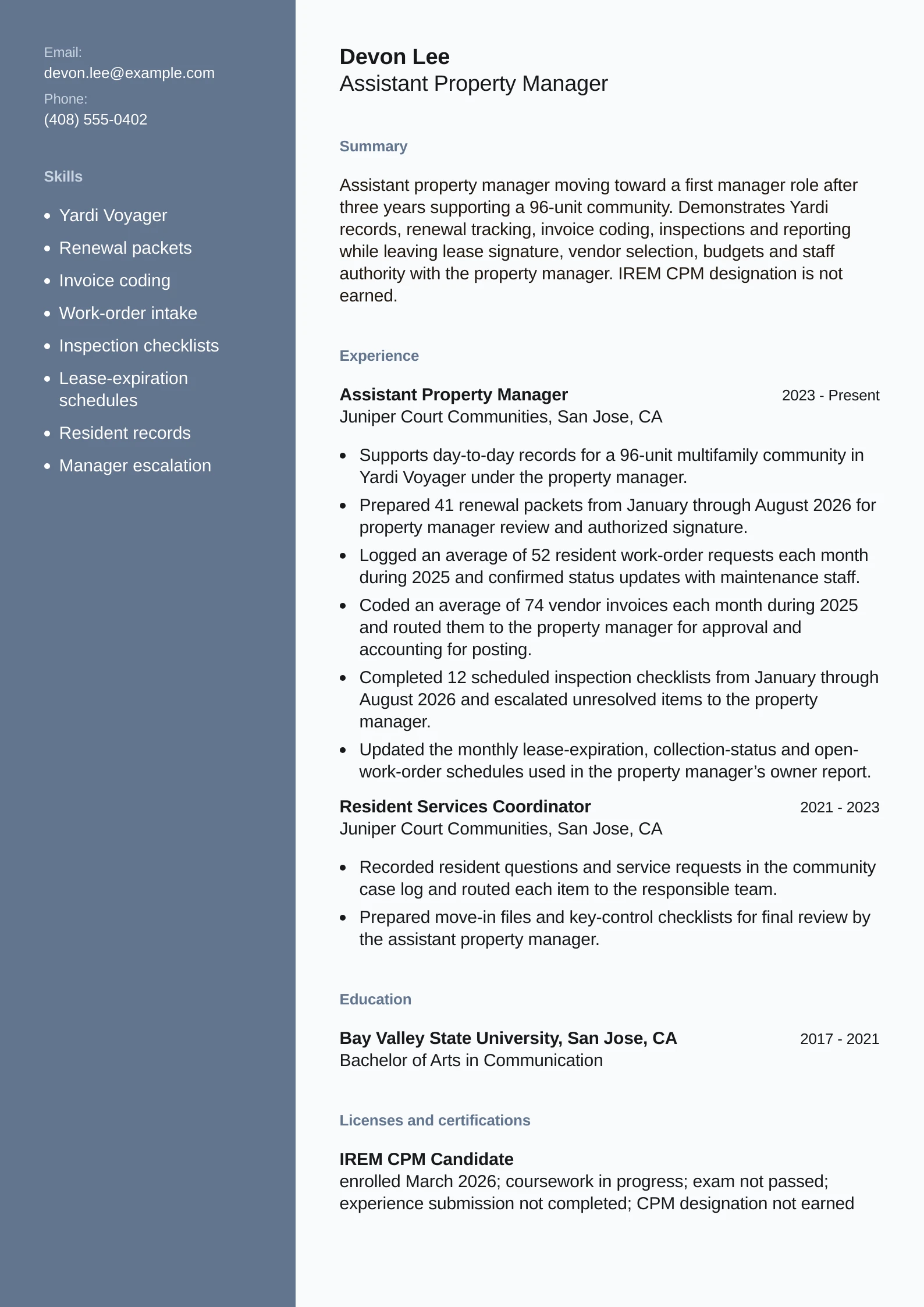
Devon is ready to discuss manager-level work, but the current title remains Assistant Property Manager. The resume leads with renewal packets, invoice coding, inspections and monthly schedules. Signatures, budgets, vendor selection and staff decisions stay with the property manager. The credential section is just as careful: IREM CPM Candidate, coursework in progress, exam and experience submission incomplete, designation not earned.
Current assistant title stays intact
CPM Candidate is not presented as CPM
Approvals remain with the property manager
Onsite Property Manager Resume Example
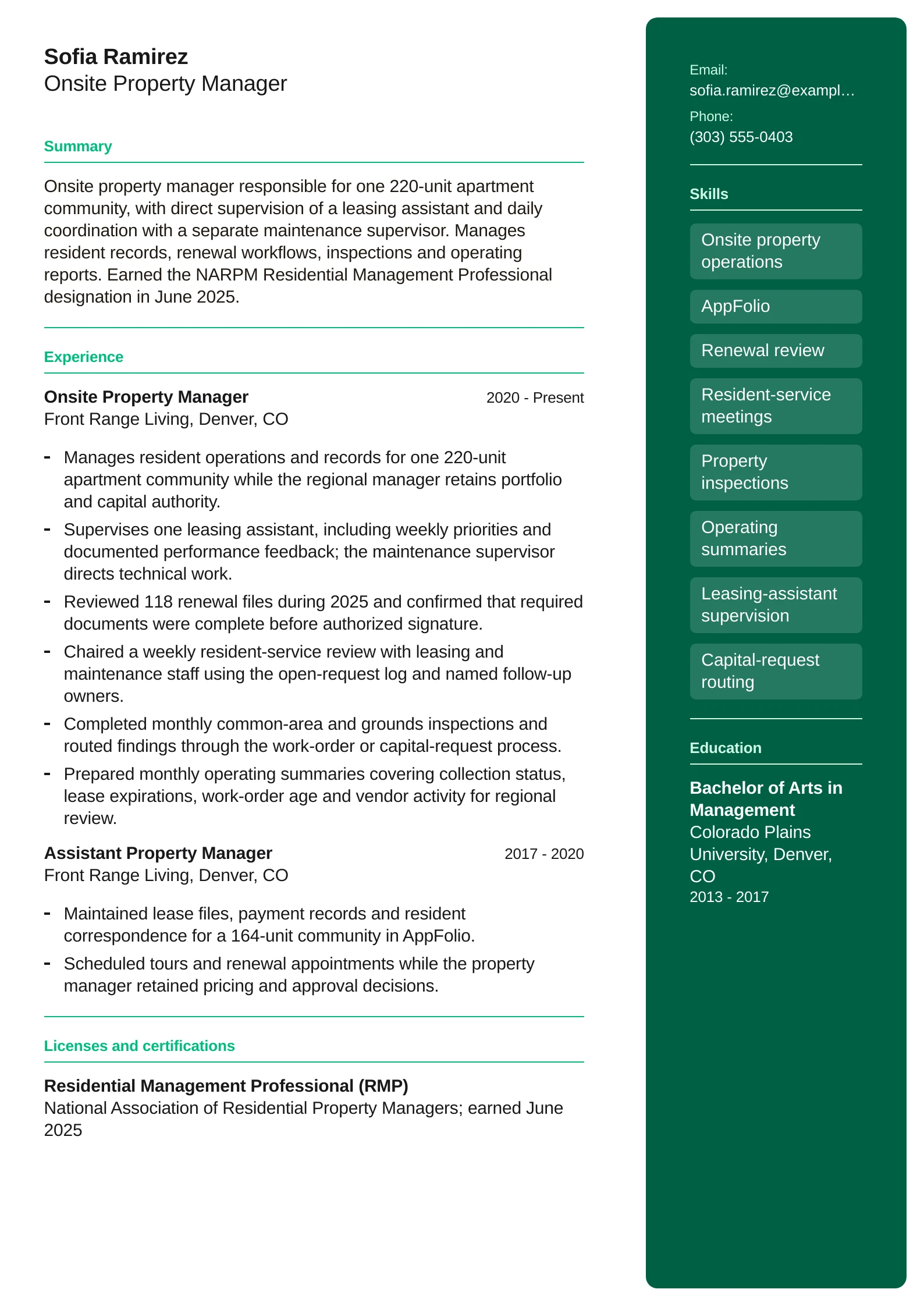
Sofia's resume is anchored to one 220-unit community. Resident operations, renewal review, inspections and reporting show the depth of her onsite role, and she directly supervises one leasing assistant. The maintenance supervisor owns technical assignments, while regional leaders keep portfolio and capital decisions. Her NARPM RMP designation includes the issuer and earned date.
One-community scope is clear
Leasing and maintenance authority stay separate
RMP designation is exact and earned
Commercial Property Manager Resume Example
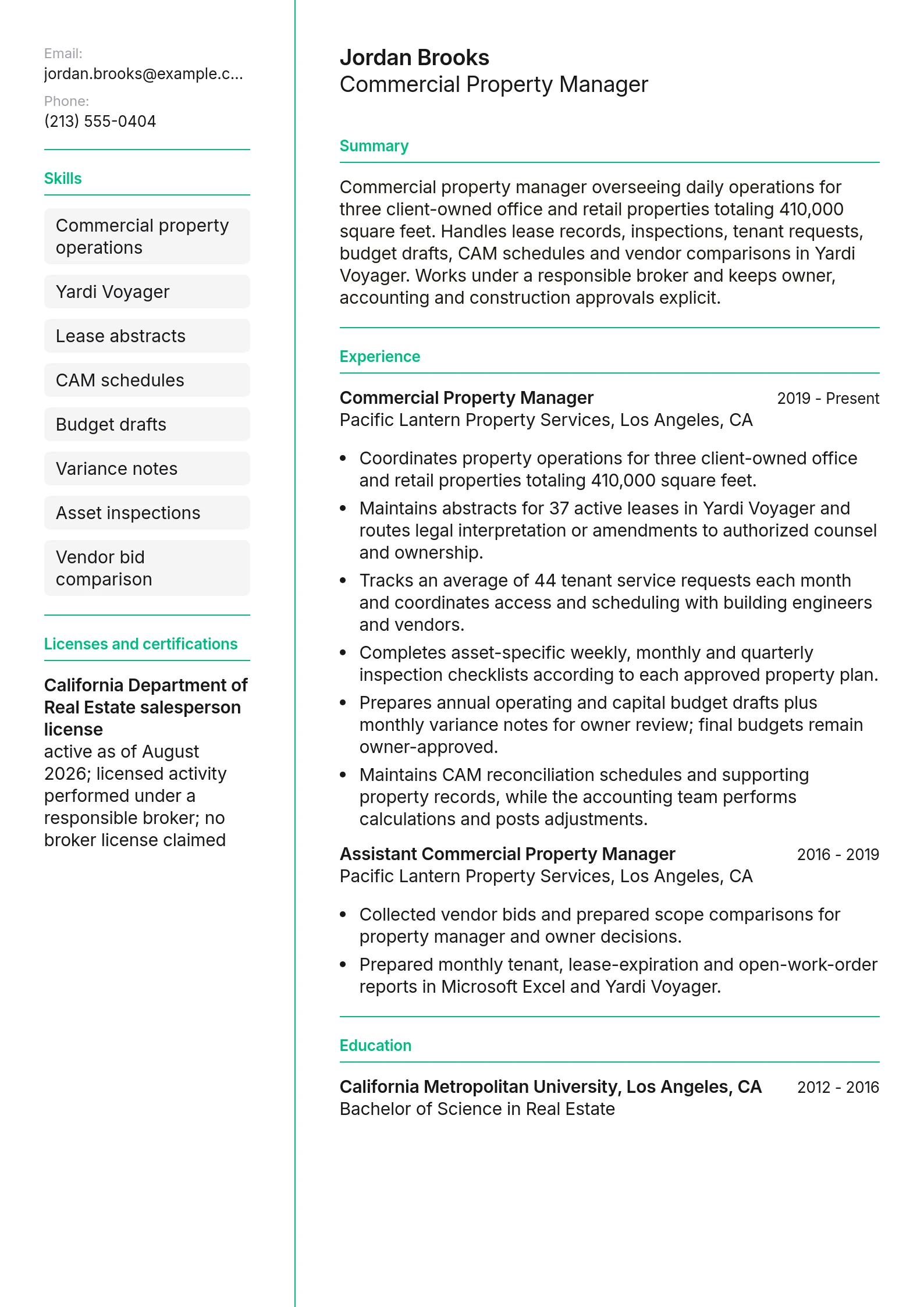
Jordan's commercial scope is easy to spot: three client-owned office and retail properties totaling 410,000 square feet. Lease abstracts, inspections, CAM schedules and owner reports carry the story. The resume also states that the active California salesperson license operates under a responsible broker. Accounting, counsel and ownership keep their separate decisions.
Commercial scope uses square feet and leases
Salesperson works under a responsible broker
Accounting and owner decisions are not borrowed
Multifamily Property Manager Resume Example
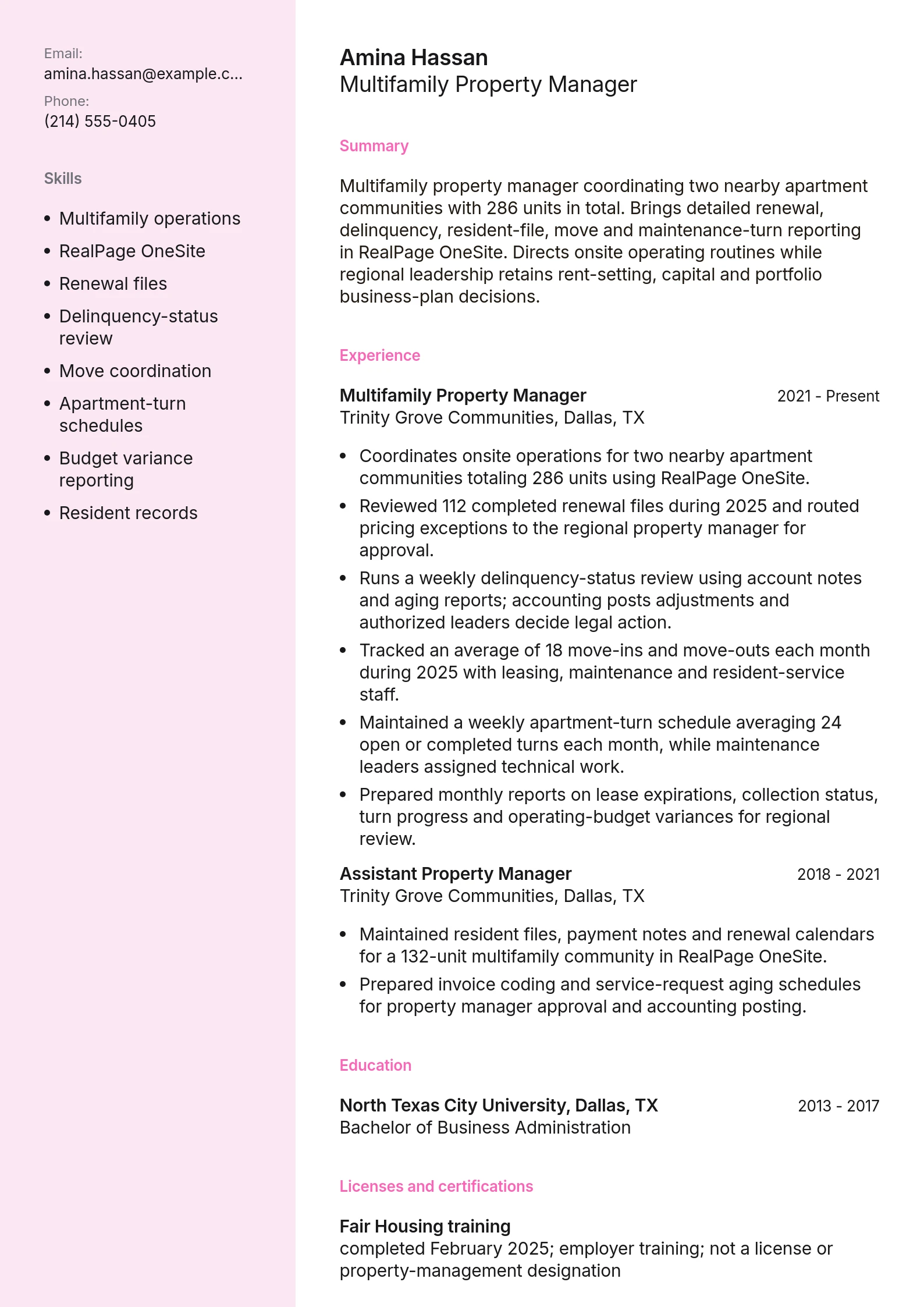
Amina manages two multifamily communities, so the resume uses the operating cadence that actually defines her work: renewals, delinquency review, moves, apartment turns and monthly reporting. The counts describe workload over a stated period. They do not claim occupancy growth, NOI or resident satisfaction. Pricing, accounting and technical maintenance decisions remain with their owners.
Two-community multifamily scope
Metrics explain work without invented outcomes
Pricing, accounting and maintenance owners remain named
Multi-Property Portfolio Manager Resume Example
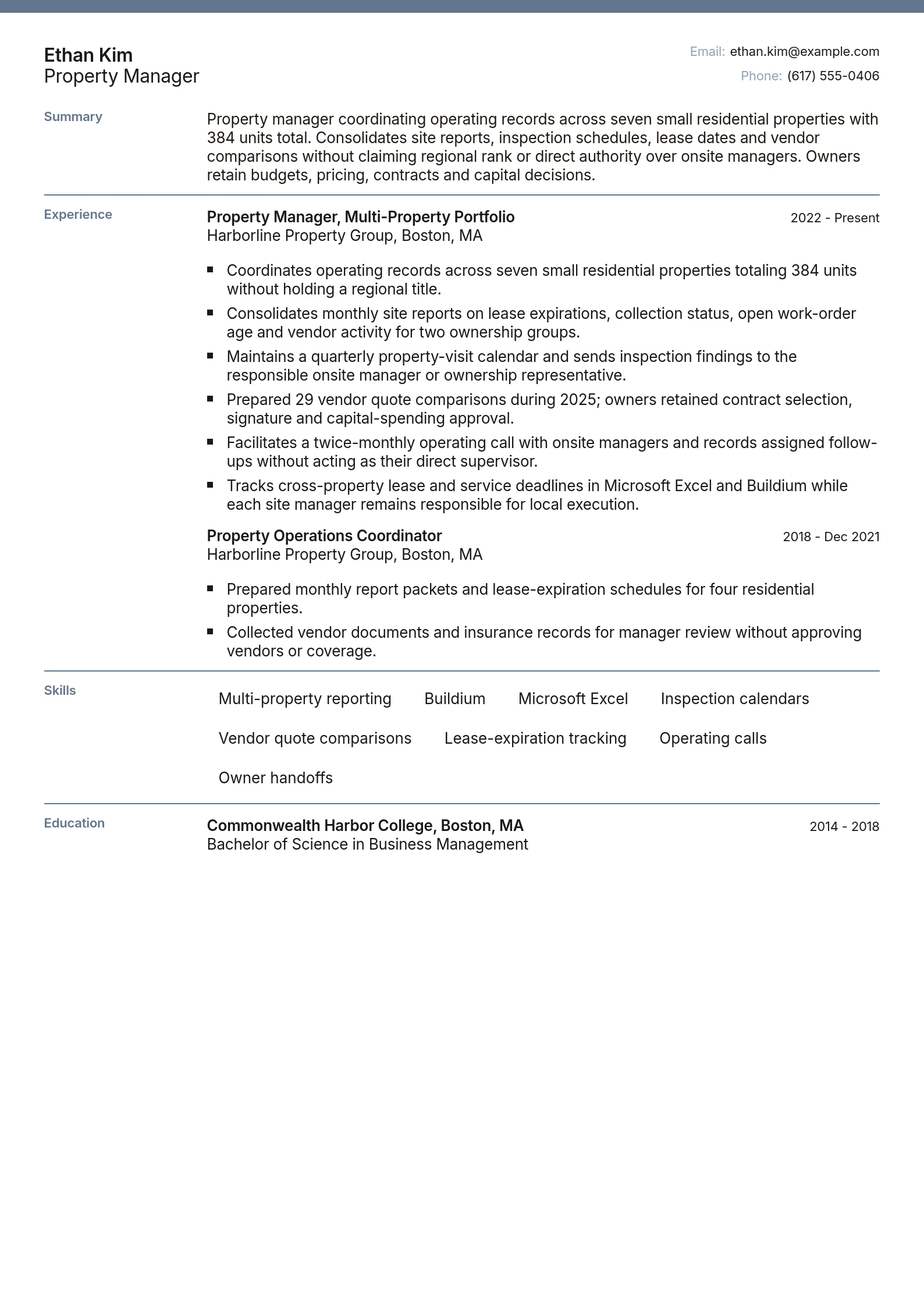
Ethan's assignment spans seven properties, but his title remains Property Manager. Consolidated reports, property visits, vendor comparisons and operating calls show his contribution across the portfolio. Site managers handle local execution, while owners approve contracts, budgets, pricing and capital work. This is the right pattern when portfolio breadth is real and command authority is limited.
Seven-property scope without regional title
No direct reports are implied
Owners retain contract and capital approval
Put portfolio scope in the first third of the resume
Put the operating setting and scale where a reader will see them quickly. For residential work, that may be a community and unit count. Commercial work often needs property count, rentable square feet and tenant mix. A portfolio role should explain both the breadth of the assignment and the candidate's relationship to the site teams. If the assignment changed during one job, date the shift so the scale stays tied to the right period.
Size does not settle seniority by itself. Someone coordinating seven properties may have no direct reports or purchasing approval, while an onsite manager at one community may supervise leasing staff. Use the personnel records and approval limits you can verify.
Operating context
Evidence to lead with
Boundary to keep
General residential
Community, units, lease records, collections and work orders
Accounting, owner and maintenance decisions
Assistant moving up
Supported units, files, invoices, inspections and manager review
Do not backdate the target manager title
Onsite single community
One community, direct resident work and onsite team relationship
Do not imply regional or asset authority
Commercial
Properties, square feet, lease abstracts, CAM and client reporting
Legal, accounting, construction and ownership approvals
Multifamily
Communities, units, renewals, moves, turns and delinquency review
Pricing, legal action and technical maintenance authority
Multi-property portfolio
Property and unit totals, consolidated reporting and site handoffs
Regional title, direct reports and purchasing approval
Write the handoff as part of the accomplishment
Property managers work among residents or tenants, owners, accounting, maintenance, vendors, leasing staff and sometimes legal counsel. A good bullet makes the candidate's part of that chain visible. Preparing a budget draft for owner review is not the same as approving a budget. Maintaining a CAM schedule is not the same as calculating the reconciliation and posting adjustments.
Match the verb to the record. Prepared, reviewed, coded, routed, recommended, coordinated and reported can all show judgment. If the candidate approved something, name the category or written limit. If that authority is not documented, show the comparison or recommendation and leave the signature out. Check every leadership verb against the reporting line, signature record or policy that gave the candidate that decision.
Be equally precise with maintenance. A property manager may log requests, set priorities under policy, coordinate access, review aging and confirm completion. Diagnosis and technical assignment may belong to the maintenance supervisor or technician. Do not make a service-request queue sound like facilities-management or trade authority.
Reporting lines matter too. Sofia directly supervises one leasing assistant, so the resume says so. Ethan runs calls with site managers, but they do not report to him. A team count is useful only when the relationship is accurate.
Use operating numbers without inventing NOI, occupancy or savings
Start with numbers that define the operation. Property and unit counts, square footage, lease files, service requests, inspections, moves, turns and vendor comparisons all give a reader usable scale. Add a month, quarter or year so the count has a clear boundary. For recurring work, state whether the figure is weekly, monthly or annual and use the same definition throughout the application form.
NOI, occupancy, delinquency and cost savings need more care. Use them only when the record has a consistent definition, a reliable period and the candidate's actual contribution. Pricing, demand, concessions, renovation work and leasing activity may all affect the same result. One person's resume should not absorb everyone else's work.
A direct workload count is often stronger. Amina reviewed 112 renewal files during 2025. Saying she improved renewals by 20 percent would require a baseline, denominator, period and evidence of what changed. Without those records, the percentage sounds confident but proves less.
Treat budget language the same way. Preparing a draft, explaining a variance and tracking approved expenses are three different jobs. Entering invoices does not prove budget ownership. If accounting posts the adjustment or an owner approves the spend, say what the candidate prepared for that decision.
Keep licenses, designations, candidacy and training separate
Licensing depends on the jurisdiction and the activity. BLS notes that some property managers must hold a state-issued license, so check the regulator and the target posting instead of relying on a national checklist. Jordan lists an active California salesperson license and the responsible-broker relationship. The public resume does not include a license number.
Designations have separate stages as well. IREM describes CPM candidate enrollment, coursework, exam, experience submission and graduation as distinct steps. NARPM's RMP is an earned designation with its own experience and process requirements. Employer Fair Housing training is training, not a universal property-manager certification.
Record
Accurate wording
Do not write
Active California salesperson license
California DRE salesperson license, active; licensed activity under a responsible broker
California broker or nationally licensed property manager
CPM Candidate
IREM CPM Candidate; list exact completed and incomplete steps
Certified Property Manager or CPM after enrollment alone
Earned RMP
Residential Management Professional, NARPM, earned month and year
RMP candidate as earned or course attendance as designation
Fair Housing training
Fair Housing training, employer and completion date when documented
Fair Housing certified or guaranteed compliant
No license or designation
Omit it and show supported operations evidence
A credential copied because the posting prefers it
Show Fair Housing work without making a compliance guarantee
HUD's 2024 guidance covers rental housing and property-management services in its discussion of Fair Housing Act responsibilities for digital advertising. That makes advertising and leasing language a poor place for broad compliance claims. Describe the approved workflow, the record review and the escalation path instead. If your part was limited to using approved copy or routing a question, keep that limit visible.
Write the task rather than the legal conclusion. A line such as "Used approved listing copy and routed audience-setting questions to the compliance lead" can be checked. "Ensured full Fair Housing compliance" may claim authority and proof the candidate did not have. Keep legal or compliance review with the authorized owner.
Maya and Amina completed employer Fair Housing training on specific dates. Those records do not create a federal license or professional designation. The training entry supports their work, but the resume still needs evidence of the listing, file or resident-service practices they performed.
Keep real applicant and resident information out of a public example. Aggregate workload counts and process descriptions are enough. Protected-class data, screening records, private messages and identifiable resident details do not belong here.
Tie property software to a real workflow
A system belongs on the resume when the candidate can connect it to work. AppFolio, Yardi Voyager, RealPage OneSite and Buildium appear here beside rent-roll review, lease abstracts, renewal files, resident records, service requests or cross-property schedules. The skills section repeats demonstrated tools instead of collecting names from a posting. That context also gives you a concrete example to discuss in an interview.
Using software does not automatically grant accounting, leasing or approval authority. Coding an invoice is not posting it. Updating a lease record is not interpreting a clause. Maintaining a CAM schedule is not completing the accounting calculation. Recording a renewal packet is not setting rent or signing the lease.
Name the product when you can explain the records, screens and outputs you used. If you cannot, "property management system" may be the more accurate phrase. A shorter, defensible list is better than an inventory of platforms you have only seen in job ads.
Excel needs context too. Ethan uses it to track deadlines across properties. Jordan used it for tenant and lease-expiration reports. Neither example quietly adds macros, advanced modeling or financial analysis.
Replace a vague result with work a reviewer can verify
Compare the scope and decision path in these two lines. The first shows Maya's real contribution. The second gives her financial authority and a savings result that the record does not support.
Specific scope with the decision owner intact
Collected three vendor quotes for repairs above $2,500 and prepared a scope comparison; the regional manager or owner approved the contract.
A stronger-sounding line that changes the facts
Negotiated all vendor contracts and reduced annual property expenses by 25 percent.
Make an assistant look ready without changing the title
If this is your first property manager application, lead with the work you already completed under a manager. Lease-file preparation, resident records, collections follow-up, work-order intake, inspections, invoice coding and scheduled reports can all support the move. Keep Assistant Property Manager in the title field.
Devon's current role names the 96-unit community, Yardi Voyager and the volume of renewals, invoices and inspection checklists. It also identifies who signed, approved and posted the work. That combination says more than a summary that gives the candidate the manager title before a promotion.
Coursework or candidacy can help when the status is exact. Devon is an IREM CPM Candidate with coursework in progress. The exam and experience submission are incomplete, and the designation has not been earned. The detail is useful because the reader does not have to guess.
Some requirements cannot be fixed with wording. If the job calls for direct staff management, a license or several years of budget authority, compare that requirement with the evidence you have. Apply where the fit is reasonable and leave unsupported qualifications off the page.
Route adjacent real-estate roles before the resume drifts
Property management overlaps with several neighboring jobs, but working with a function does not give you its title. Asset management centers investment strategy and performance. Facilities management covers building systems and technical service delivery. Construction management, leasing, real-estate sales and property accounting each require their own evidence and sometimes a separate credential.
Stay on this page when day-to-day property operations are the main job. If investment, systems, project delivery, transactions or accounting dominates the target, follow the route below.
Target intent
Disposition
Why
Asset manager
Route to asset-management owner
Investment strategy, valuations and portfolio returns need separate evidence
Facilities manager
Route to facilities owner
Building systems, technicians and service programs have different authority
Construction manager
Route to construction-management owner
Project delivery, contracts, schedules and site authority differ
Leasing agent
Route to leasing owner
Prospect pipeline, showings and lease execution are the primary task
Real-estate sales
Route to real-estate-agent owner
Representation, transactions and licensing are distinct
Property accounting
Route to accounting owner
Ledgers, reconciliations, close and financial statements need accounting evidence
Make chronology and the final fact check easy to follow
Reverse chronology works well for most property managers because it shows movement from resident services or assistant work into wider operating responsibility. Keep employer, location, official title and month-year dates together. If the assignment changed within one employer, add the effective date instead of rewriting the whole period.
One page may be enough for an assistant or an early-career manager. An experienced manager may need two readable pages to separate property types, systems, credentials and progression. Cut repeated resident-service and work-order bullets before shrinking the type.
Before you send the resume, compare it with the application and the records behind it. Check property and unit counts, square footage, systems, lease and invoice volume, inspection cadence, credential dates, reporting lines and approval limits. Remove any occupancy, NOI, savings, compliance or satisfaction claim that cannot pass the same check.
Read the posting once more after the fact check. Move the closest evidence higher, but do not add a license, designation, platform or authority simply because the employer mentions it. Tailoring changes the selection and order of true material. It does not change the history.
Property manager resume questions
Settle these points before you spend time on final layout.