Running a business gives you plenty to put on a resume, but the facts can blur quickly. These nine examples show how owners in retail, services, e-commerce, franchises, partnerships, and B2B work can present credible evidence without overstating money, people, results, credentials, or decision authority.
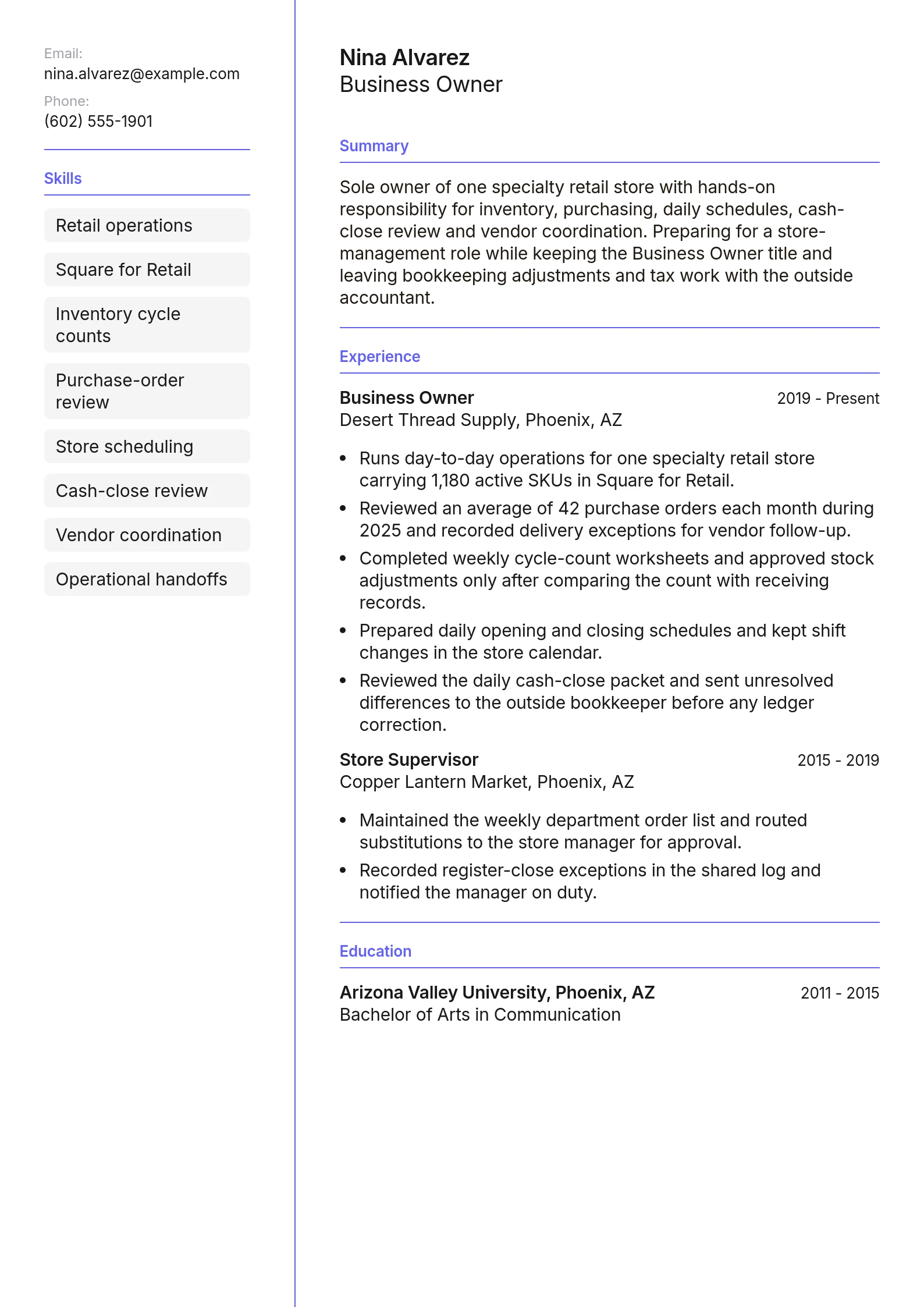
Nina's first line settles the basic question: she owns one specialty retail store. She does not borrow a corporate title or hide the business behind Store Manager because that is the job she wants next. The reader knows what she owns, how it operates, and where she is headed.
Her proof is ordinary in a good way. Square for Retail holds 1,180 active SKUs. She reviews 42 purchase orders a month, checks stock weekly, builds daily schedules, and reviews cash-close packets. When a ledger difference needs changing, the outside bookkeeper takes it from there.
Pull the records you would use to answer a follow-up question before writing your version. Note the formal title, dates, systems, recurring reports, and who completed the next step. A straightforward count you can recreate beats a dramatic percentage you cannot.
Find the operating model that feels familiar
The differences between these resumes are practical. Marcus needs a clean end date for a former business. Carmen and Layla share control with partners. Tasha must separate her franchise from the franchisor. Daniel is moving toward sales, while Priya and Owen are translating service operations.
Use the fictional numbers to see where scale can sit in a bullet, then replace them with your own source material. If the figure is shaky, leave it out. A task, system, cadence, and clear handoff can still give a hiring manager plenty to work with.
Former Business Owner Resume Example
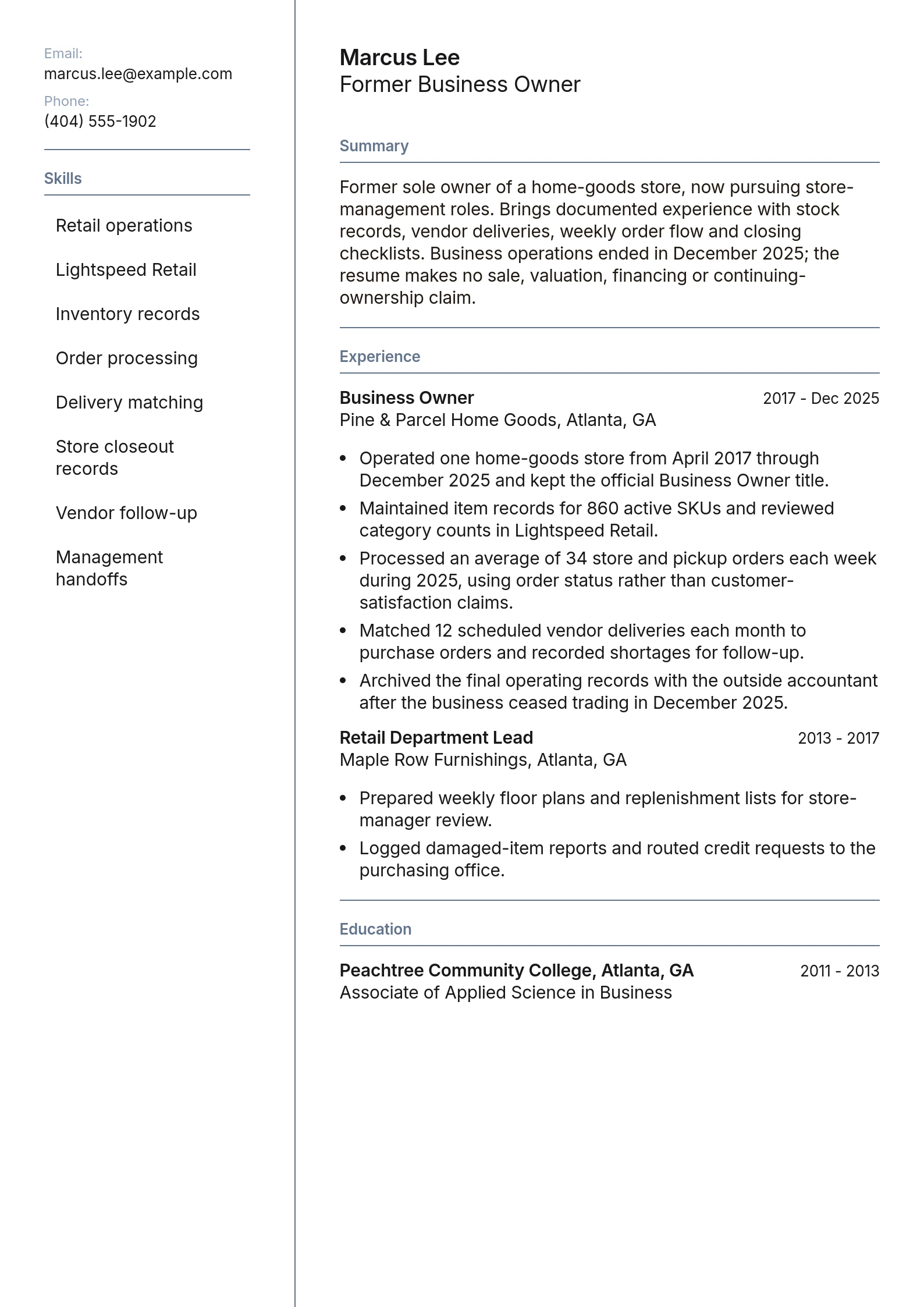
Marcus keeps the ending plain. His store stopped operating in December 2025, and the record goes no further. Inventory, weekly orders, and vendor deliveries still support a store-management application. There is no invented buyer, valuation, or polished exit story. His earlier Retail Department Lead role stays separate and keeps its own dates.
Clean end date without an exit claim
Former ownership remains the official title
Retail records support the next step
Owner-Operator Resume Example
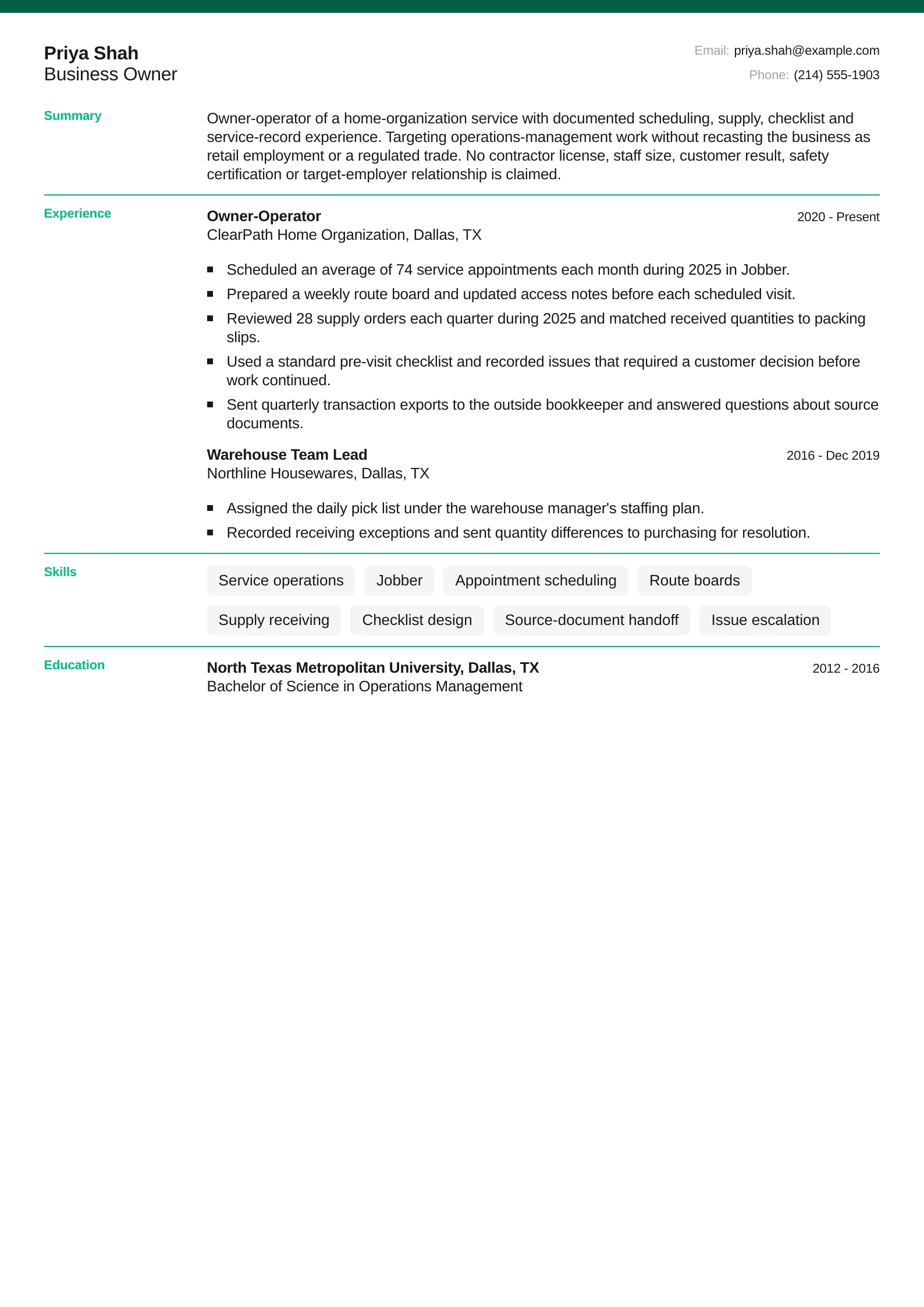
Priya runs a home-organization service, not a licensed trade business. Her appointment calendar, route board, supply receipts, and pre-visit checklist show operational discipline a new employer can understand. Customers decide scope changes, and the outside bookkeeper handles the accounts. Her earlier warehouse role also keeps the manager's staffing authority visible.
Service operations without trade claims
Customer decisions stay visible
No invented staff or safety credential
B2B Business Owner Resume Example
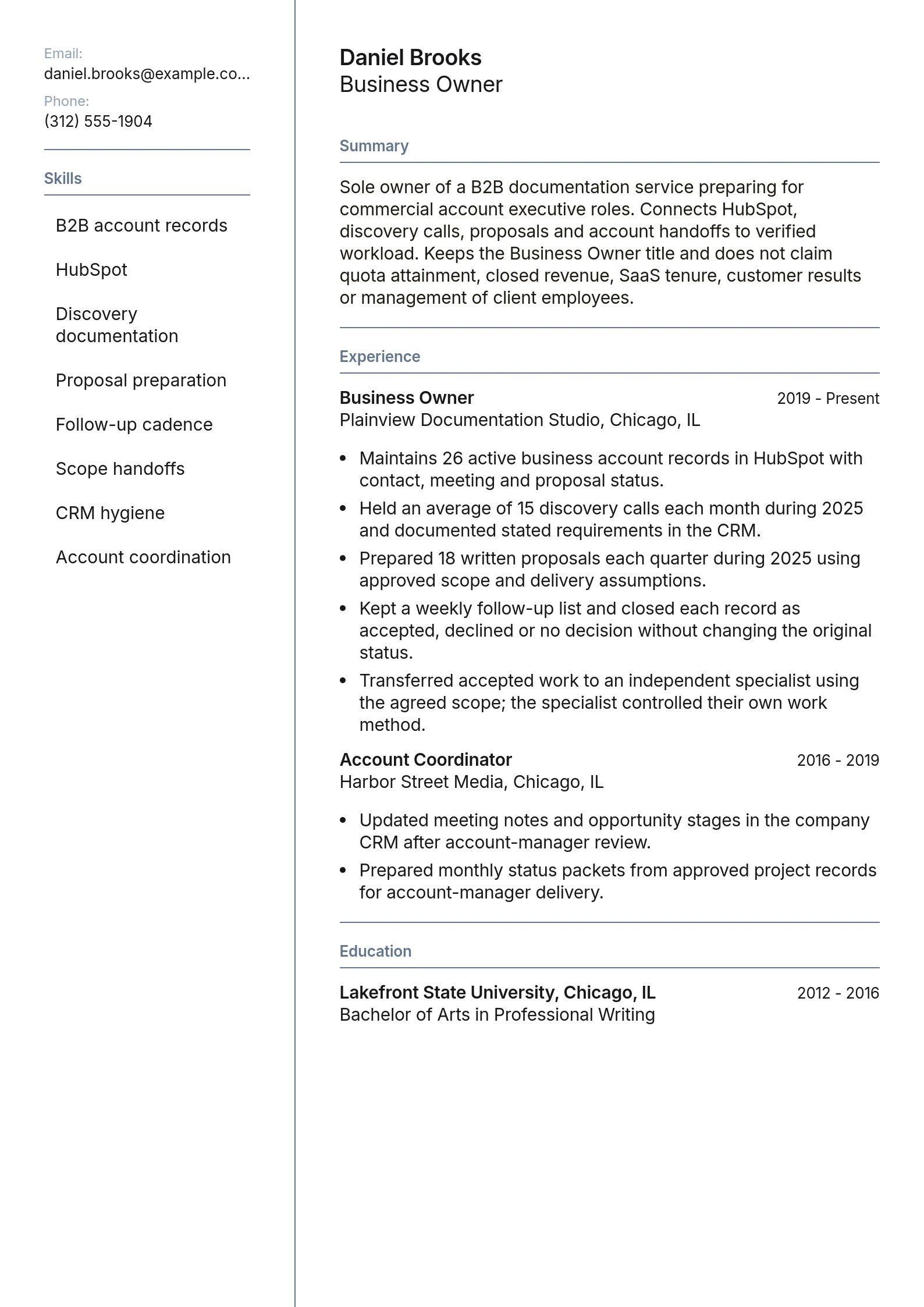
Daniel already has useful commercial evidence: current HubSpot records, discovery calls, written proposals, and tracked decisions. His title is still Business Owner. He leaves out quota, closed revenue, win rates, and SaaS tenure because running a B2B service does not prove them. His former coordinator work stays separate from sales ownership.
CRM and proposals tied to records
Business Owner title remains exact
No quota, revenue or win-rate claim
Co-Owner Resume Example
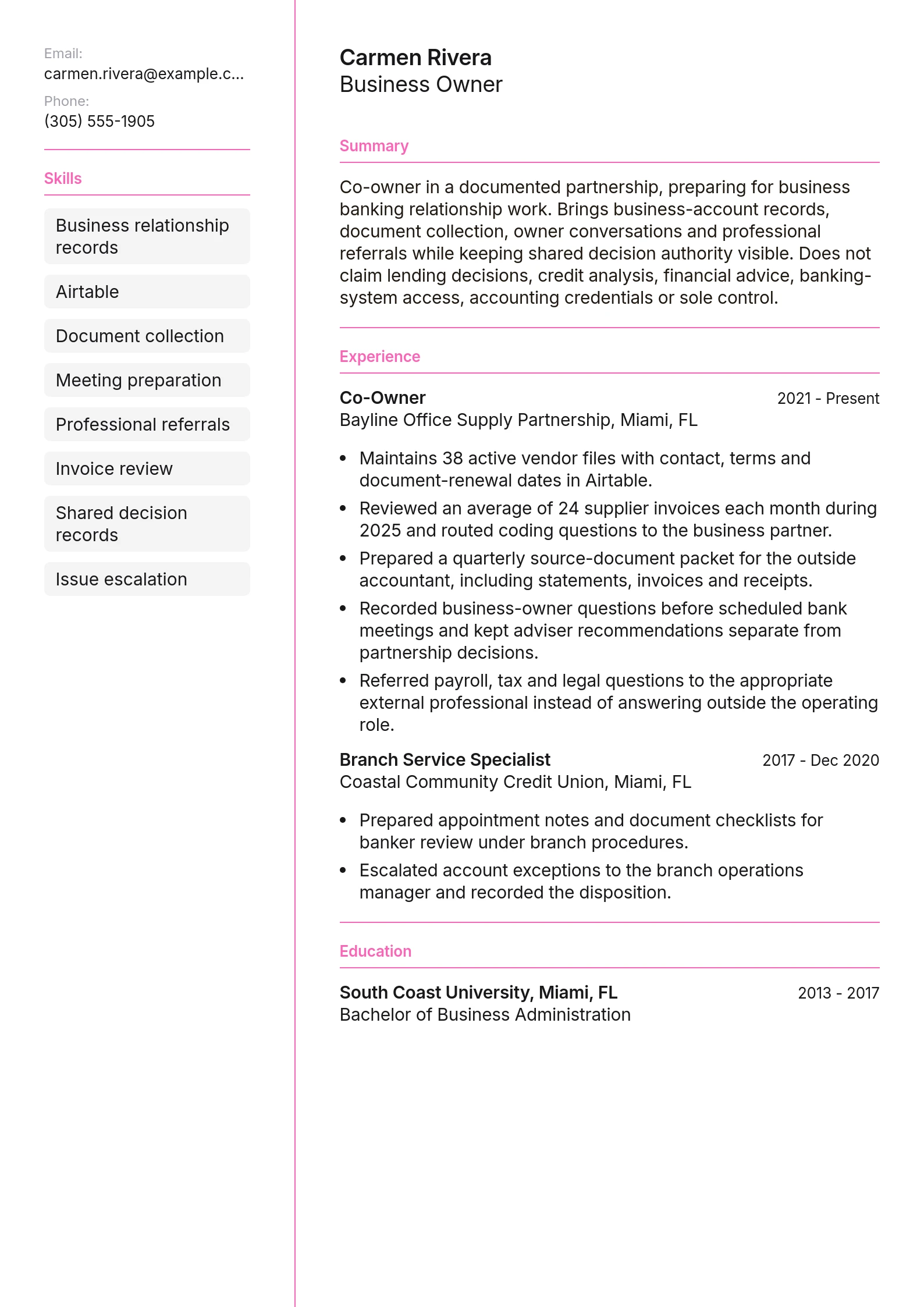
Carmen shares ownership with a business partner. Her resume reads like a record of collaboration rather than solo command. She maintains vendor files, prepares documents, and captures questions for bank meetings. The accountant, banker, and partner retain their separate decisions. Her branch experience likewise keeps banker review and manager decisions explicit.
Co-owner authority is shared
Professional referrals are explicit
No lending or advice claim
E-Commerce Business Owner Resume Example
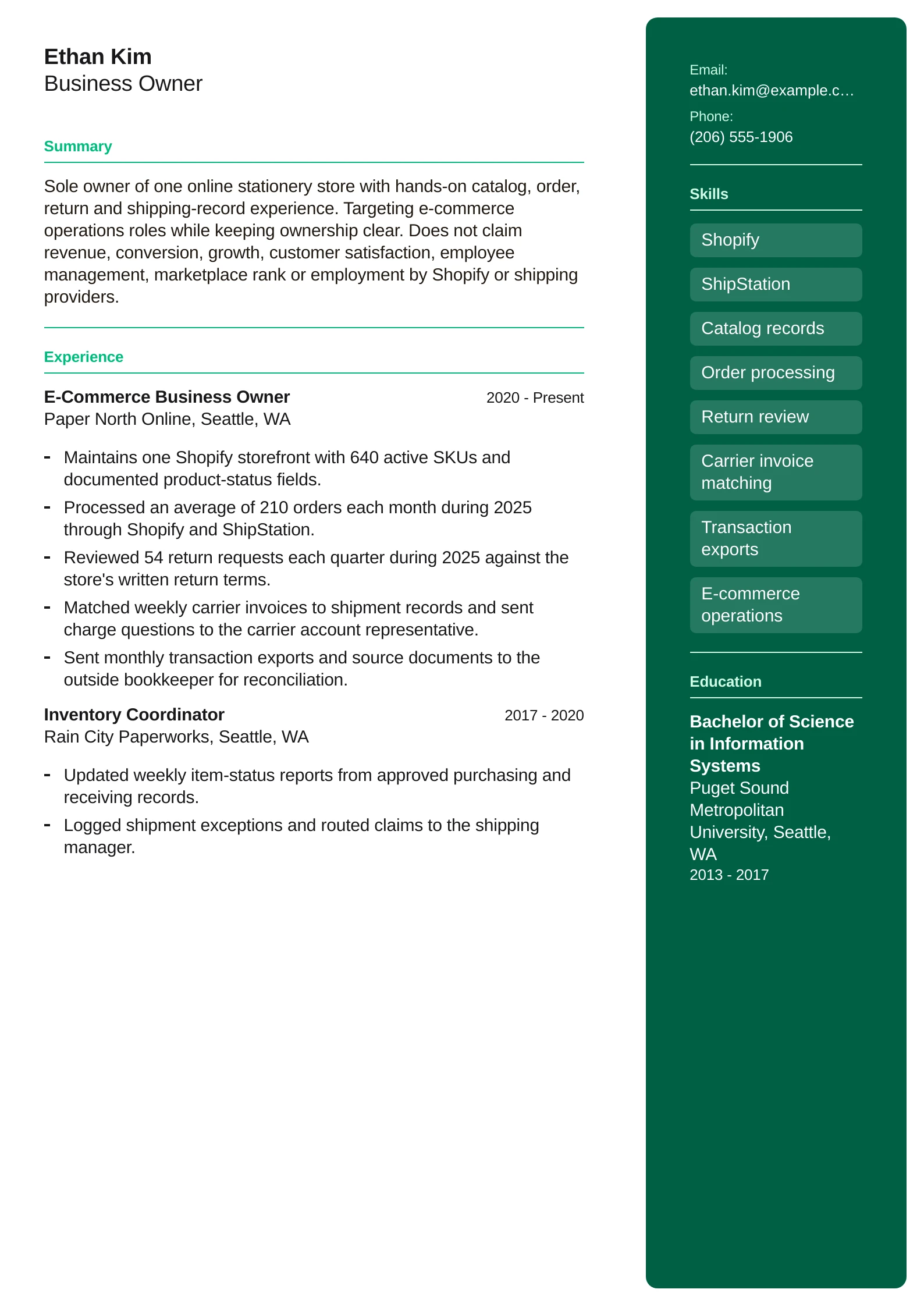
Ethan's scale is easy to picture: one Shopify store, 640 active SKUs, 210 monthly orders, and a quarterly return queue. He can discuss the workflow behind each figure. None becomes a claim about sales growth, conversion, marketplace rank, or satisfaction. The prior inventory role also keeps purchasing and claims authority with the right managers.
Catalog, orders and returns define scale
Platforms are tools, not employers
No growth or satisfaction outcome
Franchise Owner-Operator Resume Example
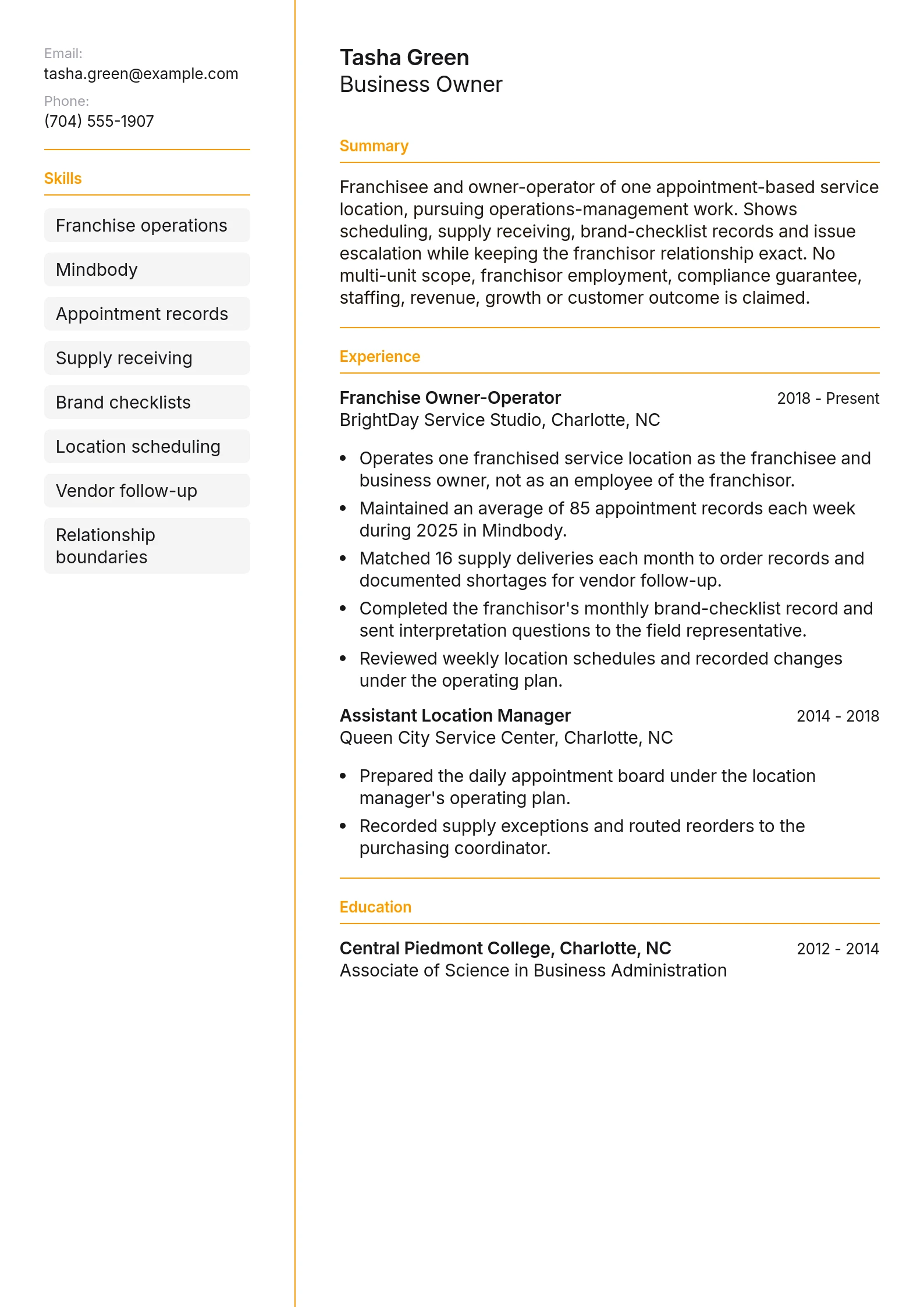
Tasha is the franchisee and owner of one service location. She is not an employee of the franchisor. Appointment records, supply deliveries, the monthly brand checklist, and weekly schedules carry the example. Questions about the checklist go back to the field representative. Her earlier assistant role keeps the location manager's plan and purchasing decisions separate.
Franchisee is not franchisor employee
One-location scope is clear
Checklist is not certification
Independent Business Owner Resume Example
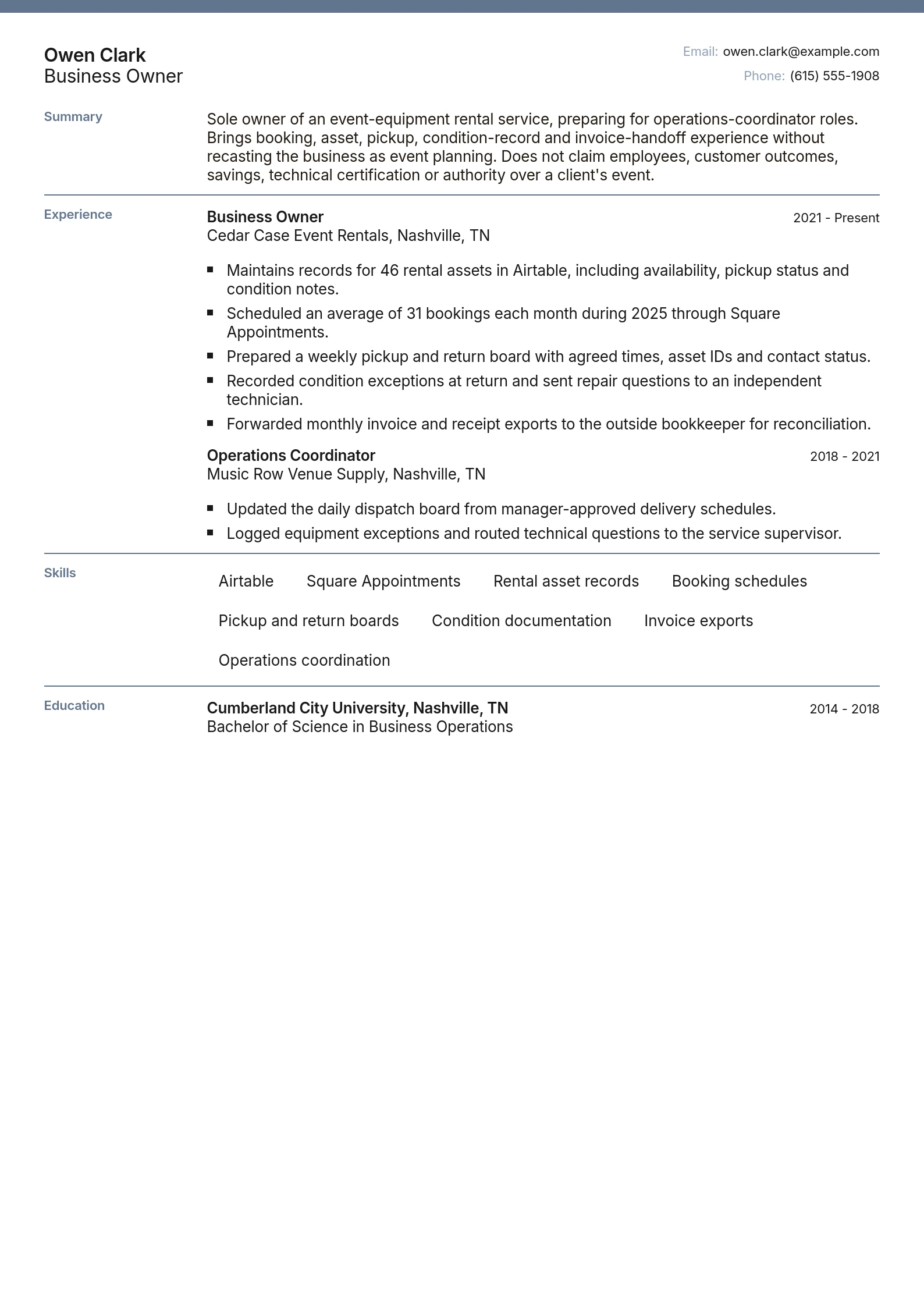
Owen rents event equipment; he does not plan the event itself. Airtable asset records, Square bookings, pickup boards, and condition notes make a clean operations story. An independent technician assesses repairs, while the outside bookkeeper handles reconciliation. His previous coordinator role clearly leaves delivery approval and technical decisions with supervisors.
Rental operation stays distinct from events
Technical work remains external
Workload counts have periods
Family Business Co-Owner Resume Example
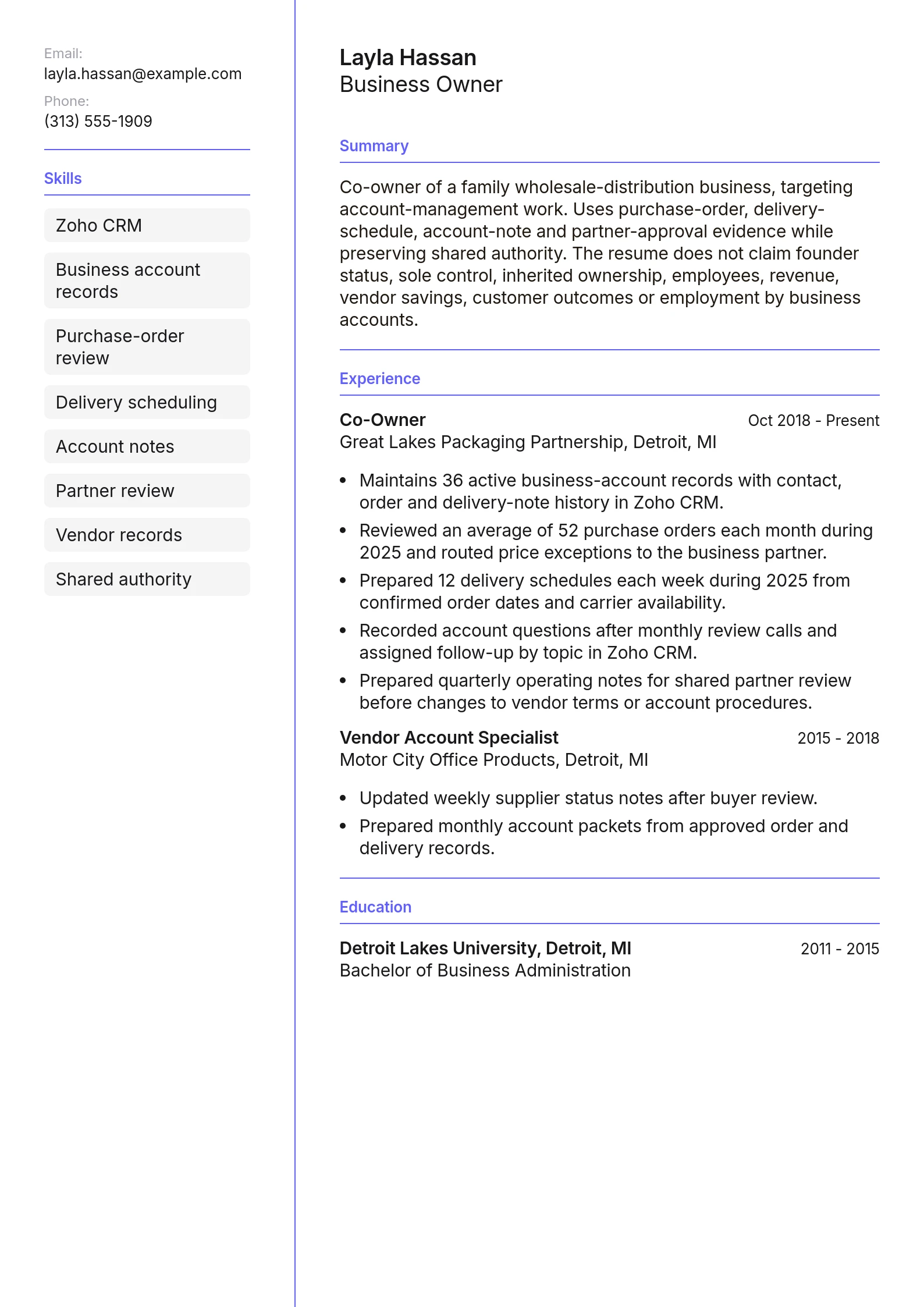
Layla's family connection does not grant automatic control. Co-Owner is the exact title, and the bullets show where her partner joins pricing, vendor-term, and procedure decisions. The CRM, purchase orders, and delivery schedules support an account-management move without manufacturing sales results. Her earlier vendor role remains separate and does not imply purchasing authority.
Family relationship does not imply control
Partner approvals stay visible
Account records do not become sales outcomes
Use the title in the ownership record
Business Owner is not a catch-all label for founder, CEO, contractor, partner, or employee. Formation papers, partnership agreements, franchise records, and work history tell you which relationship belongs on the page. Use it even when another title sounds more senior.
If your day-to-day work had a functional emphasis, put that in the summary and bullets. Do not replace Business Owner with Store Manager or Account Executive merely because those are target roles. A truthful transition is easy to understand when the reader can see both the ownership record and the relevant work.
Record
Accurate resume wording
Boundary to keep
Sole owner
Business Owner or Owner-Operator, if that is the recorded title
Do not add partner, founder or CEO
Co-owner or partnership
Co-Owner or Partner, with shared decisions where relevant
Do not imply sole control
Franchisee
Franchise Owner-Operator or Franchisee
Do not imply franchisor employment
Self-employed contractor
Use the actual service title and self-employed status
Do not claim business ownership without the record
Founder or startup entrepreneur
Route to the entrepreneur resume owner
Do not absorb startup or fundraising intent here
Former owner
Keep Business Owner with an end date
Do not invent a sale, exit or valuation
Employee target
Name the target in the summary
Do not rename the past business role
Choose numbers you can find again
Owner resumes often arrive with ambitious figures for revenue, profit, growth, savings, satisfaction, and staff. Some belong there. Many do not survive a basic question about the source, period, or denominator. Keep a number only when you can find it in a stable record and explain your part.
Operating counts are easier to defend. This page uses stores, SKUs, purchase orders, appointments, proposals, orders, returns, rental assets, and delivery schedules. Where cadence matters, the month, quarter, or year sits beside the figure. The numbers describe workload rather than performance.
Revenue and profit need source records and consistent definitions. Gross sales are not profit. Booked work is not collected revenue. A proposal value is not a closed contract. If you cannot reproduce the figure from the business's financial records, leave it out. The same rule applies to savings: name the baseline, method, period and shared contributors or use the purchasing work itself.
Customer outcomes require their own proof. Order count, appointment count and active-account count describe scope; they do not establish satisfaction, retention or service quality. Do not convert reviews, anecdotes or an informal impression into a percentage. The operational story usually remains strong without it.
Tailor the evidence, not the old job title
A current posting tells you what to retrieve from your history. Home Depot's management roles call for store routines, inventory or receiving, schedules, reports, and escalation. Salesforce asks for account relationships, pipeline work, and coordination with internal partners. Bank of America adds document review, referrals, procedural controls, and financial analysis.
Those postings are selection guides, not permission to claim the job. Nina can lead with inventory and store routines, Daniel with discovery and proposals, and Carmen with records and referrals. None should copy employer-only systems, quotas, lending authority or credentials.
Target
Owner evidence that may transfer
Claim that still needs separate proof
Store manager
Store scope, inventory, schedules, opening and closing records
Employee supervision, store P&L, target-employer systems
SOP authority, safety credentials, staffing and site results
Commercial account executive
CRM records, discovery, proposals, follow-up and handoffs
Quota, closed revenue, SaaS tenure and enterprise selling
Business banking relationship manager
Owner conversations, document collection, referrals and records
Lending, credit analysis, financial advice and banking systems
E-commerce operations
Catalog, order, return, shipping and platform workflow
Conversion, marketplace rank, growth and customer outcomes
Operations coordinator
Booking, asset, dispatch, condition and invoice records
Technical judgment, savings and authority over client operations
Say who made the next decision
Few owners work alone, even when they own the whole business. Bookkeepers, accountants, attorneys, bankers, vendors, contractors, franchise representatives, and customers all make decisions that touch the operation. Keep those people in the bullet when their part affects what you can honestly claim.
For example, "Prepared transaction exports for the outside bookkeeper" works when the bookkeeper reconciled the accounts. "Recorded questions for a bank meeting" does not turn the owner into a finance adviser. Prepared, reviewed, documented, routed, scheduled, and referred are often more accurate than managed or led.
Partnerships need special care. Carmen and Layla are co-owners, so their bullets show when the business partner resolves coding, pricing, terms or procedure questions. Shared authority does not make their experience weaker. It tells the hiring manager how they worked through a real governance relationship.
External workers also need an exact label. An independent specialist or technician is not automatically an employee, direct report or managed team member. State the scope handoff and keep technical method or diagnosis with the independent professional.
Give the business a clean timeline
Place the company, location, owner title, and month-year dates together. Current businesses use present tense. Former businesses use past tense and a real end date. If all you know is that operations ended, say that. Sold, acquired, dissolved, and exited describe specific events that need records.
Keep earlier employment separate. A prior Store Supervisor role should not be folded into the later ownership period, and current ownership should not be hidden to make a return to employment look simpler. Consistent dates help a recruiter compare the resume with an application or background form.
If you owned more than one operation, give each one its own dated entry unless the legal and operating record clearly treats them as one business. Avoid a combined date range that makes simultaneous ownership, franchise scope or partner relationships impossible to understand.
Former owners should also explain the present in the summary without filling gaps with speculation. Marcus says he is pursuing store-management roles and gives December 2025 as the business end date. The resume does not invent an acquisition, sale or reason for ending operations.
Make software earn its place
A platform name is useful when a bullet shows what happened inside it. Nina uses Square for Retail for item records. Daniel keeps contacts and proposal status in HubSpot. Ethan processes Shopify orders through ShipStation. Carmen maintains vendor files in Airtable, and Layla records follow-up in Zoho CRM.
Using a platform does not create an employment relationship or credential. A Shopify merchant is not a Shopify employee. A franchisee who completes a brand checklist is not certified by the franchisor. A business owner who sends QuickBooks or transaction exports to a bookkeeper has not necessarily performed reconciliation or tax work.
Do not add a target employer's internal system merely because a posting mentions it. Keep the generic workflow if your product differs: CRM, point-of-sale, order management, appointment scheduling or inventory records. Name the product only when you can discuss what you entered, reviewed and produced.
The skills section should repeat demonstrated work, not become a wish list. If Salesforce, credit analysis, advanced financial modeling or safety compliance does not appear in the candidate's evidence, leave it off even when the next job values it.
One bullet, one record, one honest handoff
The useful version gives the hiring manager a workload, a period, and the next party in the process. The inflated version quietly adds sole negotiating power and a profit result.
A purchase-order count you can verify
Reviewed an average of 42 purchase orders each month during 2025 and recorded delivery exceptions for vendor follow-up.
A profit claim the record cannot carry
Negotiated all supplier contracts and increased annual profit by 30 percent.
Know when another resume page owns the question
This page covers broad business-owner resumes and ownership-to-employment transitions. Small Business Owner and Entrepreneur have separate search demand and separate factual problems. Startup funding, founder narratives, and explicit small-business searches belong with those canonical owners.
Stay here when the main problem is presenting ownership operations or moving from ownership into employment. Route the reader when the adjacent occupation is the primary search task.
Intent
Disposition
Reason
Broad business owner
Keep here
Ownership model, operating records and next step are the main task
Small business owner
Route to /resume-examples/small-business-owner
Separate canonical owner has 710 mapped demand
Entrepreneur or startup founder
Route to /resume-examples/entrepreneur
Separate canonical owner has 660 mapped demand
Construction owner
Route to construction-management owner
Licenses, estimating and site authority need specialist evidence
Tutor owner
Route to /resume-examples/tutor
Instruction, student outcomes and safeguarding need separate evidence
Fitness studio owner
Route to /resume-examples/personal-trainer
Programming and fitness credentials require specialist review
Food-service owner
Route to hospitality owner
Food safety, staffing and local licensing are a different evidence problem
Read it once as a skeptical reviewer
Start with the owner relationship. Then verify the business name, location, title, dates, operating status, tools, counts, and periods. Read the handoffs as carefully as the metrics. Partners and outside professionals should not disappear because a shorter sentence sounds smoother.
Circle the claims most likely to drift: revenue, profit, growth, valuation, financing, exits, savings, headcount, customer satisfaction, compliance, and approval. Keep one only when its source, definition, period, and attribution are clear. Otherwise, use the work or scale you can support.
Read the target posting after the fact check. Move relevant evidence higher, but do not rename the business role, add an employer's system, or borrow quota, lending, safety, staffing or financial authority. Tailoring changes selection and order; it does not rewrite history.
Finally, remove private details. Public resumes do not need tax IDs, account numbers, client names, partner disputes, transaction-level financial data or sensitive contract terms. Aggregate workloads and clear relationships are enough to show how the business operated.
Business owner resume questions
Settle these questions before layout decisions distract from the facts.