Find the CNA resume closest to your care setting. These five examples cover newly certified, long-term care, hospital, home health and rehabilitation work, with practical guidance on describing current credentials, patient care, documentation, workload, safe transfers and reporting to licensed nursing staff.
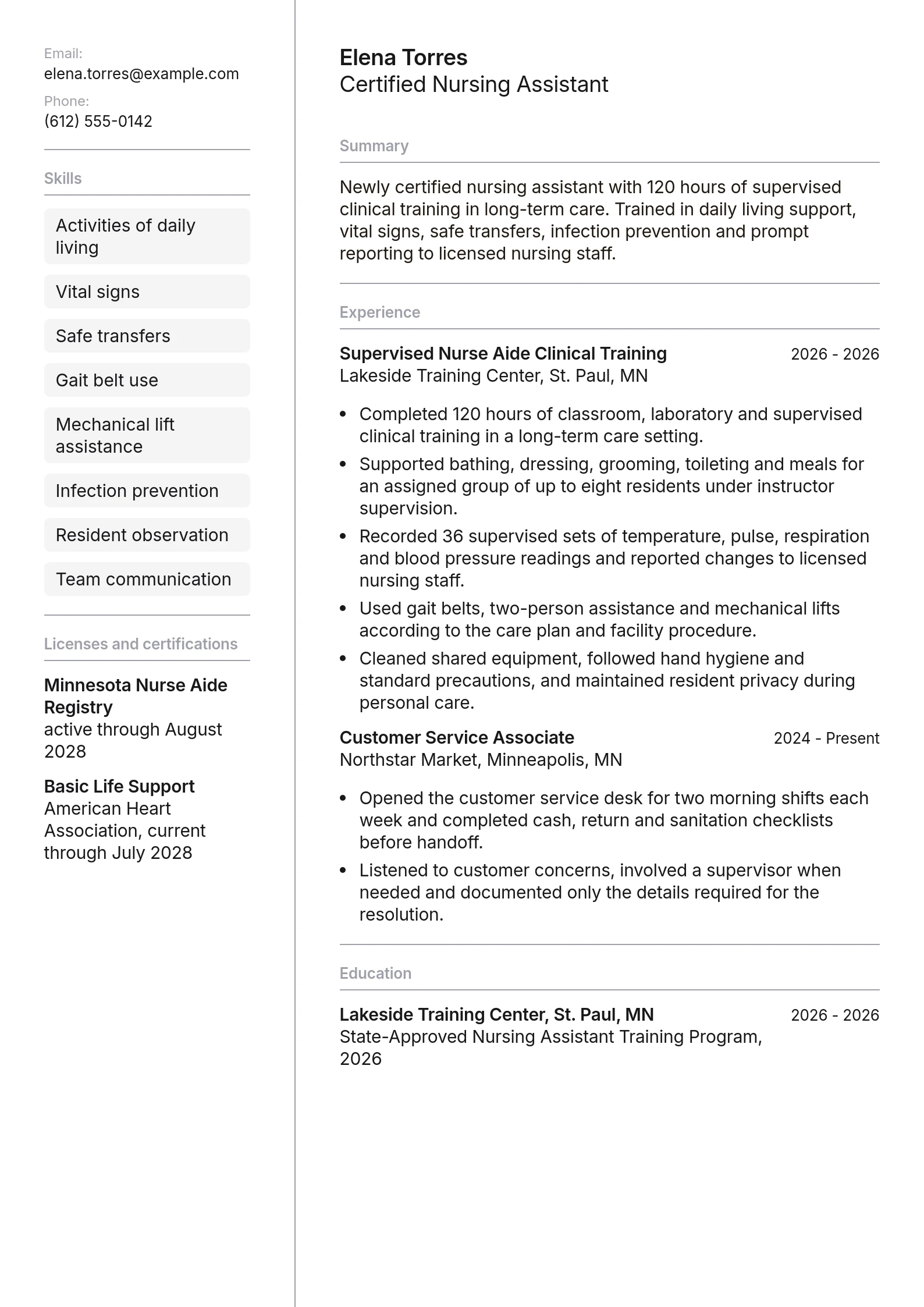
Elena leads with 120 hours of supervised clinical training in long-term care. Her bullets cover daily living support, 36 sets of vital signs, transfer equipment and reporting to licensed staff. Start here if your registry status is current and you are applying for your first paid CNA role.
Compare five CNA resumes by care setting
CNA and nursing assistant titles vary by employer and state. Choose the resume whose care setting and daily responsibilities are closest to yours.
Use its structure and emphasis, then add your own registry wording, employers, dates, equipment, workload and care tasks.
Long-Term Care CNA Resume Example
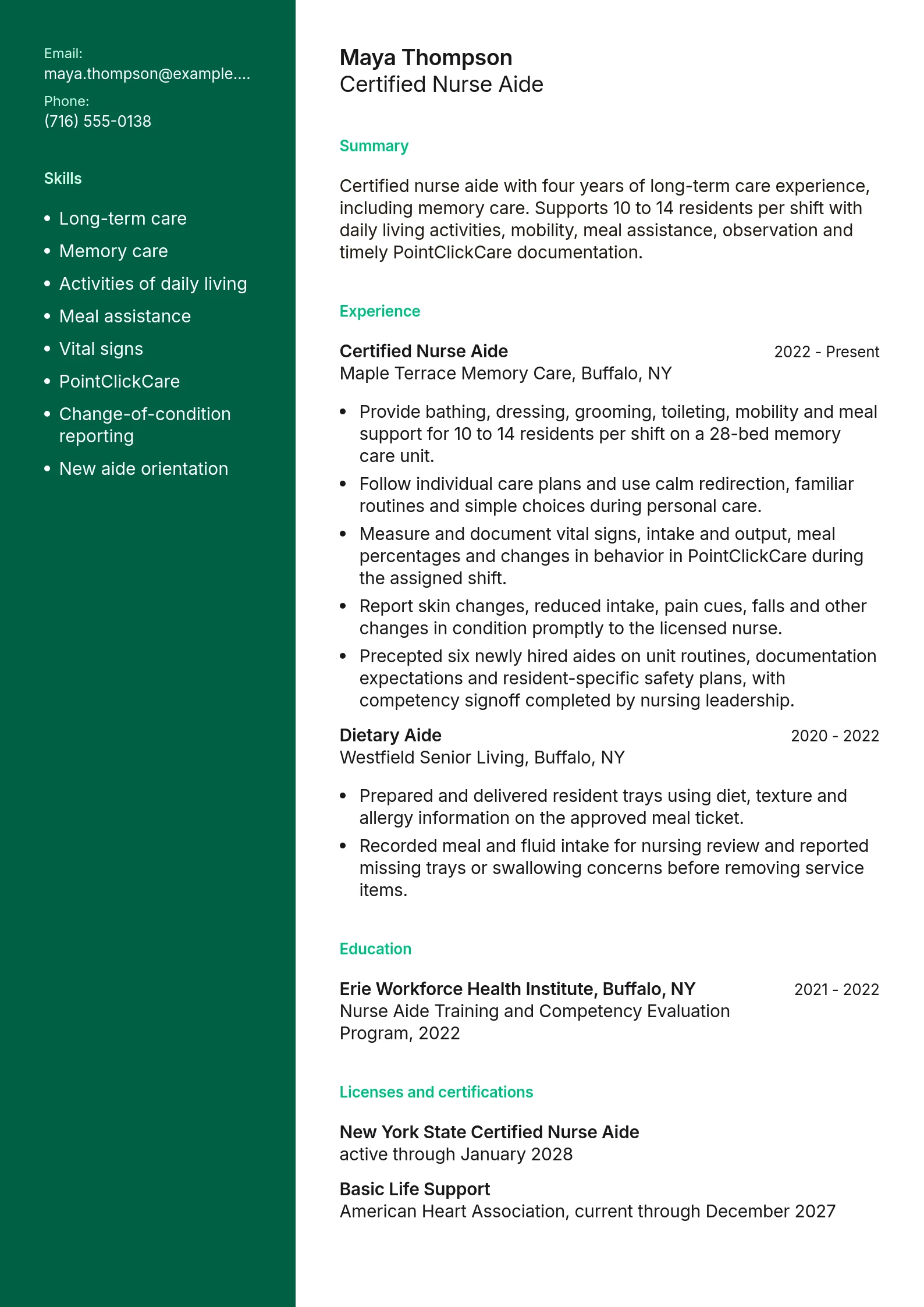
Maya supports 10 to 14 residents per shift on a 28-bed memory care unit. Her resume connects daily living support and familiar routines with PointClickCare documentation, observation and prompt reports to the licensed nurse. Use this model when consistent resident care and dependable shift communication are central to your work.
Connects workload with specific daily care.
Shows observation, charting and nurse handoff together.
Hospital Nursing Assistant Resume Example
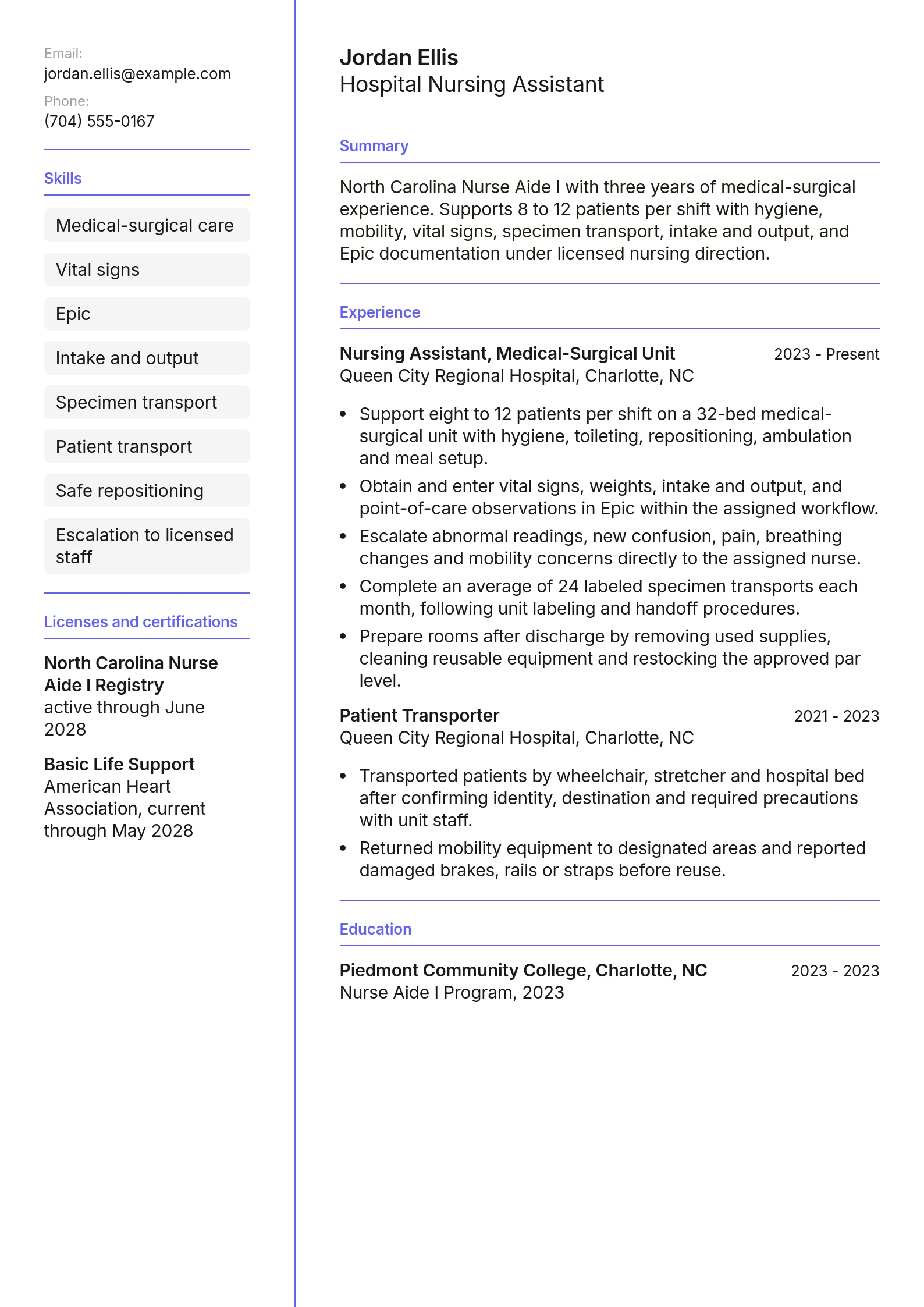
Jordan supports eight to 12 patients per shift on a 32-bed medical-surgical unit. The resume connects bedside care with Epic documentation, specimen transport, room preparation and direct reports to the assigned nurse. Choose it when you need to show how several patient-care tasks fit together across one busy hospital shift.
Connects bedside care with hospital workflow.
Pairs Epic documentation with timely nurse handoff.
Home Health CNA Resume Example
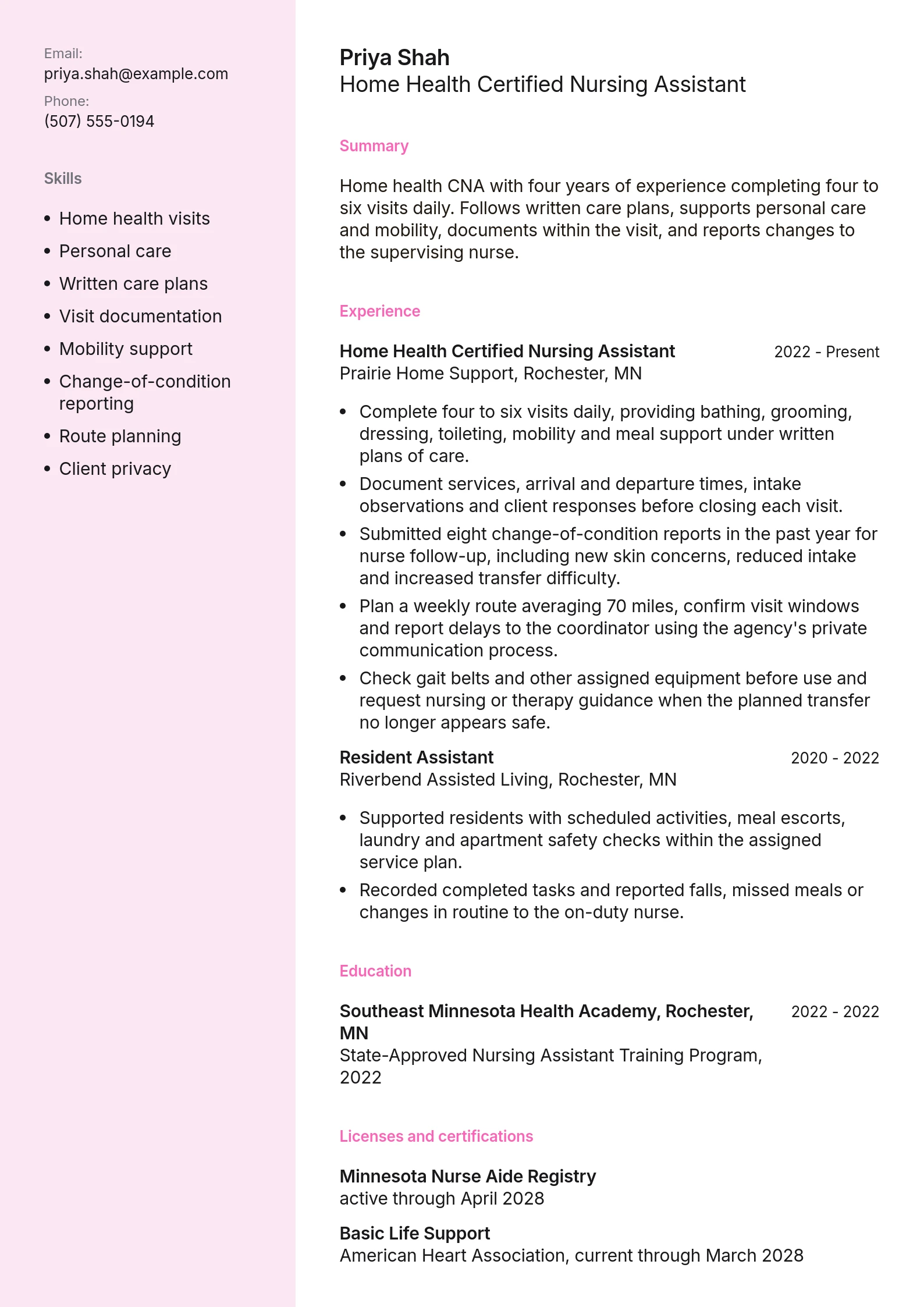
Priya completes four to six home visits a day using written care plans. Her resume brings together personal care, same-visit documentation, a 70-mile weekly route and eight change-of-condition reports sent for nurse follow-up. Use this example when working independently between visits is balanced by clear plans and a supervising nurse.
Connects daily visits with same-visit documentation.
Shows written care plans and nurse follow-up in home health.
Rehabilitation CNA Resume Example
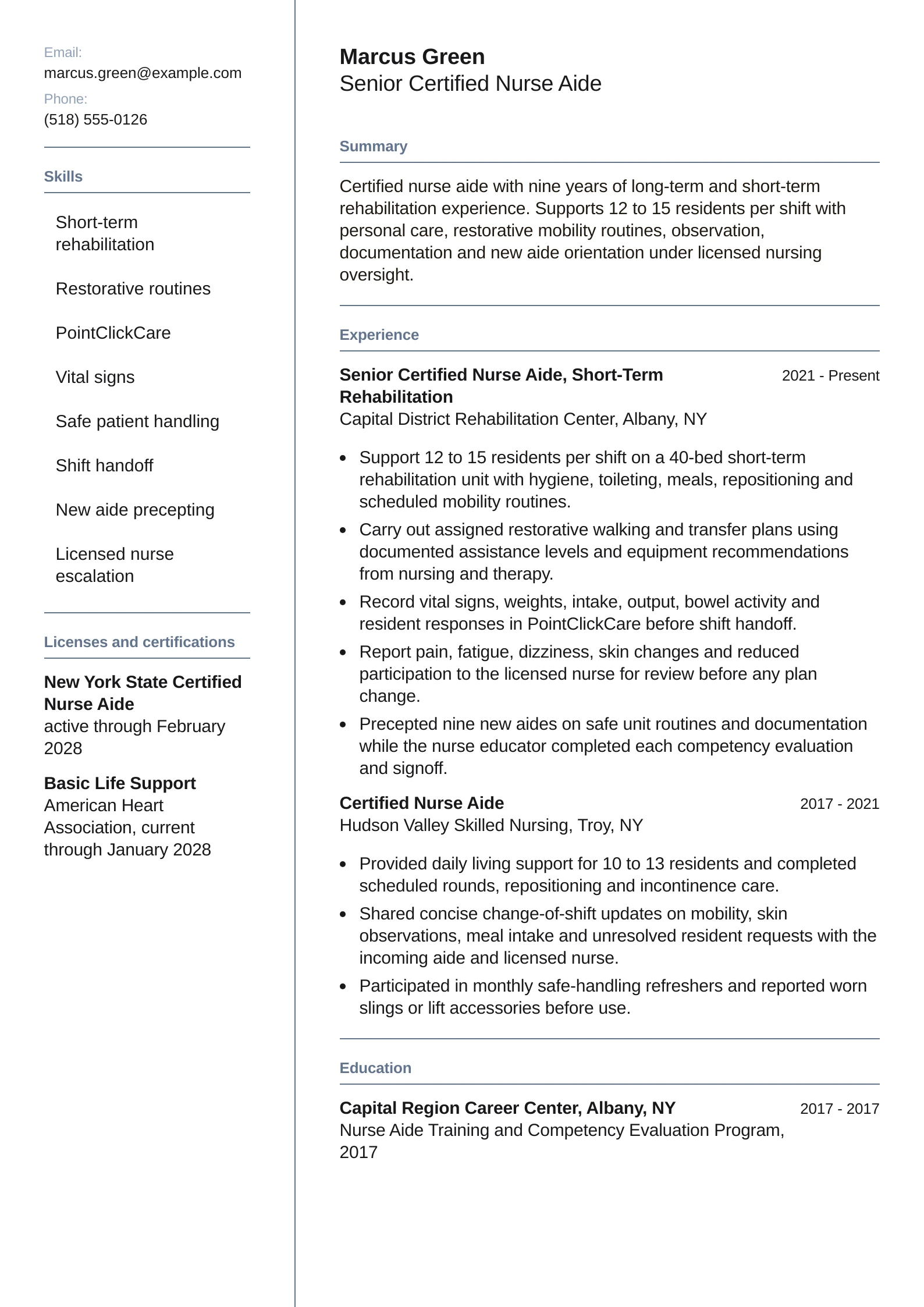
Marcus brings nine years of direct-care experience to a 40-bed short-term rehabilitation unit. His resume connects restorative routines, PointClickCare and shift handoffs with precepting nine new aides. Use it when your seniority comes from reliable resident care, safe unit routines and coaching, with plan changes and competency signoff handled by nursing and therapy staff.
Connects restorative routines with shift documentation.
Start with the daily work, not the title alone. Nursing assistant, nurse aide, certified nurse assistant and CNA can describe closely related roles, but the pace, equipment and reporting chain change between a skilled nursing facility, hospital unit and private home. A useful resume lets the reader recognize that environment before reaching the skills section.
Long-term care bullets often need to show an assigned resident group, daily living support, meals, rounds and change-of-shift reporting. For memory care, include calm redirection and familiar routines when they were part of the care plan, and send changes in behavior or cognition to the licensed nurse for assessment.
Hospital nursing assistants can name the unit, typical patient load, electronic record, transports, specimens and point-of-care workflow they actually handled. Home health CNAs need a different kind of operational evidence: scheduled visits, written plans of care, visit notes, travel reliability and escalation to the supervising nurse when a client's condition changes.
Rehabilitation work may include assigned walking, transfer or restorative routines. Name the documented assistance level or equipment you followed, the person's response and the handoff you made. Nursing and therapy staff establish or change the plan.
When two examples seem close, compare the reporting moment. A long-term care aide may hand observations to the nurse throughout one shift. A home health aide may use a visit note and a call to a remote supervisor. Pick the pattern that matches your work; setting, supervision and documentation tell more than the title alone.
Match the posting to work you have done
Job description language
Where you used it
Resume wording
Activities of daily living
Bathing, dressing, grooming, toileting or meals you supported
Supported bathing, dressing and meal setup for up to 12 residents per shift
Vital signs
Which readings you obtained, where you entered them and who received concerns
Recorded vital signs in Epic and reported abnormal readings to the assigned nurse
Safe patient handling
Assistance level, equipment, care plan and team method
Used gait belts and mechanical lifts according to documented assistance levels
Observation and reporting
A change you noticed and the route you used to report it
Reported reduced intake and new transfer difficulty for nurse follow-up
Documentation
Record system, fields and timing
Entered intake, output and resident responses in PointClickCare before handoff
Teamwork
The handoff, huddle or coordinated task you took part in
Shared mobility and skin observations with the incoming aide and licensed nurse
Reliability
Visit completion, shift preparation or checklist evidence
Completed 4 to 6 scheduled visits and closed each note within the visit workflow
Write the credential exactly as your state records it
Use the credential name shown by your state. One state may use Nurse Aide I, another may use Certified Nurse Aide, and another may maintain a nurse aide registry without placing CNA in the formal title. Copy the exact designation, state and active status from your current record.
A useful credential line might read "North Carolina Nurse Aide I Registry, active through June 2028." Include an expiration or renewal date only when it is current and you can verify it. Do not add a registration number unless an employer specifically requests it through a secure application process.
Training and registry status are separate. If you completed an approved program but have not yet passed the required competency process or appeared on the registry, state the completed training accurately. Do not call yourself certified early. If an application asks about eligibility or pending status, answer in the employer's form rather than inventing a credential line.
List Basic Life Support, CPR or other training only when it is current and relevant. Name the issuing organization and renewal date if space allows. Medication assistance and other expanded duties depend on state rules, training and employer policy, so include them only when you were authorized and the target job calls for them.
Check the record again before sending an application. Registry status and renewal dates can change, and an old resume can quietly preserve expired information. If the employer uses a different everyday title, keep the formal credential intact and use the posting's accurate title in the headline or summary.
Show the care task, record and nurse handoff
Observed, documented and reported
Noticed reduced meal intake during the shift, documented the percentage in PointClickCare and reported the change to the licensed nurse. This version gives the observable detail, record and handoff.
Assessment language hides the aide's work
Assessed residents for nutritional decline and adjusted care interventions to improve health outcomes. This skips the observation and record while assigning assessment and care-plan changes to the aide. Use the first version when your role was to observe, document and report.
Write clear patient-care bullets
A strong CNA bullet follows the work from assigned care to follow-through. Start with what you did, such as repositioning, meal support or vital signs. Add the assignment size or other useful context, then show where you documented or reported it.
Use observable language. An aide can notice new redness, reduced intake, a change in behavior or greater difficulty transferring. The licensed clinician assesses what that change means. Words such as observed, recorded, notified, escalated and followed are often both safer and more specific than diagnosed, prescribed, evaluated or developed a treatment plan.
Documentation connects one shift or visit with the next. Name Epic, PointClickCare or another system you used, along with the fields you completed, such as intake and output, meal percentage, weight, bowel activity or resident response.
A clear handoff, timely report, completed visit note or prepared room is a useful result. If a nurse changed the plan after your report, keep the bullet focused on the observation, documentation and handoff you completed.
Use supervised clinical training when paid CNA experience is new
Give supervised clinical training its own experience entry when it is your strongest preparation. Include the program, facility type, dates and total hours so the reader can see the setting and level of oversight.
Choose training bullets that show repeated practice. Daily living support, vital signs, transfers, infection prevention, resident privacy and reporting are stronger than a list of classroom topics. If you know the number of supervised readings, clinical hours or residents in an assignment, include it. Keep the instructor or licensed staff relationship visible.
Transferable work can help when it shows reliability, calm communication, sanitation habits or accurate records. Elena's retail role, for example, uses two weekly opening shifts and checklists to make those habits concrete. Connect the task, not the old industry title, to the CNA role.
Place the current registry credential near the top or in a clear credentials section. Education can follow the experience section unless the program is your main evidence. Once paid direct-care work becomes substantial, shorten older transferable roles and let the CNA experience carry the page.
Include the care you personally practiced and the checks you completed. If an instructor demonstrated a procedure or the clinical group shared an assignment, name your own task and supervised practice rather than using the whole facility census as your workload.
Write a CNA summary for your setting and experience
A useful CNA summary gives the reader four anchors in two or three lines: current credential wording, experience level, care setting and the support work that follows. Write it after the experience section so your strongest facts are already visible.
For a newly certified applicant, lead with the exact current registry designation and supervised training. Elena's summary names 120 hours in long-term care, then identifies daily living support, vital signs, transfers, infection prevention and reporting to licensed staff.
An experienced applicant can replace training detail with years, setting and a representative assignment. Maya names four years in long-term care, a memory care setting, 10 to 14 residents per shift and PointClickCare. Jordan uses a medical-surgical setting, an eight to 12 patient assignment and Epic. Those details quickly distinguish the candidates.
Use the same work verbs in the summary that appear in your experience. A nursing assistant may support personal care, observe changes, record assigned information and report to the licensed team. If assessment or care-plan decisions belonged to the nurse, lead with your care and reporting work instead.
Use numbers to show workload and frequency
CNA metrics work best when they describe scale, frequency or timeliness. Residents supported per shift, patients on an assigned unit, visits per day, training hours and new aides precepted help a reader understand the job.
Give the number a boundary. "Supported 10 to 14 residents per shift on a 28-bed unit" is clearer than "cared for 28 residents" when 28 describes the whole unit. Likewise, a hospital aide can state the usual assignment and unit size separately. That distinction keeps team capacity from becoming a personal caseload claim.
Patient satisfaction, recovery, falls and health outcomes have many causes, so workload is usually more useful on a CNA resume. Focus on scheduled rounds, notes closed during the visit or concerns reported through the right channel. Use a clinical outcome only when a reliable record connects your contribution to the measure.
Use numbers you can recover from a schedule, assignment sheet, training record or de-identified personal total. When no useful number is available, name the care task, equipment, charting field and handoff instead.
A range is often more truthful than one fixed number because assignments change with census, acuity and staffing. Use the usual range you can explain, not the busiest shift you remember.
Show what each number describes
Evidence type
Useful version
Misleading version
Shift assignment
Supported 10 to 14 residents per shift on a 28-bed unit
Managed all care for 28 residents
Home visits
Completed 4 to 6 scheduled visits per day and documented each visit
Maintained perfect outcomes across a full client caseload
Clinical training
Completed 120 hours of supervised nurse aide training
Delivered 120 hours of expert patient care
Observation
Submitted eight change-of-condition reports for nurse follow-up
Prevented eight medical emergencies
Precepting
Precepted nine new aides; the nurse educator completed competency signoff
Certified nine new CNAs
Choose skills from work you have done
Start with tasks you have performed that the target posting requests. Activities of daily living, vital signs, intake and output, meal assistance, safe transfers, infection prevention, documentation and change-of-condition reporting are useful when the experience section shows where you used them. Keep the list focused enough to scan.
Name equipment with context. Gait belt use, mechanical lift assistance, wheelchair transport and repositioning can belong in the skills section when the experience shows the care plan, assistance level and facility procedure you followed.
Add the setting and system vocabulary that distinguishes your work. Memory care, medical-surgical care, home health visits, short-term rehabilitation, Epic and PointClickCare can help an employer see the match. Spell out an unfamiliar term once before using an abbreviation, and remove systems that you have only observed.
Show communication and organization through the work: calm redirection, a concise shift handoff or a note completed before the visit closed. The skills section can then use plain terms such as resident observation or team communication.
Protect patient privacy while keeping useful detail
Top tip
Describe the setting, assignment and care task, but remove names, dates of birth, room numbers, exact service dates, rare diagnoses and any combination of details that could identify a patient or resident. Keep the repeatable work and leave out the clinical story that belongs to someone else.
Use aggregate numbers such as residents per shift or visits per day. Do not keep protected information in a private resume worksheet just because the public version uses initials. Build metrics from schedules, training records or de-identified totals that you are allowed to use. Never copy a chart, screenshot, handoff sheet or patient list into the material you use to draft a resume.
If a story depends on a distinctive case, replace it with the general observation, action and reporting path. For example, write that you noticed a change in intake, documented it and notified the nurse. Leave out the person's diagnosis, age, family circumstances and what happened after your part ended. The employer needs evidence of your practice, not a patient's history.
Privacy also applies during applications and interviews. A hiring manager can understand that you worked on a medical-surgical unit or memory care floor without hearing a resident's identity. If an application asks for work samples, use a blank training form or a fictional example approved for that purpose, never a record from care.
Describe safe transfers and equipment
Nursing assistant work can be physically demanding. Describe how you followed documented assistance levels, prepared the space, checked equipment and asked for help. That says more about safe care than a line such as "able to lift 100 pounds."
If you used gait belts, sit-to-stand devices, full-body lifts, slide sheets or two-person transfers, name only the equipment and methods you were trained and authorized to use. A good bullet states the care plan or unit procedure. It does not promise to improvise beyond it.
Report a changed transfer just as you would any other change in condition. If someone who usually stands with one-person assistance becomes dizzy or cannot bear weight, stop and involve the nurse or therapy team. On the resume, that judgment can appear as following the plan and requesting guidance when the planned method no longer seemed safe.
Completed rounds, equipment checks and consistent team methods are practical ways to show physical reliability.
Keep the layout easy to read
Most newly certified and mid-career CNAs can present the most relevant evidence on one readable page. Use a short summary, reverse-chronological experience, focused skills, education and current credentials. Two pages can be reasonable when a long career includes several relevant settings, but repetition is not experience.
Put the current job first and give it four or five substantial bullets. Earlier direct-care roles can use two or three. Training belongs in the experience section when it is the main source of hands-on evidence. Keep dates consistent, and do not remove months if doing so would hide a short tenure or unexplained gap.
Use plain headings and a font size that remains comfortable on screen and paper. Tables, rating bars and dense icon columns can make dates or credentials harder to parse. A professional design should help the reader find assignment scale, care setting and active registry status in seconds.
Tailor the first half of the page to the posting. It should show the care setting, current credential and two or three relevant tasks before less important detail. Keep the aide's care, observation, recording and reporting work easy to find.
Save the file with a plain name such as Elena-Torres-CNA-Resume.pdf and open the exported version before sending it. Make sure dates stay with the right job, bullets remain inside the margin and the credential line is visible. Keep the editable copy for future applications.