Find the medical assistant resume closest to your setting. These six examples cover an externship, family practice, urgent care, administration, pediatrics and lead work, with practical guidance on describing credentials, rooming, records, clinical tasks, patient flow and team support at the right level.
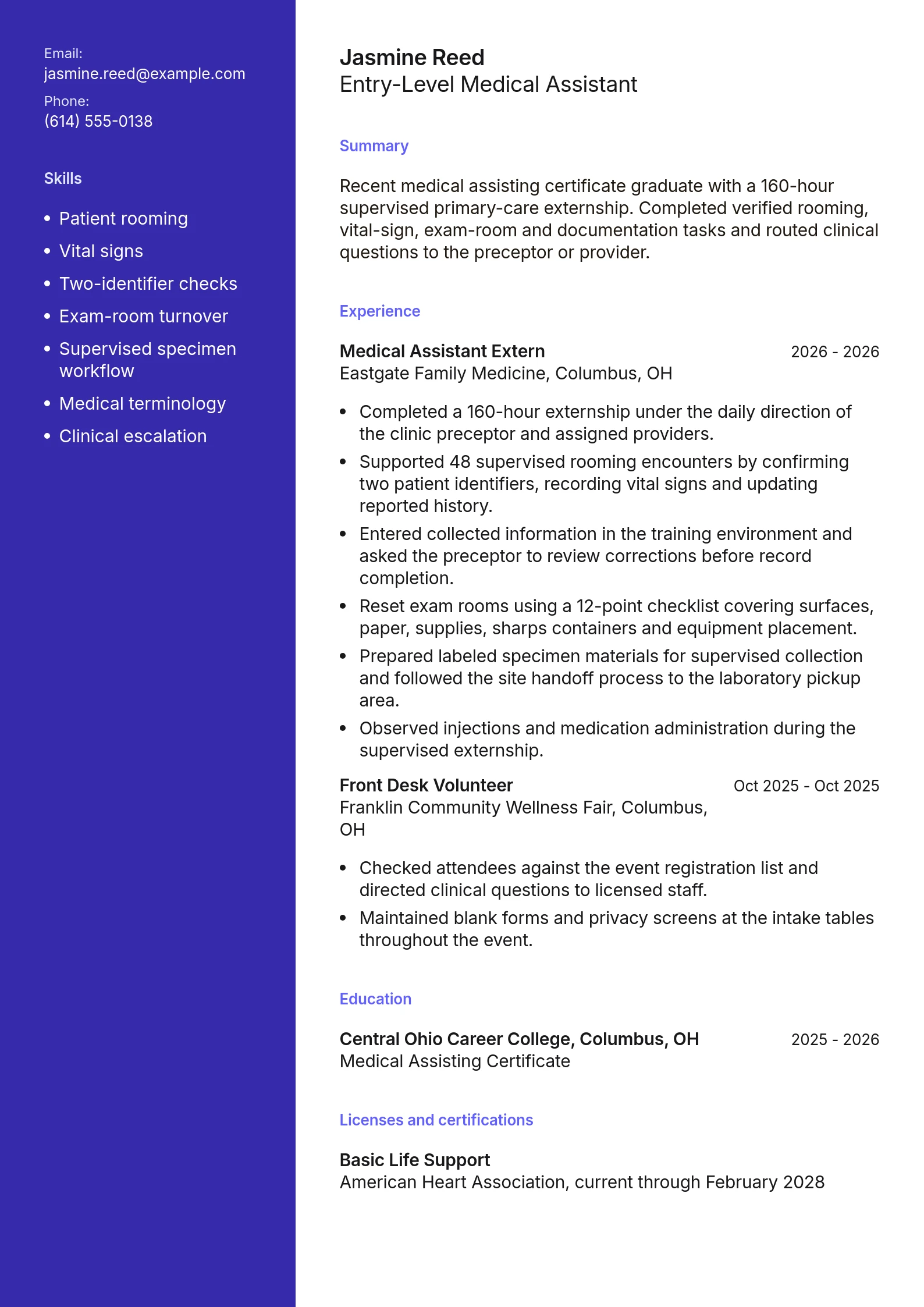
See how an entry-level medical assistant resume uses an externship
Jasmine leads with a 160-hour primary-care externship because she has no paid medical assistant role yet. Forty-eight supervised rooming encounters show patient identification, vital signs, room preparation and specimen handoff. Her exposure to injections and medication administration is listed as observation.
Use this example when training is your strongest experience. Keep the Extern title, then add the tasks you completed, the setting and the point where a preceptor or clinician took over. Observation can be relevant, but it does not belong in the skills list as hands-on work.
Choose the example closest to your setting and work
Start with the setting and daily work. A family-practice CMA, urgent-care assistant and pediatric assistant may all room patients, but the pace, procedures, communication and handoffs change what belongs near the top.
Use the nearest example for structure and emphasis. Keep your own dates, credentials, tools and results, and name provider direction or competency records when they change what the task means.
Certified Medical Assistant Resume Example
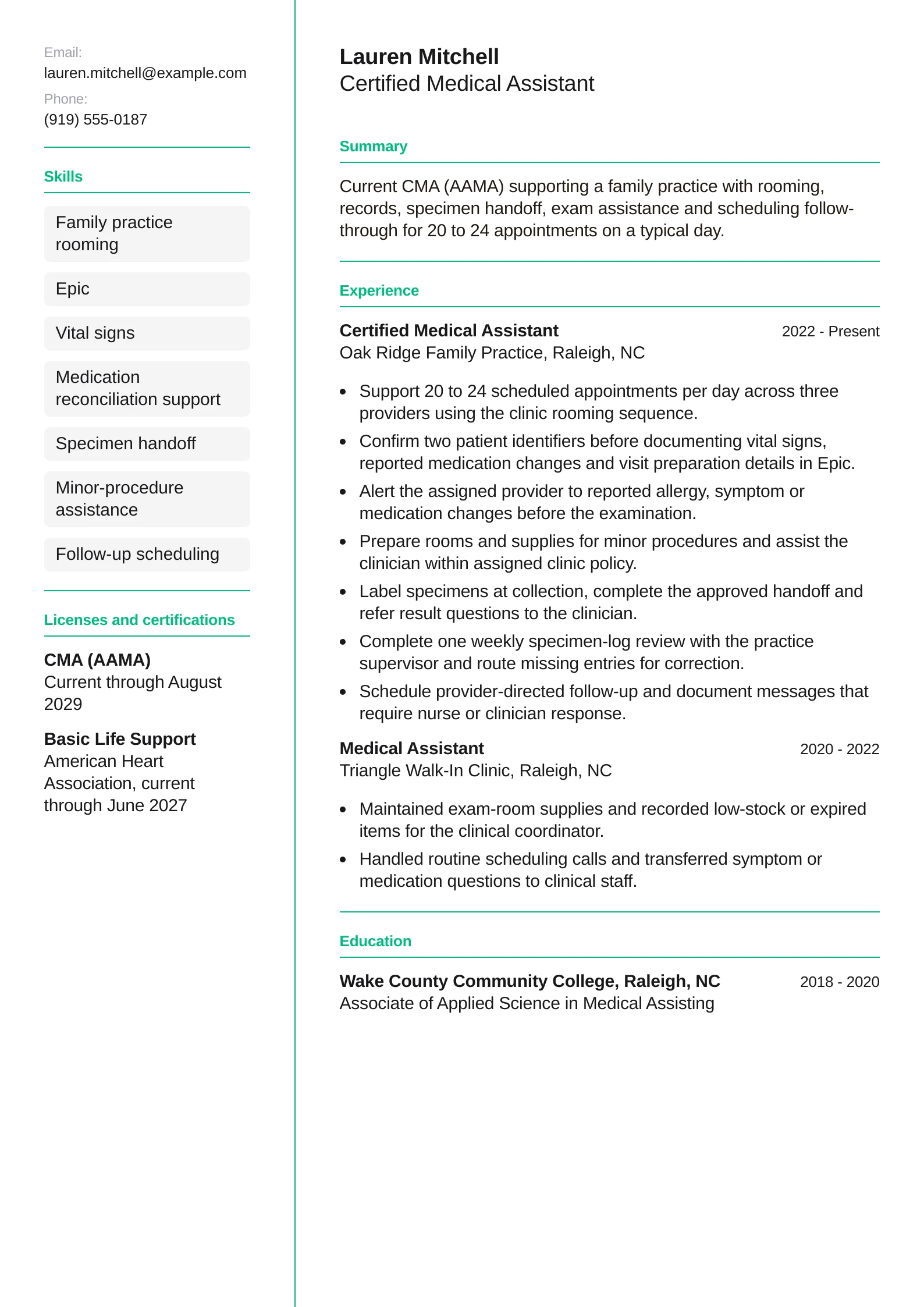
Lauren is a current CMA (AAMA) in a three-provider family practice. Her resume connects 20 to 24 appointments a day with two-identifier checks, Epic updates, specimen handoff, procedure setup and provider-directed follow-up. Use this model when your family-practice role combines clinical and administrative support across a busy general ambulatory schedule.
Pairs the exact credential with its current-through date.
Connects rooming, specimen handoff and follow-up in one daily workflow.
Clinical Medical Assistant Resume Example
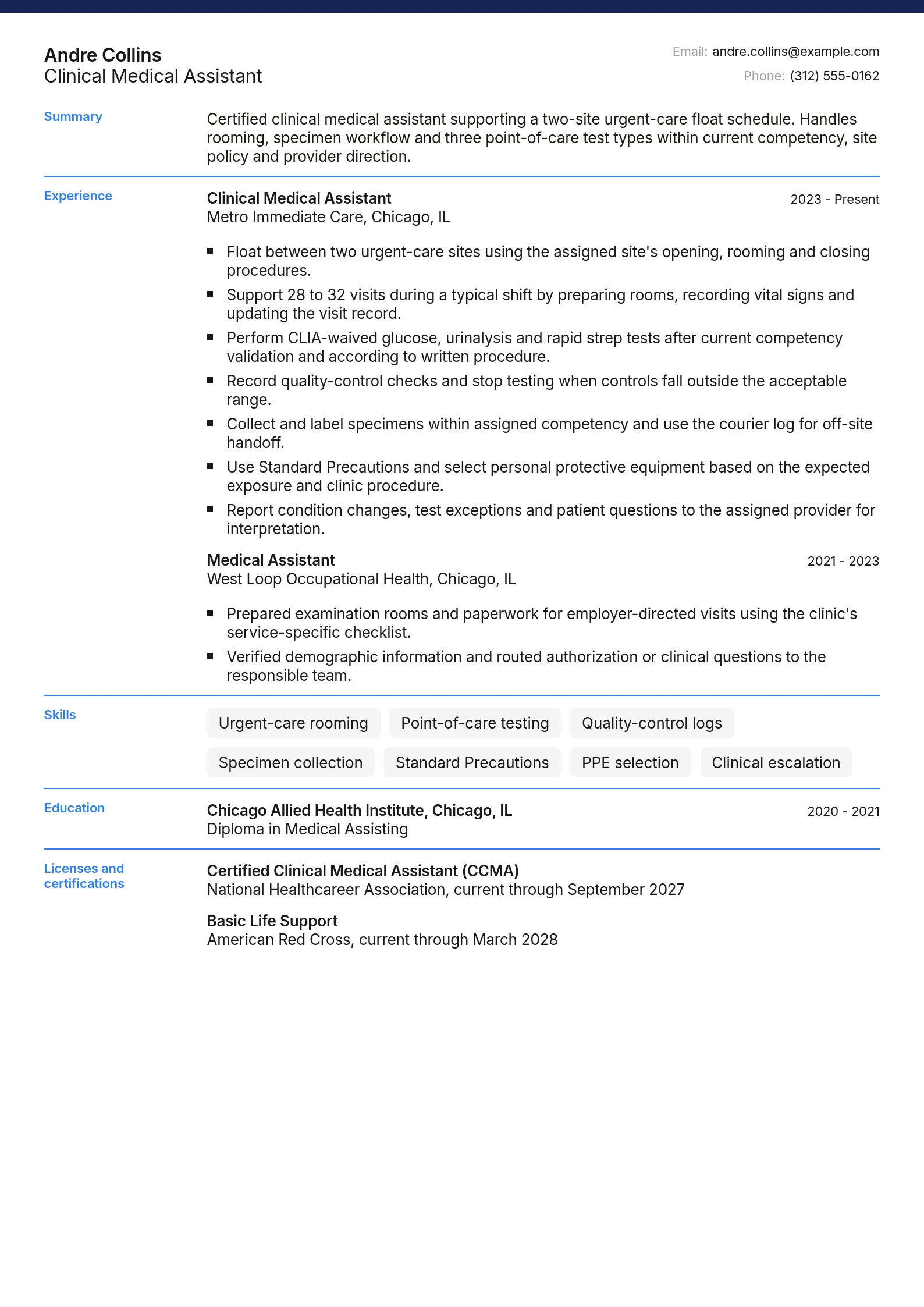
Andre floats between two urgent-care sites and supports 28 to 32 visits per shift. He performs three point-of-care test types after competency validation, records quality-control checks and stops testing when a control falls outside the acceptable range. Choose this example when urgent-care pace, testing and provider handoffs are central to your role.
Connects three test types with quality control and a stop-work rule.
Shows visit volume alongside rooming, records and specimen workflow.
Administrative Medical Assistant Resume Example
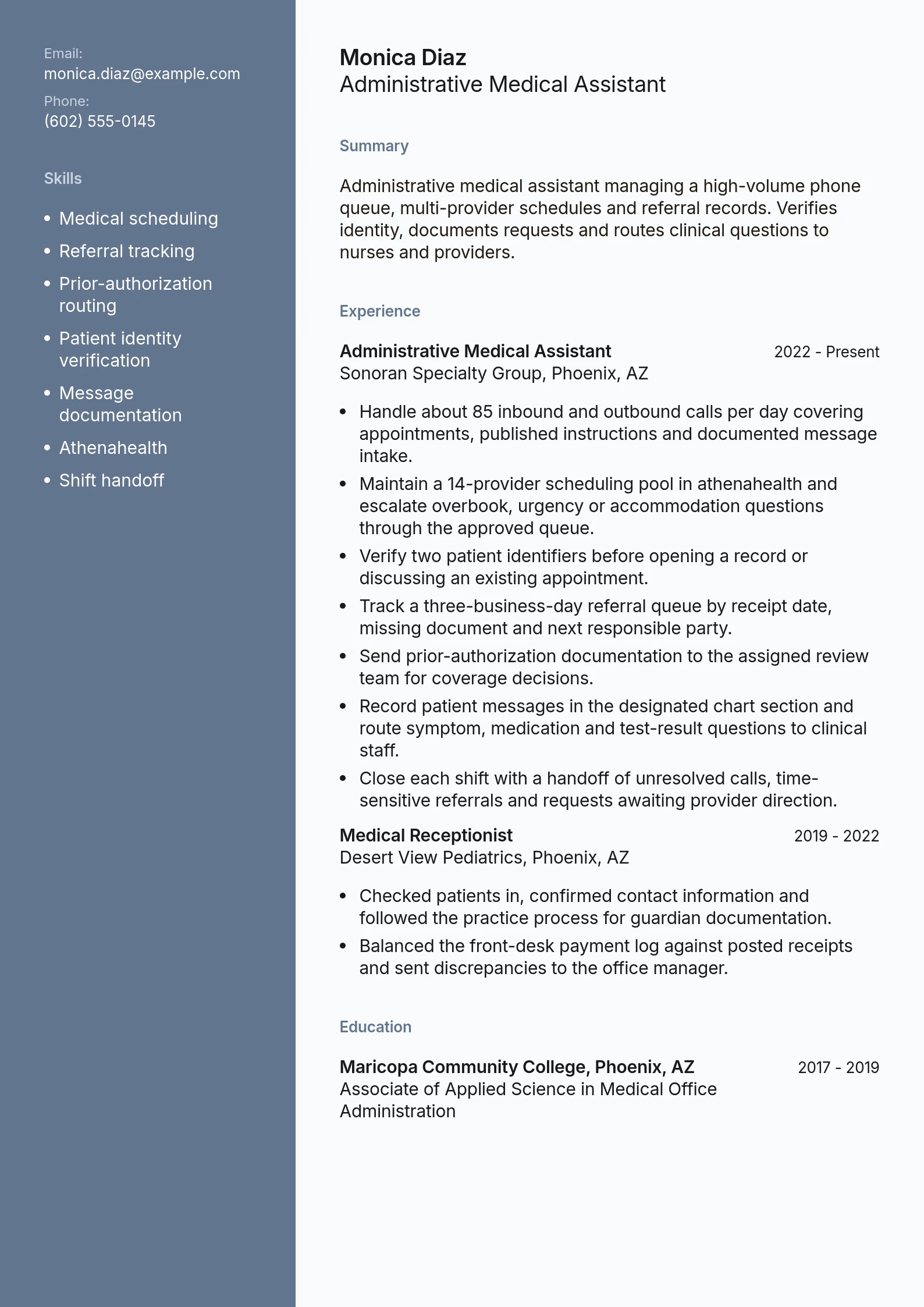
Monica works at the front office rather than the exam table. She handles about 85 calls a day, maintains a 14-provider scheduling pool and tracks referrals through a three-business-day queue. Identity checks, message documentation and routing of symptoms, medication questions and authorization work make this the closest example for administrative roles centered on records and follow-through.
Connects scheduling, calls and referrals to clear daily volume.
Shows how clinical questions and coverage requests reach the responsible team.
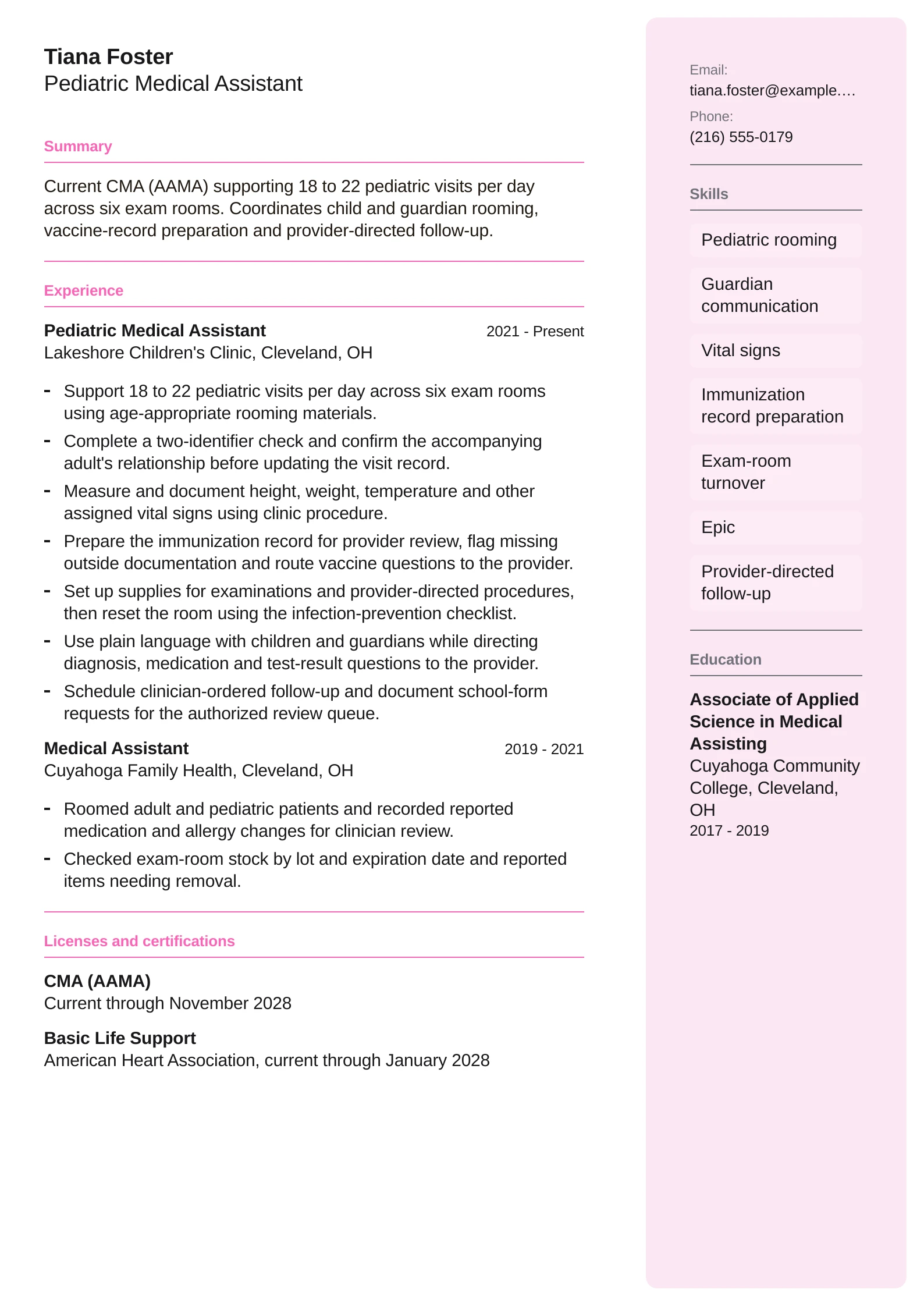
Pediatric Medical Assistant Resume Example
Tiana supports 18 to 22 pediatric visits across six exam rooms. Her resume shows what changes in this setting: confirming the accompanying adult's relationship, using age-appropriate rooming materials, preparing vaccine records for provider review and explaining the next step in plain language. Use it when pediatric applications need family communication, rooming and careful records near the top.
Makes guardian checks and child-friendly communication part of the workflow.
Connects immunization-record preparation with provider review.
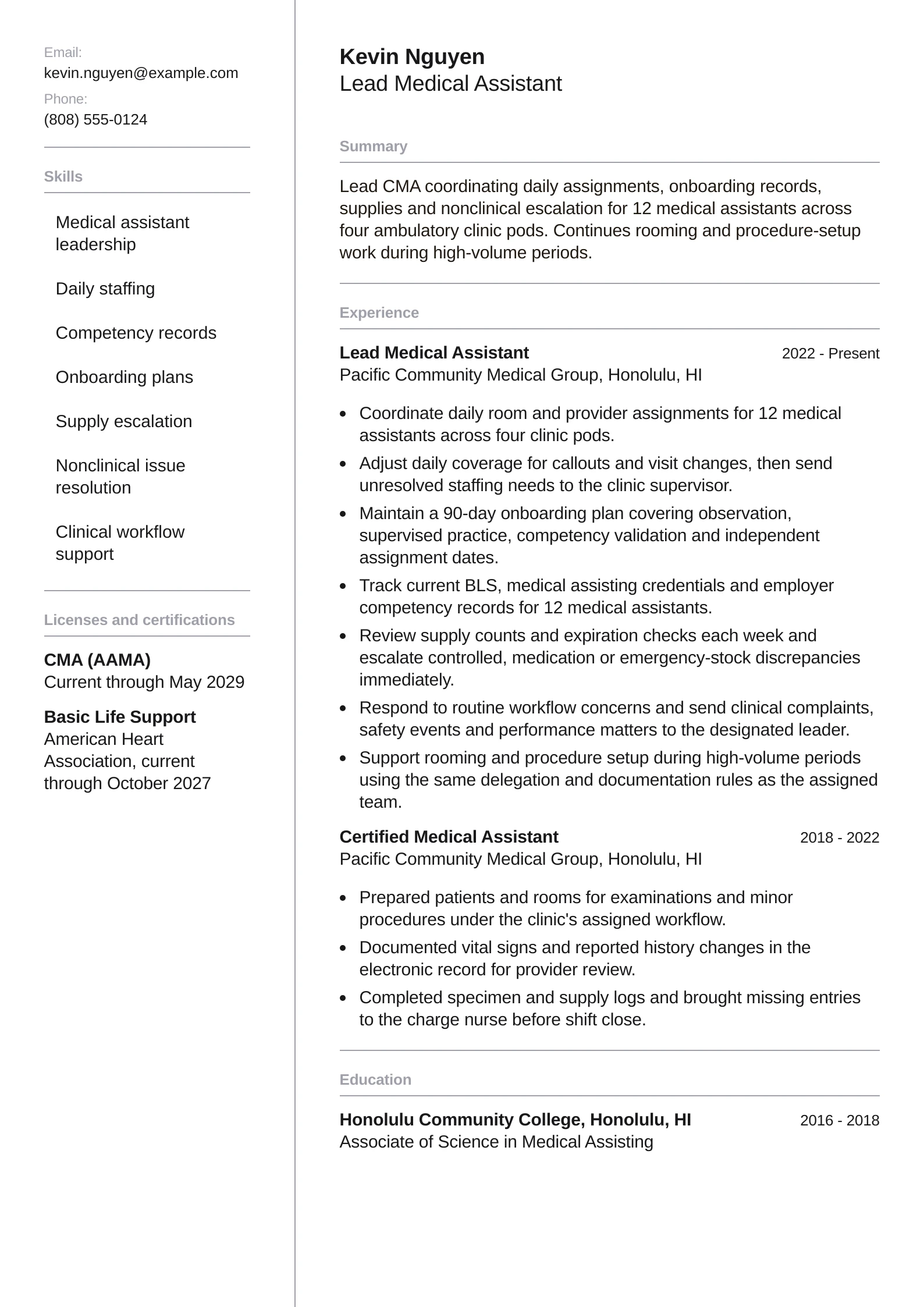
Lead Medical Assistant Resume Example
Kevin coordinates assignments for 12 medical assistants across four clinic pods. Staffing coverage, competency records, a 90-day onboarding plan, supply escalation and nonclinical issue handling show the scale of his lead role. He still supports rooming and procedure setup during busy periods. Use this version when team coordination has grown around continued clinical support.
Shows lead scope through team size, pods and onboarding records.
Connects daily assignments, supply checks and busy-period clinical support.
Build an entry-level resume from supervised work
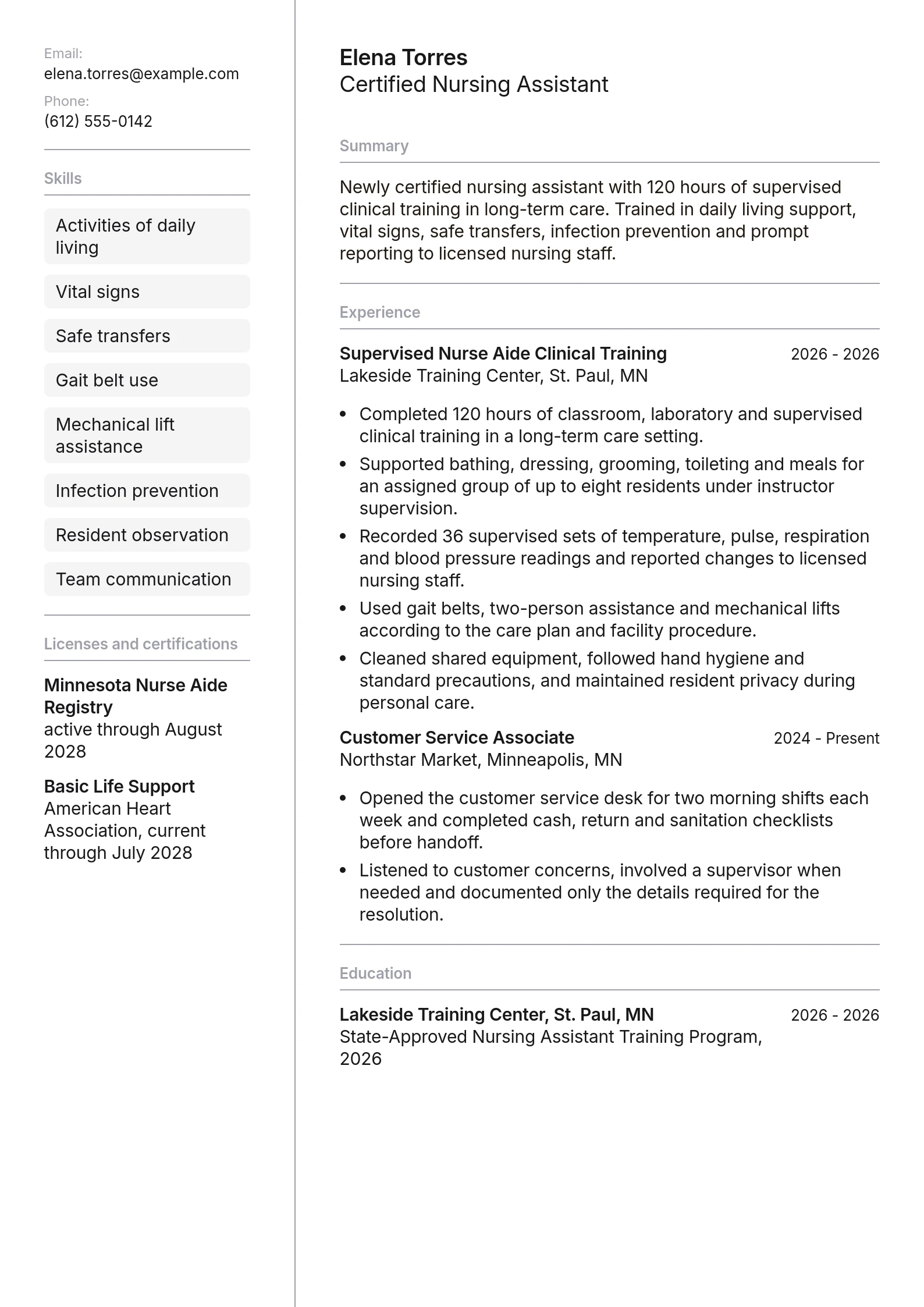
An externship can lead the experience section when you label it clearly. Use the site, dates and program relationship, then describe the tasks you completed. Supervised rooming, vital signs, exam-room turnover, appointment preparation and approved specimen workflow all give an employer a useful picture of the placement. The word supervised tells the reader how the work happened.
Separate practice from observation. If you watched injections or medication administration but did not perform them, leave them out of the skills list or state the observation only when it serves a clear purpose. A lab checkoff or classroom demonstration is not automatically the same as current competency in an employer's clinic.
Use previous work when it adds relevant experience. A front-desk job may show accurate records, confidential conversations or steady service during a busy shift. Keep the original title and setting, then describe the part that transfers to the medical assistant role.
Put education and current credentials where they are easy to find. For a new graduate, that may be near the top. Once paid medical assistant experience becomes the stronger qualification, the experience section can lead and education can become shorter.
Describe clinical responsibility clearly
Clinical tasks need a precise verb and enough context to show your role. Performed can fit a task you were trained, authorized and assigned to complete. Assisted keeps the clinician's procedure ownership visible. Prepared identifies setup work. Recorded describes documentation. Routed or reported shows that a question, change or exception moved to the person who could act on it.
When the work depended on an order, delegation, protocol, direct supervision or competency record, include that relationship in the relevant bullet. Most resumes need it only once or twice. Diagnosis, result interpretation, prescribing and treatment selection stay with the licensed professional responsible for those decisions.
Scope varies by state and employer. A task that belonged in one clinic may not belong in the next. Check the posting, your training record and the rules that apply where you are applying before you copy a procedure into the skills section. If the posting is unclear, ask which competencies the employer expects at hire.
Use the verb that matches what you did
Choose the verb that describes your part in the work and the handoff that followed.
Work relationship
Context to include
Possible wording
Performed
Current competency, assigned procedure and operating standard
Performed three CLIA-waived test types after competency validation and recorded required quality controls
Assisted
Clinician-owned procedure and your supporting action
Prepared the field and handed supplies to the practitioner during minor procedures
Prepared
Room, record, equipment or supplies made ready
Prepared immunization records for provider review and flagged missing outside documentation
Recorded
Information gathered and where it was entered
Recorded vital signs and reported medication changes in Epic for clinician review
Reported or routed
Exception, question, change and responsible recipient
Reported symptom and test exceptions to the assigned provider for interpretation
Observed
Training context and supervision
Observed medication administration during a supervised externship
Write clinic bullets around the visit
Start with one recurring part of the visit and follow it to a safe finish. Rooming might include confirming two identifiers, recording vital signs, updating the stated history and alerting the provider to a change. Specimen work might include collection within competency, labeling at the point of collection, a log and a courier handoff. The details show more than roomed patients or helped with specimens.
Administrative bullets deserve the same treatment. Scheduling is stronger when the reader can see the provider pool, common request, exception and next responsible person. Referral work can show the receipt date, missing document, queue age and handoff. For prior authorization, name the information you prepared or routed and the review team that made the coverage decision.
Use the standard or check that made the work dependable. That might be a two-identifier check, room turnover checklist, quality-control log, expiration review or end-of-shift handoff. Avoid empty claims such as ensured HIPAA compliance or maintained perfect infection control. The workflow is more convincing than the label.
A medical assistant is part of a care team. Use supported, assisted, prepared, documented and coordinated when those verbs fit. Use led or managed for assignments, people or workflow you were responsible for, and add what changed when the record supports it.
Match job-posting language to your experience
Recent employer postings combine rooming, records, procedures, follow-up and credentials in different ways. Read the duties and requirements together before deciding what to emphasize.
Posting pattern
Details to recover
Possible resume emphasis
Rooming and vital signs
Patient identification, measurements, history updates and escalation
Team size, daily assignment, onboarding record and supervisor handoff
Coverage coordination, competency records, staff support and supervisor escalation
Certification and BLS
Exact issuer, credential name and current status
CMA (AAMA), RMA, CCMA or BLS written exactly as held
Choose skills you have used in practice
Use the skills section as a quick index to the experience below it. Patient rooming, vital signs, specimen workflow, referral tracking, scheduling and point-of-care testing are useful when a bullet shows where you used them. Keep class practice and observation in the training context rather than listing them as current workplace competencies.
Name software when you have used it. Epic or athenahealth can help a reader recognize a familiar system, but the product name alone says little. Pair it with the record you maintained, the message you routed or the follow-up you completed. If the posting names a different EHR, keep your real system and emphasize the underlying record work that transfers.
Show communication by explaining published instructions, documenting a patient question or reporting a change to the provider. A referral queue, supply check or shift handoff can demonstrate organization. These examples say more than a skills list filled with compassionate, detail-oriented and team player.
List each credential by its exact name and status
Write the credential exactly as the issuing organization does. CMA (AAMA), RMA and CCMA are not interchangeable labels. Include the issuer and current status or renewal date when it helps the employer verify a requirement. If a credential has expired, do not place the initialism after your name or present it as current.
Keep education separate from certification when that makes the difference easier to see. Completing a medical assisting certificate or associate program describes education. Passing and maintaining a certification describes a credential. An employer may ask for one, the other or both, along with BLS or an approved route that varies by location.
Check the posting before rearranging this section. If active certification is required, move it near the summary. If several credential routes are accepted, show the one you actually hold rather than copying the whole requirement list. Do not add a phlebotomy, coding or specialty credential because related tasks appeared in your training.
A stronger medical assistant bullet, side by side
The useful version gives the workload, the checks and the provider handoff.
Workload with a reliable method
Supported 20 to 24 family-practice appointments per day, confirmed two patient identifiers, recorded vital signs and reported history changes to the assigned provider in Epic.
Clinic-wide outcome with no link to the work
Delivered exceptional patient care that improved satisfaction and ensured perfect clinical outcomes in a fast-paced practice.
Use numbers to show workload and scale
Visits per day, rooms supported, calls handled, providers scheduled and staff coordinated can explain scale. Add the kind of work performed within that number. Supporting 30 visits says more when the bullet also names rooming, records, test workflow or the handoff that kept the visit moving.
A number does not need to be a percentage. Exact percentages often hide an unclear measure. If you received a documented audit or quality score, name what was reviewed and the period it covered. If the clinic reported a patient satisfaction result, use it only when you can show your contribution and avoid claiming that you caused the whole score.
Do not estimate time saved, errors prevented or revenue protected because the bullet feels incomplete. A clear process can stand on its own. Keep a private note for every metric with the source, time period and whether it describes your work, the team or the facility.
Adapt the examples to your medical assistant setting
These six patterns come from the complete resumes above. Choose the nearest work setting, then replace its tasks, equipment and handoffs with details from your own experience.
For another specialty, start with the recurring visit types, equipment, preparation steps, documentation and clinician handoff. Use a procedure name only when you performed or assisted with that task in the stated setting.
Language ability is an attribute, not a certification. If it matters to the role, list the language and the proficiency level you can support, and connect it to patient communication only when you actually used it.
Students and recent graduates whose strongest work comes from supervised training
Family practice: Lauren
20 to 24 appointments, two identifiers, Epic updates, specimen handoff, procedure setup and provider-directed follow-up
Certified assistants combining clinical and administrative work across a general schedule
Urgent care: Andre
Two-site float schedule, 28 to 32 visits, three point-of-care test types, quality controls and stop-work escalation
Clinical roles where pace, testing and rapid provider handoffs lead
Administration: Monica
About 85 calls, a 14-provider pool, a three-business-day referral queue, identity checks and message routing
Front-office roles centered on schedules, referrals, records and follow-through
Pediatrics: Tiana
18 to 22 visits, six exam rooms, guardian checks, age-appropriate communication and immunization-record preparation
Pediatric roles where rooming, family communication and provider review matter
Lead: Kevin
12 medical assistants, four clinic pods, daily assignments, a 90-day onboarding plan, competency records and supply escalation
Lead roles that combine team coordination with continued rooming and procedure setup
Describe privacy and infection-prevention work
A resume can show careful healthcare work without carrying a patient record into a public document.
Top tip
Leave out names, dates of birth, record numbers, photographs, exact appointment dates, test results, screenshots and unusual case details that could identify someone. Describe the repeatable work instead: verified two identifiers, documented the stated change, routed the message to the provider and recorded the handoff in the approved system.
Use infection-prevention language the same way. Name the hand hygiene, room turnover, equipment cleaning, quality-control or personal protective equipment step you followed. Do not claim that you guaranteed safety or prevented every infection. Standard Precautions and facility procedures belong to the care system, and your bullet should show the part you carried out.
Write a useful summary and keep the layout clear
A clear summary, reverse-chronological experience, compact skills section and accurate education or credentials give most medical assistant candidates enough structure. Put the setting, current credential and strongest relevant responsibility near the top. A summary should help the reader place you, not announce that you are compassionate or results-driven.
One page is a useful starting point for a recent graduate or candidate with a short, focused history. An experienced lead or assistant with several relevant settings may need a second page. Do not shrink the type or crowd a sidebar to force the document into a rule the posting did not set.
Use familiar headings and consistent dates. Avoid rating bars, procedure icons and dense skill clouds. Export the requested file type, then check that the credential dates, tense and contact details survived the export. A simple layout makes it easier to spot a scope mistake before you submit.
Tailoring means changing emphasis, not history. Keep your real title and dates. Move the supported work that matches the posting higher, and use the employer's ordinary term only when it describes the same task you performed.
Medical assistant resume questions
The right wording depends on what you were trained, authorized and assigned to do. These answers keep that check practical.